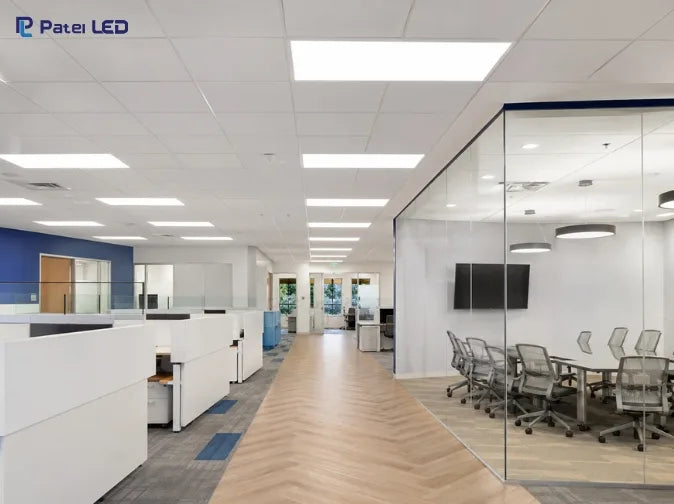
Why Buying 2×4 LED Flat Panels in Bulk Can Save Businesses Thousands
Table of Contents
- Why Buy LED Flat Panels in Bulk?
- What Comes in the Patel LED 72-Pack?
- Why Commercial Buyers Rarely Need Only One LED Panel
- The Real Cost of Buying One Fixture at a Time
- Why 72 Panels Can Be a Practical Commercial Quantity
- How Many 2×4 LED Panels Does Your Building Need?
- Modeled ROI: Replacing 72 Fluorescent Troffers
- Energy Savings Are Only Part of the Business Case
- Buying 10 Panels vs Buying 72 Panels
- Five Selectable Color Temperatures Support Different Spaces
- Bulk-Order Checklist
- Common Objections to Ordering 72 Panels
- Why Patel LED’s 72-Pack May Fit a Commercial Project
- FAQs
- Final Decision: Should You Buy 2×4 LED Panels in Bulk?
- Complete the Lighting Project Once
Replacing commercial ceiling lights one fixture at a time may appear easier on the budget.
In practice, it can make an office lighting upgrade more expensive, slower, and harder to manage.
Every separate order may introduce another purchase approval, shipping schedule, product availability check, contractor visit, invoice, and installation delay. When fixtures are purchased months apart, businesses may also receive products from different batches or discover that the original model is no longer available.
That can result in:
- Inconsistent color temperatures
- Visible brightness differences
- Multiple warranties
- Repeated shipping and handling
- Additional contractor mobilization
- Project delays
- Unplanned maintenance inventory
- More administrative work
- Difficulty standardizing lighting across a property
For offices, schools, healthcare facilities, retail locations, government buildings, contractors, and property managers, purchasing bulk LED panel lights can simplify the entire project.
A project-ready order such as the Patel LED 72-pack of 2×4 LED flat panels gives commercial buyers enough fixtures to complete a major lighting zone, standardize several smaller locations, or maintain replacement inventory after installation.
The objective is not simply to purchase more lights.
It is to complete the lighting project with fewer disruptions, consistent specifications, and a clearer long-term cost.
Why Buy LED Flat Panels in Bulk?
Buying LED flat panels in bulk helps commercial buyers standardize fixture specifications, consolidate purchasing, coordinate installation, reduce repeat administrative work, and keep replacement inventory available. A 72-panel order can support office floors, school wings, medical facilities, tenant improvements, multi-location properties, and contractor-led commercial renovations.
The five biggest advantages
- One coordinated order can simplify procurement.
- Matching fixtures help create consistent light and color.
- Contractors can schedule a complete installation phase.
- Extra panels can support future maintenance.
- Lower fixture wattage may reduce annual electricity costs.
Buyer recommendation
Choose a bulk quantity only after confirming the ceiling type, voltage, required brightness, color temperature, dimming system, fixture count, and installation schedule.
Planning a commercial ceiling-lighting upgrade? Review the Patel LED 72-pack before splitting the project across multiple fixture orders.

What Comes in the Patel LED 72-Pack?
The Patel LED bulk package contains 72 commercial 2×4-foot LED flat panels designed for recessed installation in compatible grid ceilings.
The current product listing includes:
| Product feature | Specification |
|---|---|
| Fixture size | 2×4 feet |
| Quantity | 72 panels |
| Selectable wattage | 30W, 40W, 50W, 60W or 72W |
| Selectable color temperature | 3000K, 3500K, 4000K, 5000K or 6500K |
| Lumen range | 3,750–9,000 lumens |
| Efficacy | 125 lumens per watt |
| Voltage | 120–277V AC |
| Dimming | 0–10V, from 10% to 100% |
| Installation | Recessed grid-ceiling installation |
| Construction | Back-lit aluminum design |
| Listed operating life | 50,000 hours |
| Certifications shown | ETL and DLC |
| Warranty | Three years |
| Profile | Approximately 1.37 inches |
| Intended use | Indoor commercial spaces |
Product availability, pricing, certifications, and specifications should be reconfirmed on the product page before ordering.
The adjustable wattage and five selectable color temperatures make this pack particularly useful when one project contains rooms with different lighting needs.
For example, the same model could potentially be configured differently for:
- Private offices
- Open work areas
- Conference rooms
- Hallways
- Reception areas
- Classrooms
- Retail floors
- Back-office spaces
This reduces the need to purchase several separate panel models for one building.
Why Commercial Buyers Rarely Need Only One LED Panel
Commercial buyers are not replacing a table lamp.
They are managing a lighting system.
A single office floor may contain dozens of 2×4 fluorescent troffers. A school wing may include classrooms, corridors, offices, restrooms, and shared spaces. A property manager may need the same fixture across several buildings.
Buying one or two fixtures may solve an immediate failure, but it does not address the larger system.
Uniform lighting matters
Fixtures installed within the same visible space should normally provide a consistent appearance.
When products are ordered separately, differences may occur in:
- Color temperature
- Light output
- lens appearance
- Dimming behavior
- Driver performance
- Fixture depth
- Trim color
- Startup behavior
Even two products advertised as “4000K” may not look identical when they come from different manufacturers or product generations.
Ordering a coordinated quantity gives the buyer a better opportunity to use the same fixture model across the completed project.
One product simplifies future maintenance
Standardization helps the maintenance team know:
- Which fixture is installed
- Which wattage setting was selected
- Which color temperature was selected
- Which driver and dimmer are compatible
- Which replacement panel should be stocked
- Which warranty applies
Instead of managing several similar-looking products, the facility team can document one standard panel configuration.
One purchase can simplify internal approvals
A commercial lighting project may involve:
- Facility management
- Purchasing
- Finance
- Ownership
An electrical contractor
Building management
Safety personnel
IT or security teams
Local inspectors
Processing one planned project order can be more manageable than repeating approvals every time another group of fixtures needs replacement.
Contractors can plan labor more efficiently
Contractors usually prefer a clearly defined installation scope.
When all required fixtures are available, the installer can:
- Organize the crew
- Schedule lifts and equipment
- Plan disposal of old fixtures
- Coordinate access to occupied rooms
- Configure wattage and CCT settings
- Complete testing
- Document the installation
- Finish the phase without waiting for more products
A delayed or incomplete material order can interrupt that workflow.
Managing a full retrofit? Compare the cost of one coordinated installation with the cost of repeatedly bringing contractors back to the property.
The Real Cost of Buying One Fixture at a Time
The visible price of a fixture is only one part of the project cost.
The total cost may also include freight, purchasing time, installation labor, access equipment, maintenance, project management, and future replacement inventory.
1. Multiple purchase orders
Each separate purchase may require:
- Vendor review
- Product comparison
- Manager approval
- Invoice processing
- Payment processing
- Receiving documentation
- Internal delivery coordination
The administrative cost of a purchase order may be small once, but it becomes meaningful when the same process is repeated throughout a large property.
2. Repeated shipping and receiving
Multiple deliveries require someone to:
- Track the shipment
- Receive the cartons
- Inspect for damage
- Verify quantities
- Move products into storage
- Match the order with an invoice
- Deliver fixtures to the installation area
One coordinated bulk order does not eliminate receiving work, but it can reduce the number of separate transactions.
3. Contractor remobilization
A contractor may need to return because:
- Only part of the fixture quantity was ordered.
- Additional lights fail later.
- Another department receives budget approval.
The original product becomes unavailable.
Installation was divided into too many small phases.
Every return visit can add scheduling, travel, setup, supervision, and access costs.
4. Mixed lighting appearance
Purchasing products at different times can introduce differences in output or appearance.
That may be especially noticeable in:
- Open offices
- Long corridors
- Classrooms
- Retail stores
- Medical reception areas
- Conference rooms
- Hotels
- Government offices
- Lighting inconsistency can make a newly renovated space look unfinished.
5. Product discontinuation
Commercial lighting products change over time.
A fixture purchased today may be modified or replaced by a new model later. A facility that does not keep replacement inventory may struggle to find an exact visual match several years after installation.
6. Separate warranty records
Mixing brands and models can leave the maintenance department managing:
- Different purchase dates
- Different warranty terms
- Different suppliers
- Different claim procedures
- Different replacement products
Standardization makes documentation easier.
7. Project delays
A missing carton of fixtures can prevent the completion of:
- A renovated office
- A tenant handover
- A classroom wing
- A retail opening
- A medical-office buildout
- A final inspection
- A contractor closeout
The cost of the delay may exceed the value of the missing fixtures.
Why 72 Panels Can Be a Practical Commercial Quantity
A 72-pack is not appropriate for every property.
It becomes useful when the project involves enough ceiling area, multiple rooms, multiple properties, or future replacement inventory.
One large office floor
A corporate office floor may have:
- Open workstations
- Private offices
- Meeting rooms
- Break areas
- Copy rooms
- Corridors
- Reception areas
A complete floor can quickly require several dozen 2×4 panels.
Ordering 72 panels may allow the facility to complete the visible floor with matching fixtures and reserve several units for replacements.
An entire school wing
A school lighting project may include:
- Classrooms
- Hallways
- Administrative offices
- Teacher workrooms
- Libraries
- Computer rooms
- Cafeterias
- Support areas
The U.S. Department of Energy notes that new LED luminaires can offer an estimated 40%–60% energy-savings potential against a fluorescent baseline, depending on the project and selected solution. DOE also recommends evaluating light output, controls, color quality, existing equipment condition, costs, and local energy-code requirements before choosing an upgrade.
A 72-pack can be suitable for one defined school phase rather than an unplanned fixture-by-fixture replacement program.
A medical office or outpatient center
Healthcare-related spaces benefit from consistency because lighting affects:
- Staff visibility
- Patient comfort
- Reception appearance
- Record handling
- Cleaning
- Examination support
- Hallway navigation
Selectable wattage and color temperature can help project teams configure different rooms while maintaining a consistent fixture design.
The final setting should be selected according to the visual task, project plan, applicable codes, and professional lighting recommendations.
A commercial renovation
Tenant-improvement and renovation projects often have fixed deadlines.
Contractors need fixtures available before:
- Ceiling grids are closed
- Furniture is installed
- Employees move in
- Final inspections occur
The tenant takes possession
A project-ready pack can reduce the risk of completing most - but not all - of the lighting scope.
Electrical contractor inventory
Contractors serving offices, schools, retail stores, churches, and other grid-ceiling buildings may use the same 2×4 fixture type across several jobs.
A bulk pack may allow them to:
- Support active projects
- Respond to change orders
- Replace damaged units
- Avoid emergency sourcing
- Standardize a common commercial product
Property-management inventory
A property manager overseeing several commercial buildings may keep a limited quantity of matching panels for:
- Tenant turnovers
- Emergency replacements
- Office expansions
- Common-area upgrades
- Small renovation projects
The appropriate inventory quantity depends on the number of properties, frequency of failures, available storage, and the lighting standard used across the portfolio.
Government and institutional buildings
Public buildings often involve formal procurement and scheduled capital projects.
A coordinated quantity can help align:
- Approved specifications
- Budget periods
- Contractor scope
- Receiving
- Installation phases
- Asset records
- Maintenance inventory
Retail and hospitality portfolios
Retail chains and hotels care about brand consistency.
Using the same fixture family across multiple areas or locations can help preserve a similar appearance and make future maintenance easier.
Upgrading a full floor, school wing, tenant space, or multi-property portfolio? Use the 72-pack quantity as a project-planning benchmark rather than ordering fixtures reactively.
How Many 2×4 LED Panels Does Your Building Need?
Fixture quantity should be determined through a lighting plan, not by applying one universal number to every square foot.
The correct count depends on:
- Room dimensions
- Ceiling height
- Desired illumination
- Fixture lumen output
- Wattage setting
- Light distribution
- Wall and ceiling reflectance
- Work performed in the room
- Existing fixture spacing
- Daylight
- Controls
- Local code requirements
The estimates below are for early procurement planning only. They are not photometric recommendations.
| Project type | Illustrative planning range | Is a 72-pack potentially suitable? |
|---|---|---|
| Small professional office | 8–24 panels | More than one site or future inventory may be needed |
| Medium office suite | 24–48 panels | Yes, with reserve stock or a second phase |
| Full office floor | 48–90 panels | Often |
| Medical office | 20–60 panels | Potentially |
| School classroom wing | 40–100 panels | Often |
| University department | 50–150 panels | Yes |
| Retail tenant improvement | 20–80 panels | Potentially |
| Government office phase | 40–120 panels | Often |
| Contractor project inventory | Varies | Yes |
| Multi-property portfolio | Varies | Yes |
A better fixture-counting process
Step 1: Count existing fixtures
Document every 2×4 fixture included in the project.
Do not rely on floor plans alone. Verify the quantity on site because previous renovations may have changed the layout.
Step 2: Separate fixtures by space type
Group the fixtures into:
- Open office
- Private office
- Hallway
- Classroom
- Reception
- Storage
- Retail floor
- Medical area
- Conference room
- Support area
- Different spaces may require different settings or control strategies.
Step 3: Record the existing system
Identify:
- Number of fluorescent lamps
- Lamp wattage
- Ballast type
- Input wattage where available
- Current brightness
- Current color temperature
- Existing dimming or controls
- Fixture condition
Step 4: Confirm the ceiling
The Patel LED bulk product is listed as a recessed fixture for compatible grid ceilings. Confirm the grid size, ceiling access, clearances, wiring, and local installation requirements.
Step 5: Determine light-output requirements
The listed product can be configured from 3,750 to 9,000 lumens using its selectable wattage settings. That flexibility is helpful, but the highest setting should not automatically be used in every room.
Step 6: Add a reasonable project reserve
Some projects order a modest number of additional fixtures for:
- Freight damage contingencies
- Field changes
- Future replacements
- Expansion
- Maintenance stock
The reserve percentage should reflect the size of the project, storage capacity, warranty process, and likelihood of future changes.
Modeled ROI: Replacing 72 Fluorescent Troffers
The following calculation demonstrates how a commercial buyer can estimate electricity savings.
It is a modeled example, not a guaranteed saving.
Example assumptions
- Existing fixtures: 72 fluorescent troffers
- Existing estimated input: 96W per fixture
- New LED setting: 40W per panel
- Operating schedule: 3,000 hours annually
- Electricity rate: $0.1388 per kWh
- Lighting controls: Not included
- Maintenance savings: Not included in the initial calculation
The electricity-rate assumption is based on a recent U.S. average revenue figure reported by the U.S. Energy Information Administration. Local commercial electricity prices vary substantially by state, provider, demand charges, and rate plan, so buyers should use their own utility rate.
Existing fluorescent electricity use
72 fixtures × 96W = 6,912 watts
6.912 kW × 3,000 hours = 20,736 kWh annually
20,736 kWh × $0.1388 = $2,878.16 annual electricity cost
New LED electricity use
72 panels × 40W = 2,880 watts
2.88 kW × 3,000 hours = 8,640 kWh annually
8,640 kWh × $0.1388 = $1,199.23 annual electricity cost
Modeled annual electricity savings
20,736 kWh − 8,640 kWh = 12,096 kWh
$2,878.16 − $1,199.23 = $1,678.93 per year
Modeled five-year electricity savings
$1,678.93 × 5 = $8,394.65
Modeled ten-year electricity savings
$1,678.93 × 10 = $16,789.30
This simple model does not include:
- Electricity-price changes
- Demand charges
- HVAC effects
- Utility incentives
- Dimming
- Occupancy sensors
- Daylight harvesting
- Fluorescent lamp replacement
- Ballast replacement
- Maintenance labor
- Disposal
- Installation
- Financing
- Taxes
DOE guidance indicates that replacing fluorescent systems with new LED luminaires can have an estimated energy-savings potential of approximately 40%–60%, although the actual result depends on the baseline, product, controls, and operation.
Use Your Own Numbers
Use this formula:
Annual electricity savings = Fixture quantity × wattage reduction ÷ 1,000 × annual operating hours × electricity rate
Example
- Fixture quantity: 72
- Existing wattage: 96W
- Proposed wattage: 40W
- Wattage reduction: 56W
- Annual hours: 3,000
- Rate: $0.1388
- Calculation:
- 72 × 56 ÷ 1,000 × 3,000 × $0.1388
- = $1,678.93 estimated annual electricity savings
Fast comparison by operating schedule
Using the same 96W-to-40W replacement and $0.1388/kWh assumption:
| Annual operating hours | Estimated annual savings |
|---|---|
| 2,000 hours | $1,119.28 |
| 3,000 hours | $1,678.93 |
| 4,000 hours | $2,238.57 |
| 5,000 hours | $2,798.21 |
| 6,000 hours | $3,357.86 |
Buildings with longer operating hours generally have a stronger energy-saving opportunity.
Calculate your current wattage, operating hours, and utility rate before comparing the project cost with the potential five-year savings.
Energy Savings Are Only Part of the Business Case
A lighting retrofit can affect several categories of cost.
Maintenance savings
Fluorescent fixtures may require:
- Lamp replacement
- Ballast replacement
- Labor
- Ladders or lifts
- Storage of lamps and ballasts
- Disposal
- Work-order processing
- Disruption to occupied rooms
The Patel LED panels are currently listed with a 50,000-hour life and three-year warranty. Actual service life will depend on installation, environment, voltage, controls, usage, and product conditions.
Labor coordination
Replacing all fixtures within a defined phase may allow the contractor to work room by room rather than responding to isolated failures.
This can reduce:
- Repeated setup
- Multiple access requests
- Repeated safety coordination
- Separate cleanup
- Repeated testing
- Occupant disruption
The exact labor savings should come from contractor quotations.
Purchasing efficiency
A consolidated project may reduce the number of:
- Vendor searches
- Price comparisons
- Purchase approvals
- Invoices
- Receiving events
- Internal deliveries
- Accounting entries
These soft costs are difficult to see on an energy bill, but they affect the total project.
Inventory value
Keeping a limited number of matching fixtures may prevent:
- Emergency orders
- Visual mismatch
- Long maintenance delays
- Temporary lighting problems
- Dependence on a future substitute
Inventory also has a carrying cost, so buyers should balance preparedness with available storage and expected usage.
Buying 10 Panels vs Buying 72 Panels
The right choice depends on the project not merely the quantity.
| Decision factor | Buying 10 | Buying 72 |
|---|---|---|
| Best suited for | Small repair or pilot | Full project or portfolio |
| Installation scope | Limited | Larger coordinated phase |
| Fixture consistency | Suitable for a small area | Supports wider standardization |
| Procurement | May require future orders | Can consolidate the project |
| Storage | Minimal | Requires receiving and storage planning |
| Future inventory | Limited | Can include reserve fixtures |
| Upfront budget | Lower | Higher |
| Project completion | Partial | Potentially complete |
| Contractor scheduling | Small visit | Full installation phase |
Risk
Future stock or model changes
Overordering if the count is inaccurate
Choose a smaller order when:
- You are testing one room.
The full project is not approved.
The ceiling system has not been verified.
You need a sample before standardization.
You have fewer than 20 fixtures.
Storage is unavailable.
The installation design may change.
Consider the 72-pack when:
- The confirmed requirement is close to 72 fixtures.
- Several locations use the same ceiling system.
- A full office floor is being renovated.
- A school or government project is being completed in phases.
- A contractor needs project inventory.
- The property wants replacement stock.
- Standardization is a priority.
- The material must be available before installation begins.
Selectable Wattage Reduces Procurement Risk
One challenge in bulk ordering is choosing the correct brightness before installation.
The Patel LED panels are currently listed with five selectable wattage settings:
- 30W
- 40W
- 50W
- 60W
- 72W
These correspond to listed lumen outputs from 3,750 to 9,000 lumens.
This gives the project team more flexibility than purchasing a fixed-output fixture.
For example:
| Space | Possible planning approach |
|---|---|
| Hallway | Lower setting may be appropriate |
| Private office | Moderate setting |
| Open office | Setting based on layout and task needs |
| Retail floor | Higher setting may be considered |
| High-output commercial space | Higher setting after verification |
These are not prescriptive settings. The contractor or lighting professional should determine the correct configuration.
Why flexibility matters in a 72-panel order
A fixed-output bulk order creates more risk if different areas need different light levels.
A selectable product may allow:
- One model across several rooms
- Field adjustment
- Easier inventory
- Fewer separate SKUs
- More flexible project planning
Settings should be documented after installation so maintenance personnel know how each area was configured.
Five Selectable Color Temperatures Support Different Spaces
The product currently lists:
- 3000K
- 3500K
- 4000K
- 5000K
- 6500K
This allows the installer to choose the color appearance before installation.
General commercial considerations
| Color temperature | General commercial consideration |
|---|---|
| 3000K | Warmer appearance that may suit hospitality-oriented or comfortable customer-facing environments. |
| 3500K | A slightly warm-neutral appearance for offices, reception spaces, and mixed-use areas. |
| 4000K | A neutral commercial white commonly considered for offices, classrooms, corridors, and general workspaces. |
| 5000K | A cooler daylight appearance that may suit task-oriented, retail, utility, or high-visibility areas. |
| 6500K | A very cool appearance that should be visually evaluated before use in occupied commercial interiors. |
DOE recommends evaluating CCT and CRI and, where practical, visually reviewing product samples because products with the same nominal color temperature can still produce unexpected results.
Important bulk-order rule
Do not leave CCT selection undocumented.
Create an installation schedule showing the selected setting for every room or zone. Otherwise, one contractor may set fixtures to 4000K while another installs them at 5000K.
Using one selectable-CCT product across a project can simplify purchasing - but only when installers follow a documented room-by-room configuration plan.
Who Should Consider the 72-Pack?
Office-building owners
Bulk purchasing can support complete floors, reduce visual inconsistency, and simplify future replacement stock.
Typical project: 40–100 panels per floor.
Consistency matters because employees can easily notice different brightness or color across open offices.
Replacement cycle: Often planned by floor, tenant turnover, renovation phase, or fixture condition.
Schools
A 72-pack may support a classroom wing, administrative area, or planned summer retrofit.
Typical project: 40–150 panels per phase.
Consistency matters for classrooms, hallways, and maintenance planning.
Replacement cycle: Often aligned with capital budgets, summer access, or scheduled facility upgrades.
Universities
Departments, labs, offices, libraries, and teaching areas may contain large numbers of grid-ceiling fixtures.
Typical project: 50–300 panels depending on the building and phase.
Consistency matters because campus maintenance departments manage many spaces over long periods.
Replacement cycle: Frequently completed by building, floor, department, or renovation program.
Hospitals and healthcare facilities
Hospitals require careful lighting design and should not assume one fixture setting is appropriate for every clinical area.
Typical project: Varies significantly.
Consistency matters for maintenance, staff visibility, patient experience, and facility standards.
Replacement cycle: Commonly phased to reduce disruption.
Medical offices
Medical-office projects may include exam rooms, reception, corridors, administrative rooms, and staff areas.
Typical project: 20–80 panels.
Consistency matters because visible mismatches can make a renovated practice look incomplete.
Replacement cycle: Often tied to a buildout, relocation, or renovation.
Government buildings
Bulk quantities can align with formal procurement, contractor scope, and capital-improvement schedules.
Typical project: 40–200 panels per phase.
Consistency matters for asset documentation and long-term facility maintenance.
Replacement cycle: Frequently tied to budget cycles and approved project phases.
Warehouses with office areas
The warehouse may use high bays, while attached offices use 2×4 panels.
Typical office-area project: 15–80 panels.
Consistency matters in administrative spaces and future additions.
Replacement cycle: Often triggered by facility expansion or a wider energy-upgrade project.
Retail chains
A standardized panel may support several stores or back-office areas.
Typical project: 20–100 panels per site.
Consistency matters for brand appearance and maintenance across locations.
Replacement cycle: Often tied to store refreshes, relocations, and new openings.
Hotels
Panels may suit administrative, conference, service, staff, or selected common areas with compatible ceilings.
Typical project: Varies by property.
Consistency matters across conference rooms and operational spaces.
Replacement cycle: Usually phased around renovation schedules and occupancy.
Property-management companies
A 72-pack can serve several tenant suites or provide portfolio inventory.
Typical project: Varies across properties.
Consistency matters because standardized fixtures reduce maintenance complexity.
Replacement cycle: Often occurs during tenant turnover and common-area upgrades.
Electrical contractors
Contractors can use a bulk order for a confirmed project or stock common fixtures for upcoming commercial work.
Typical project: 24–150 panels.
Consistency matters for closeout, warranty documentation, and change orders.
Replacement cycle: Project-based.
General contractors and builders
A 72-pack can support tenant improvements, office buildouts, and commercial construction.
Typical project: 40–200 panels.
Consistency matters for scheduling, inspection, and owner handover.
Replacement cycle: New-project based.
Facility managers
Facility managers benefit from a documented fixture standard and reserve inventory.
Typical project: One building phase or several maintenance zones.
Consistency matters for work orders, replacement selection, and staff training.
Replacement cycle: Planned retrofit plus ongoing maintenance.

Bulk-Order Checklist
Before purchasing 72 panels, confirm every item below.
Existing system
- Current fixture dimensions
- Current lamp type
- Current wattage
- Ballast condition
- Existing light output
- Existing color temperature
- Number of fixtures
- Condition of ceiling grid
Electrical requirements
- Building voltage
- 0–10V dimming compatibility
- Available wiring
- Emergency circuits
- Battery-backup requirements
- Occupancy sensors
- Daylight controls
- Local electrical code
Installation
- Recessed grid compatibility
- Ceiling access
- Above-ceiling clearance
- Junction boxes
- Support requirements
- Contractor availability
- Disposal plan
- Installation schedule
Lighting quality
- Required foot-candle levels
- Wattage setting
- Lumen output
- Color temperature
- Glare
- Uniformity
- CRI
- Flicker considerations
- Room purpose
Commercial requirements
- Project quantity
- Reserve quantity
- Delivery location
- Receiving capacity
- Storage
- Project deadline
- Warranty documentation
- Certification requirements
- Tax-exemption documentation
- Utility-incentive eligibility
Product verification
- Final product price
- Pack quantity
- Available stock
- Shipping arrangement
- Current volume discount
- Return terms
- Warranty terms
- ETL/DLC documentation
- Exact wattage selections
- Exact CCT selections
Common Objections to Ordering 72 Panels
“Seventy-two panels are too many.”
They may be too many for a small office.
However, the quantity can make sense when the confirmed installation plus reserve stock approaches 72, when several suites use the same fixture, or when a contractor is completing multiple commercial projects.
Do not order excess inventory without a use plan.
“We need only 40 panels.”
Calculate whether the remaining 32 fixtures would be used for:
- A second project phase
- Another property
- Planned expansion
- Tenant turnover
- Maintenance stock
When there is no realistic use for the balance, compare smaller quantities.
“We do not have storage.”
Storage is a genuine procurement consideration.
Commercial fixtures need a clean, dry, secure space where cartons will not be crushed, exposed to moisture, or accidentally used for another project. Coordinate delivery closer to the installation date or send the order to the contractor when appropriate.
“The upfront cost is too high.”
Compare the upfront order with:
- Five-year energy savings
- Avoided fluorescent maintenance
- Repeated shipping
- Contractor remobilization
- Administrative work
- Project delay risk
- Future fixture availability
Bulk purchasing should support a financially justified project - not create unnecessary inventory.
“Can we phase the installation?”
Yes. The building can purchase the project quantity and install by floor, room type, department, or operating schedule.
The fixtures should be stored properly, and the selected wattage and CCT should be documented for each phase.
“Can we reorder later?”
Potentially, but price, availability, specifications, packaging, and product revisions can change.
Buyers who require exact visual consistency should account for that risk.
“Will the colors match if we order later?”
An identical model and setting should be the goal, but ordering later can create batch or product-generation differences.
Commercial buyers should confirm the manufacturer’s specifications and consider keeping reasonable replacement inventory.
“Should electrical contractors buy in bulk?”
Bulk buying can make sense for a confirmed project, several similar projects, or frequently used inventory.
Contractors should avoid tying up cash in products without a realistic installation pipeline.
“Should property managers keep spare panels?”
A limited reserve can reduce downtime and visual mismatch.
The correct reserve depends on building count, fixture quantity, historical failure rate, storage, warranty support, and replacement lead time.
Why Patel LED’s 72-Pack May Fit a Commercial Project
The strongest feature of the Patel LED bulk panel package is not simply the number of fixtures.
It is the combination of:
- 72 project-ready panels
- Five selectable wattage settings
- Five selectable color temperatures
- 0–10V dimming
- 120–277V commercial voltage range
- Recessed grid-ceiling design
- 3,750–9,000 listed lumen range
- ETL and DLC listings shown on the page
- Back-lit aluminum construction
- Three-year warranty
- Listed 50,000-hour operating life
These specifications allow one fixture family to support multiple commercial spaces while simplifying product standardization.
The product is currently presented for offices, schools, universities, retail spaces, shops, churches, restaurants, basements, and other compatible indoor environments.
Patel LED also displays a bulk and commercial inquiry option and a volume-discount structure for qualifying order values. Buyers should confirm the final applicable price and discount directly on the live order or quotation before approving the project.
FAQs
Final Decision: Should You Buy 2×4 LED Panels in Bulk?
A 72-pack may be a strong fit when:
- Your project requires approximately 60–72 fixtures.
- You have several compatible project phases.
- You manage multiple commercial properties.
- You want matching replacement inventory.
- The contractor needs all fixtures before mobilization.
- You are standardizing offices, classrooms, retail areas, or tenant spaces.
- The ceiling and electrical requirements have been verified.
- The projected energy and maintenance savings justify the investment.
A smaller quantity may be better when:
- You are testing the product.
- The ceiling type has not been confirmed.
- Your project is fewer than 20 fixtures.
- You lack secure storage.
- Your light levels have not been designed.
- Your budget or project scope is not approved.
- You require surface-mounted rather than recessed fixtures.
- You need specialized clinical, emergency, or code-specific features that have not been confirmed.
The right bulk order is based on a verified project, not on quantity alone.
Complete the Lighting Project Once
If your project requires dozens of identical commercial LED panels, purchasing one fixture at a time may increase procurement time, maintenance complexity, project uncertainty, and installation delays.
A coordinated bulk order can help your team:
- Standardize fixture appearance
- Complete a full installation phase
- Configure different rooms with selectable wattage and CCT
- Consolidate purchasing
- Coordinate contractor labor
- Maintain matching replacement inventory
- Estimate long-term energy savings
- Reduce dependence on reactive fixture replacement
Compare Patel LED’s 72-Pack of 2×4 LED Flat Panels and determine whether purchasing once could simplify your entire commercial lighting project.
Review the 72-Pack: