Best LED Lights for Commercial Buildings: Indoor and Outdoor Fixture Guide
Table of Contents
- Introduction
- Why This Topic Matters for Commercial Buildings
- What Is Commercial LED Lighting?
- Indoor vs Outdoor Commercial LED Lighting
- Best Indoor LED Lights for Commercial Buildings
- Best Outdoor LED Lights for Commercial Buildings
- Commercial LED Fixture Selection Guide
- How to Choose the Right LED Lights for a Commercial Building
- ROI Analysis: How LED Lighting Saves Money
- Indoor Fixture Comparison Table
- Outdoor Fixture Comparison Table
- Real-World Commercial Lighting Examples
- Common Mistakes to Avoid When Buying Commercial LED Lights
- Commercial LED Lighting Best Practices
- How Patel LED Helps Businesses Choose Commercial LED Lighting
- FAQs
- Expert Recommendations for Commercial Buyers
- Upgrade Your Commercial Building with Patel LED
Introduction
Commercial buildings need lighting that does more than brighten a space. The right LED lighting system supports safety, productivity, energy savings, security, customer experience, and long-term facility performance.
For business owners, contractors, facility managers, property developers, warehouse operators, retailers, schools, hotels, healthcare facilities, parking lots, and industrial buildings, choosing the correct fixture is one of the most important decisions in a lighting upgrade.
A commercial building usually needs different lighting fixtures for different areas. Offices may need LED panel lights. Warehouses may need LED high bay lights. Parking lots may need LED area lights. Building exteriors may need LED wall pack lights. Gas stations and covered entrances may need LED canopy lights. Outdoor security zones may need LED flood lights. Existing buildings may benefit from LED retrofit lighting instead of full fixture replacement.
That is why a one-size-fits-all lighting approach rarely works.
This guide explains the best LED lights for commercial buildings, how to choose indoor and outdoor fixtures, how to calculate basic lighting needs, how ROI works, and how Patel LED helps commercial buyers in the USA select practical, energy-efficient LED lighting solutions.
What You Need to Know
The best LED lights for commercial buildings depend on ceiling height, room purpose, outdoor exposure, brightness needs, mounting type, operating hours, and energy-saving goals. Offices usually need LED panels or troffers, warehouses need high bays, parking lots need area lights, exteriors need wall packs, and covered outdoor spaces need canopy lights.
Quick Summary
- Use LED panel lights or troffers for offices, schools, clinics, and retail ceilings.
- Use LED high bay lights for warehouses, gyms, factories, and high-ceiling commercial spaces.
- Use LED area lights or parking lot lights for outdoor lots, roads, campuses, and large exterior areas.
- Use LED wall pack lights, canopy lights, and flood lights for security, entrances, loading zones, gas stations, and building exteriors.
- Use LED retrofit lighting when the existing fixture body is still usable and the goal is to upgrade performance without full replacement.
Expert Takeaway
A smart commercial LED lighting plan starts with the application, not the fixture. First identify the space, ceiling height, required brightness, operating hours, and environment. Then choose the correct fixture type, lumen output, color temperature, beam spread, mounting method, and control option.
Why This Topic Matters for Commercial Buildings
Lighting is one of the most visible and heavily used systems in a commercial property. In many buildings, lights run for long hours every day. Poor lighting can affect safety, visibility, customer comfort, employee productivity, security, maintenance costs, and energy bills.
Commercial LED lighting matters because it helps businesses:
- Lower monthly electricity costs
- Improve visibility in work areas
- Reduce maintenance and replacement frequency
- Improve building appearance
- Support safety in parking lots and walkways
- Improve product display in retail spaces
- Create better working conditions in offices and warehouses
- Modernize older properties
- Improve outdoor security
- Reduce downtime caused by fixture failures
A commercial lighting upgrade is not only about saving money. It is also about making the building easier to operate, safer to use, and better prepared for long-term business needs.

What Is Commercial LED Lighting?
Commercial LED lighting refers to LED fixtures designed for business, industrial, institutional, and professional environments. These fixtures are built to deliver reliable brightness, long operating life, better energy efficiency, and stronger durability than many traditional lighting systems.
Commercial LED lighting is commonly used in:
- Office buildings
- Warehouses
- Retail stores
- Shopping centers
- Schools and universities
- Hospitals and clinics
- Hotels and motels
- Gas stations
- Parking lots
- Auto dealerships
- Manufacturing facilities
- Storage buildings
- Restaurants
- Gyms and fitness centers
- Loading docks
What makes LED lighting better for commercial buildings?
LED lighting is better for commercial buildings because it uses less energy, lasts longer, produces strong light output, starts instantly, works with controls, and reduces maintenance needs. For commercial properties with long operating hours, LED fixtures can create measurable savings while improving visibility and safety.
Indoor vs Outdoor Commercial LED Lighting
Indoor and outdoor commercial lighting have different requirements. Indoor lighting is usually focused on comfort, task visibility, productivity, and appearance. Outdoor lighting is focused on safety, security, weather resistance, and wide-area coverage.
| Factor | Indoor LED Lighting | Outdoor LED Lighting |
|---|---|---|
| Main Goal | Comfort, productivity, visibility | Security, safety, area coverage |
| Common Fixtures | Panels, troffers, high bays, strip lights | Wall packs, area lights, flood lights, canopy lights |
| Key Rating | Damp location, glare control, CRI | Wet location, IP rating, durable housing |
| Common Spaces | Offices, warehouses, clinics, retail | Parking lots, entrances, roads, loading docks |
| Lighting Concern | Glare, shadows, color quality | Weather, mounting height, light spread |
| Control Options | Dimmers, occupancy sensors, daylight controls | Photocells, timers, motion sensors |
Can the same LED fixture be used indoors and outdoors?
Some LED fixtures can be used in both indoor and outdoor spaces only if they are rated for the environment. Outdoor fixtures must handle moisture, dust, temperature changes, and weather exposure. Always check wet-location, damp-location, IP, UL, ETL, or DLC information before choosing a fixture.
Best Indoor LED Lights for Commercial Buildings
Indoor commercial lighting should make spaces safe, comfortable, bright, and efficient. The best fixture depends on ceiling height, room use, layout, and visibility needs.
1. LED Panel Lights
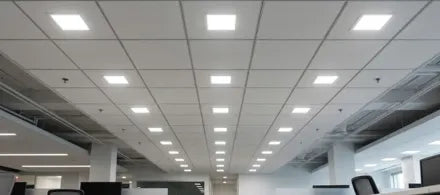
LED panel lights are flat, modern fixtures commonly used in offices, schools, clinics, conference rooms, retail spaces, and commercial interiors.
They are popular because they provide:
- Even light distribution
- Clean ceiling appearance
- Low glare
- Comfortable brightness
- Energy savings
- Simple replacement for fluorescent panels
- Good options for 2x2 and 2x4 ceiling grids
Best Uses for LED Panel Lights
| Commercial Space | Why LED Panels Work |
|---|---|
| Offices | Comfortable general lighting |
| Schools | Uniform classroom illumination |
| Clinics | Clean, bright, professional appearance |
| Retail stores | Good product visibility |
| Conference rooms | Even light for meetings |
| Reception areas | Modern ceiling design |
Where should LED panel lights be used?
LED panel lights should be used in commercial interiors with drop ceilings or flat ceiling layouts where uniform, comfortable light is required. They are ideal for offices, schools, clinics, retail stores, meeting rooms, and reception spaces because they reduce harsh shadows and create a clean professional look.
2. LED Troffer Lights
LED troffer lights are designed for grid ceilings and are common in offices, schools, hospitals, retail spaces, and commercial corridors. They are often used to replace older fluorescent troffers.
LED troffers are useful when a building needs:
- A traditional commercial ceiling fixture
- Better energy efficiency
- Improved brightness
- Reduced flicker
- Long-term reliability
- Better light quality than fluorescent tubes
LED Panel Lights vs LED Troffer Lights
| Feature | LED Panel Lights | LED Troffer Lights |
|---|---|---|
| Appearance | Slim and modern | More traditional commercial fixture |
| Best For | Offices, clinics, schools, retail | Offices, hallways, institutions |
| Ceiling Type | Drop ceiling/grid ceiling | Drop ceiling/grid ceiling |
| Light Spread | Soft and even | Strong general illumination |
| Upgrade Type | Common fluorescent panel replacement | Common fluorescent troffer replacement |
Are LED panels and LED troffers the same?
LED panels and LED troffers are similar because both are used in commercial ceiling grids, but they are not exactly the same. LED panels are usually slimmer and more modern, while troffers often have a deeper fixture body and are used as direct replacements for traditional fluorescent troffer fixtures.
3. LED High Bay Lights
LED high bay lights are used in large indoor spaces with high ceilings. They are one of the most important fixture types for warehouses, manufacturing facilities, gyms, storage centers, logistics buildings, and big-box retail spaces.
High bay fixtures are designed to deliver strong light from higher mounting heights.
Best Uses for LED High Bay Lights
- Warehouses
- Industrial facilities
- Distribution centers
- Manufacturing plants
- Gymnasiums
- Auto repair shops
- Large retail stores
- Storage facilities
- Workshops
- Aircraft hangars
When Do You Need LED High Bay Lights?
You usually need LED high bay lights when the ceiling height is around 15 feet or higher. Lower ceilings may use low bay lights, linear fixtures, panels, or strip lights depending on the layout.
| Ceiling Height | Common Lighting Choice |
|---|---|
| 8–12 ft | Panels, troffers, strip lights |
| 12–15 ft | Linear fixtures or low bay lighting |
| 15–25 ft | LED high bay lights |
| 25+ ft | High-output LED high bays with planned spacing |
What are LED high bay lights?
LED high bay lights are powerful commercial fixtures designed for spaces with high ceilings. They provide bright, wide light coverage from elevated mounting heights. They are commonly used in warehouses, factories, gyms, workshops, distribution centers, and industrial facilities where strong visibility is required.
4. LED Strip Lights
LED strip lights are flexible and useful for commercial accent lighting, display lighting, architectural lighting, under-shelf lighting, cove lighting, signage lighting, and decorative business interiors.
They are not always the main source of light in a commercial building, but they can improve the look and function of certain areas.
Best Uses for LED Strip Lights
- Retail displays
- Shelving
- Reception counters
- Restaurants
- Bars
- Hotels
- Showrooms
- Cove lighting
- Signage
- Accent lighting
- Under-cabinet task lighting
Are LED strip lights useful for commercial buildings?
Yes, LED strip lights are useful for commercial buildings when used for accent lighting, display lighting, signage, counters, shelves, hospitality spaces, and architectural details. They should be selected based on voltage, brightness, color temperature, indoor/outdoor rating, and installation location.
5. LED Retrofit Lighting
LED retrofit lighting is used when a business wants to upgrade an existing lighting system without replacing every fixture body. Retrofit options can reduce labor, material waste, and installation disruption when existing housings are still suitable.
Retrofit lighting may be a good option for:
- Older commercial buildings
- Parking lot fixtures
- Recessed lighting systems
- Canopy fixtures
- Wall packs
- Troffers
- Warehouses
- Facilities with many existing fixtures
What is LED retrofit lighting?
LED retrofit lighting means upgrading an existing fixture to LED technology while reusing part of the original fixture or housing. It is useful for commercial buildings that want better efficiency and brightness without a full fixture replacement. Retrofit suitability depends on fixture condition, compatibility, heat management, and code requirements.
Best Outdoor LED Lights for Commercial Buildings
Outdoor commercial lighting must handle weather, security needs, large spaces, and long operating hours. The best outdoor fixtures are durable, efficient, and properly aimed.
1. LED Area Lights
LED area lights are used for large outdoor spaces where wide, even illumination is needed. They are often used in parking lots, campuses, roadways, business parks, loading yards, and open commercial areas.
Best Uses for LED Area Lights
- Parking lots
- Walkways
- Roadways
- Campuses
- Commercial yards
- Industrial lots
- Auto dealerships
- Apartment complex exteriors
- Business parks
- Sports and recreation areas
What are LED area lights used for?
LED area lights are used to illuminate large outdoor commercial spaces such as parking lots, campuses, roadways, loading areas, business parks, and open lots. They provide wide light distribution, improve nighttime visibility, and support safety for vehicles, pedestrians, employees, and customers.
2. LED Parking Lot Lights
LED parking lot lights are usually pole-mounted fixtures designed for large outdoor parking areas. They are also called shoebox lights or pole lights depending on design and mounting style.
A good parking lot lighting plan should consider:
- Pole height
- Fixture wattage
- Lumen output
- Beam pattern
- Spacing
- Glare control
- Light trespass
- Parking lot size
- Security needs
- Local code requirements
Parking Lot Lighting Example
A small retail center may need pole-mounted LED parking lot lights around customer parking zones. A logistics facility may need higher-output fixtures around truck movement areas. An auto dealership may need bright and uniform lighting that supports both security and vehicle display.
What are the best LED lights for parking lots?
The best LED lights for parking lots are pole-mounted LED area lights or shoebox-style parking lot lights with proper lumen output, beam distribution, weather rating, and mounting hardware. The right choice depends on pole height, lot size, spacing, security needs, and local lighting requirements.
3. LED Wall Pack Lights
LED wall pack lights are mounted on building exteriors to illuminate walls, walkways, entrances, loading docks, alleys, and security zones.
They are common on:
- Warehouses
- Retail buildings
- Schools
- Storage facilities
- Apartment buildings
- Industrial buildings
- Office exteriors
- Restaurants
- Parking garage entrances
Why Wall Packs Are Important
Wall packs help improve:
- Building perimeter visibility
- Entryway safety
- Security camera performance
- Employee safety after dark
- Loading dock visibility
- Customer confidence
- Property appearance
What are LED wall pack lights?
LED wall pack lights are outdoor commercial fixtures mounted on exterior walls. They are used to illuminate building perimeters, walkways, entrances, loading docks, alleys, and security areas. They help improve nighttime visibility, safety, and building security while reducing energy and maintenance costs.
4. LED Flood Lights
LED flood lights are powerful outdoor fixtures used to illuminate wide areas, signs, facades, work zones, yards, and security-sensitive spaces. They provide broad light coverage and can be mounted on walls, poles, brackets, or ground-level supports depending on the application.
Best Uses for LED Flood Lights
- Building facades
- Outdoor signs
- Storage yards
- Loading areas
- Construction zones
- Security lighting
- Sports courts
- Landscape features
- Commercial entrances
- Service areas
When should you use LED flood lights?
Use LED flood lights when you need strong, wide-angle illumination for outdoor commercial areas, signs, facades, yards, service zones, or security-sensitive locations. They are best for targeted wide coverage but should be aimed carefully to reduce glare and unwanted light spill.
5. LED Canopy Lights
LED canopy lights are used under covered outdoor structures. They are common in gas stations, parking garages, drive-throughs, bank canopies, hotel drop-off areas, and commercial entry covers.
Best Uses for LED Canopy Lights
- Gas station canopies
- Parking garages
- Drive-through lanes
- Covered loading areas
- Hotel entrances
- Building drop-off zones
- Car wash bays
- Bank ATM canopies
What are LED canopy lights used for?
LED canopy lights are used under covered outdoor structures such as gas stations, parking garages, drive-throughs, loading canopies, and building entrances. They provide bright downward light, improve safety, and create a clean, professional appearance in high-traffic covered areas.
Commercial LED Fixture Selection Guide
Choosing the right LED fixture starts with understanding the commercial space. Do not begin with wattage alone. Start with the purpose of the area and the type of visibility required.
| Space Type | Recommended LED Fixture | Main Goal |
|---|---|---|
| Office | LED panel lights, troffers | Comfortable work lighting |
| Warehouse | LED high bay lights | High-ceiling visibility |
| Parking lot | LED area lights, parking lot lights | Outdoor safety and security |
| Building exterior | LED wall pack lights | Perimeter lighting |
| Gas station canopy | LED canopy lights | Bright covered-area lighting |
| Loading dock | Wall packs, flood lights, high-output fixtures | Worker and vehicle safety |
| Retail store | Panels, track lights, strips | Product visibility |
| Gym | High bay lights | Uniform bright coverage |
| Hotel entrance | Canopy lights, wall packs | Guest safety and appearance |
| Signage | Flood lights, strip lights | Visibility and branding |
| Old fixture upgrade | LED retrofit lighting | Cost-effective modernization |
How to Choose the Right LED Lights for a Commercial Building
A correct lighting choice depends on several practical factors. Here is a simple step-by-step process.
Step 1: Identify the Area
List every area that needs lighting:
- Offices
- Hallways
- Warehouse aisles
- Parking lots
- Entrances
- Loading docks
- Exterior walls
- Storage yards
- Canopies
- Retail display zones
- Mechanical rooms
- Restrooms
- Stairways
Each area may need a different fixture.
Step 2: Check Ceiling Height or Mounting Height
Ceiling height affects beam spread, lumen output, spacing, and fixture type.
- Low ceilings need softer, wider light.
- High ceilings need stronger fixtures.
- Outdoor poles need proper beam distribution.
- Wall-mounted fixtures need controlled spread.
- Canopy lights need focused downward illumination.
Step 3: Determine Brightness Needs
Brightness should be based on the task. A warehouse aisle, retail showroom, parking lot, and office desk do not need the same level of light.
Important terms:
- Lumens: Total light output from the fixture.
- Watts: Energy used by the fixture.
- Efficacy: Lumens per watt.
- Foot-candles: Light reaching a surface.
- Uniformity: How evenly light is distributed.
Step 4: Choose Color Temperature
Color temperature affects how a space looks and feels.
| Color Temperature | Appearance | Common Commercial Use |
|---|---|---|
| 3000K | Warm white | Hospitality, restaurants, boutique retail |
| 4000K | Neutral white | Offices, schools, healthcare, retail |
| 5000K | Cool white | Warehouses, parking lots, industrial spaces |
| 5700K–6500K | Very cool/daylight | Security, garages, task-heavy areas |
Step 5: Consider CRI
CRI means Color Rendering Index. It measures how accurately colors appear under a light source.
Higher CRI can matter in:
- Retail stores
- Showrooms
- Healthcare spaces
- Salons
- Auto dealerships
- Product inspection areas
- Food display areas
Step 6: Check Environmental Ratings
For outdoor or harsh areas, look for fixtures designed for the environment.
Important ratings include:
- Wet location rating
- Damp location rating
- IP rating
- Corrosion resistance
- Operating temperature range
- Impact resistance
- Dust protection
- UL, ETL, or DLC listing where applicable
Step 7: Review Controls
Controls can improve savings and performance.
Useful commercial lighting controls include:
- Motion sensors
- Occupancy sensors
- Photocells
- Timers
- Daylight harvesting
- Dimming controls
- Smart lighting systems
Step 8: Plan Installation and Maintenance
Before buying fixtures, confirm:
- Mounting type
- Voltage compatibility
- Junction box requirements
- Pole or bracket compatibility
- Emergency lighting needs
- Access for future maintenance
- Code requirements
- Electrical contractor requirements
Simple Commercial Lighting Calculation
A professional photometric layout is best for large commercial projects, but a simple calculation can help estimate fixture needs.
Basic Formula
Total lumens needed = Area square footage × target lumens per square foot
Then:
Number of fixtures = Total lumens needed ÷ lumens per fixture
Example: Warehouse Lighting Estimate
Suppose a warehouse is 10,000 square feet.
Target: 50 lumens per square foot
Total lumens needed: 10,000 × 50 = 500,000 lumens
If each LED high bay provides 25,000 lumens:
500,000 ÷ 25,000 = 20 fixtures
So, the rough estimate is 20 LED high bay lights.
Important Note
This is only a rough estimate. Final fixture count depends on ceiling height, beam angle, racking layout, reflectance, fixture spacing, shadows, required foot-candles, and code requirements. Large warehouses, parking lots, campuses, and industrial facilities should use a photometric lighting plan.
ROI Analysis: How LED Lighting Saves Money
Commercial LED lighting can create savings in three main ways:
- Lower energy use
- Reduced maintenance
- Longer fixture life
The bigger the building and the longer the operating hours, the stronger the ROI potential.
ROI Formula
Annual energy savings = wattage reduction × operating hours × electricity rate
To use the formula:
- Convert watts saved to kilowatts.
- Multiply by annual operating hours.
- Multiply by electricity cost per kWh.
ROI Example 1: Warehouse High Bay Upgrade
A warehouse has 100 old high bay fixtures.
Old fixture energy use: 400W each
New LED high bay energy use: 150W each
Wattage saved per fixture: 250W
Total wattage saved: 100 × 250W = 25,000W
Convert to kW: 25,000W ÷ 1,000 = 25 kW
Operating schedule: 12 hours per day, 6 days per week
Annual hours: 12 × 6 × 52 = 3,744 hours
Electricity rate: $0.14 per kWh
Annual energy savings:
25 kW × 3,744 hours × $0.14 = $13,104 per year
If the total project cost is $30,000, simple payback is:
$30,000 ÷ $13,104 = 2.29 years
What This Means
The warehouse could recover the project cost in about 2.3 years from energy savings alone. Maintenance savings, utility rebates, and improved visibility could make the real business value even stronger.
ROI Example 2: Parking Lot Lighting Upgrade
A commercial parking lot has 30 old outdoor pole lights.
Old fixture energy use: 400W each
New LED area light energy use: 150W each
Wattage saved per fixture: 250W
Total wattage saved: 30 × 250W = 7,500W
Convert to kW: 7.5 kW
Operating schedule: 12 hours per night, 365 days per year
Annual hours: 4,380 hours
Electricity rate: $0.15 per kWh
Annual energy savings:
7.5 kW × 4,380 hours × $0.15 = $4,927.50 per year
If the project cost is $12,000, simple payback is:
$12,000 ÷ $4,927.50 = 2.44 years
What This Means
Outdoor lights often run every night, so parking lot and exterior upgrades can produce strong ROI. Better lighting may also improve safety, security camera visibility, and customer confidence.
Indoor Fixture Comparison Table
| Fixture Type | Best For | Common Mounting | Key Benefit | Buyer Tip |
|---|---|---|---|---|
| LED Panel Lights | Offices, clinics, classrooms | Grid ceiling, surface mount | Soft even lighting | Choose correct size and color temperature |
| LED Troffer Lights | Offices, schools, commercial corridors | Drop ceiling | Familiar commercial fixture style | Good for fluorescent replacement |
| LED High Bay Lights | Warehouses, gyms, factories | Chain, hook, pendant | High-output illumination | Match beam angle to ceiling height |
| LED Strip Lights | Displays, shelves, cove lighting | Surface, channel, adhesive, clips | Flexible accent lighting | Check voltage and driver needs |
| LED Retrofit Lighting | Existing fixtures | Fixture-dependent | Lower disruption | Confirm compatibility before buying |
Outdoor Fixture Comparison Table
| Fixture Type | Best For | Common Mounting | Key Benefit | Buyer Tip |
|---|---|---|---|---|
| LED Area Lights | Parking lots, campuses, roads | Pole, slip fitter, arm mount | Wide outdoor coverage | Use correct distribution pattern |
| LED Wall Pack Lights | Building exteriors, entrances | Wall mount | Security and perimeter lighting | Choose cutoff style to control glare |
| LED Flood Lights | Signs, yards, facades | Wall, pole, bracket | Strong targeted lighting | Aim carefully to avoid light spill |
| LED Canopy Lights | Gas stations, parking garages | Surface or recessed canopy | Downward covered-area light | Check wet rating and mounting type |
| LED Parking Lot Lights | Parking areas | Pole mount | Vehicle and pedestrian visibility | Plan spacing and pole height |
Real-World Commercial Lighting Examples
Example 1: Office Building
An office building may use:
- LED panel lights in open workspaces
- LED troffers in corridors
- LED strip lights for reception accent lighting
- Occupancy sensors in meeting rooms
- Emergency lighting in stairwells
The goal is comfort, productivity, clean appearance, and lower energy use.
Example 2: Warehouse
A warehouse may use:
- LED high bay lights over storage aisles
- Motion sensors in low-traffic zones
- LED wall packs on exterior walls
- LED flood lights near loading docks
- LED area lights in truck yards
The goal is safety, visibility, workflow efficiency, and fewer maintenance interruptions.
Example 3: Retail Store
A retail store may use:
- LED panels for general lighting
- LED strip lights for product shelves
- Accent lighting for displays
- Warmer color temperature in boutique areas
- High CRI fixtures for accurate product color
The goal is product visibility, customer experience, and brand presentation.
Example 4: Gas Station
A gas station may use:
- LED canopy lights over fueling areas
- LED wall packs on the building
- LED area lights around the lot
- LED flood lights near signage
- Photocells for dusk-to-dawn operation
The goal is safety, visibility, professional appearance, and long operating life.
Example 5: Hotel or Motel
A hotel may use:
- LED canopy lights at entrance areas
- Wall packs around exterior walkways
- LED panels in back-office spaces
- LED strip lights for lobby accents
- Outdoor area lights in parking zones
The goal is guest safety, comfort, visual appeal, and cost control.
Common Mistakes to Avoid When Buying Commercial LED Lights
Commercial lighting mistakes can increase costs, reduce performance, and create safety problems. Avoid these common errors.
Mistake 1: Choosing by Wattage Only
Wattage tells you energy use, not brightness. Always compare lumens, efficacy, beam angle, mounting height, and fixture quality.
Mistake 2: Ignoring Ceiling Height
A fixture that works in a 10-foot office may not work in a 25-foot warehouse. High ceilings need proper lumen output and beam spread.
Mistake 3: Using Indoor Fixtures Outdoors
Outdoor fixtures must be rated for moisture, dust, and temperature changes. Indoor-rated fixtures can fail early in outdoor environments.
Mistake 4: Overlighting the Space
Too much brightness can create glare, discomfort, wasted energy, and customer complaints. More light is not always better.
Mistake 5: Underlighting Critical Areas
Low light in parking lots, loading docks, stairways, storage rooms, or production zones can create safety and security risks.
Mistake 6: Forgetting Controls
Motion sensors, photocells, timers, and dimmers can improve savings and extend fixture life.
Mistake 7: Not Checking Certifications
Commercial buyers should check relevant product listings, safety certifications, rebates, and local code requirements.
Mistake 8: Skipping Photometric Planning
Large outdoor lots, warehouses, and industrial buildings should not rely on guesswork. A photometric plan helps confirm spacing, brightness, and uniformity.

Commercial LED Lighting Best Practices
Use these best practices when planning a lighting upgrade.
1. Start With the Building Layout
Separate the building into zones:
- Work areas
- Storage areas
- Customer areas
- Security zones
- Outdoor areas
- Parking areas
- Emergency routes
- Display areas
Each zone should have its own lighting goal.
2. Use the Right Fixture for the Right Space
Do not use one fixture everywhere. Use panels for offices, high bays for warehouses, wall packs for exteriors, canopy lights for covered outdoor areas, and area lights for parking lots.
3. Balance Brightness and Comfort
Good lighting should be bright enough for the task without creating glare. Use the correct fixture spacing, lens type, beam angle, and mounting height.
4. Choose Commercial-Grade Fixtures
Commercial buildings need durable fixtures that can handle longer hours, larger spaces, and tougher environments.
5. Consider Energy Rebates
Many commercial LED upgrades may qualify for local utility rebates or incentive programs. Rebate rules vary by location, product type, and utility provider.
6. Use Controls Where Practical
Controls can reduce wasted energy in offices, warehouses, restrooms, hallways, parking lots, and storage areas.
7. Plan for Maintenance Access
Make sure fixtures can be safely accessed later. This matters in warehouses, parking lots, gymnasiums, and high-ceiling spaces.
8. Think Beyond First Cost
The cheapest fixture is not always the best value. Consider energy use, warranty, build quality, brightness, ratings, installation cost, and long-term maintenance.
Technical Concepts Explained Simply
Lumens vs Watts
Lumens measure brightness. Watts measure energy use. In commercial LED lighting, always compare lumens because a lower-watt LED can often produce strong brightness with less electricity.
Efficacy
Efficacy means lumens per watt. A higher efficacy fixture gives more light for each watt used.
Beam Angle
Beam angle controls how wide or narrow the light spreads. Narrow beams are useful for higher ceilings or focused lighting. Wide beams are useful for broader coverage.
Color Temperature
Color temperature describes light appearance. Warm light feels softer. Cool light feels brighter and more task-focused.
CRI
CRI measures how naturally colors appear. Higher CRI is useful in retail, showrooms, healthcare, and product inspection.
IP Rating
IP rating shows protection against dust and water. Outdoor and harsh commercial environments often require stronger IP-rated fixtures.
DLC, UL, and ETL
These are common commercial lighting quality and safety indicators. They may also matter for rebates, compliance, and buyer confidence.
How Patel LED Helps Businesses Choose Commercial LED Lighting
Patel LED offers commercial LED lighting solutions for businesses across the USA. The product range supports indoor and outdoor commercial applications, including LED High Bay Lights, LED Area Lights, LED Flood Lights, LED Wall Pack Lights, LED Canopy Lights, LED Panel Lights, LED Retrofit Lighting, LED Strip Lights, and Parking Lot Lights.
Patel LED helps commercial buyers by offering:
- A wide range of indoor and outdoor LED fixtures
- Lighting options for warehouses, offices, retail, parking lots, gas stations, workshops, and commercial buildings
- Commercial-grade lighting solutions for business applications
- Product options for both new projects and retrofit upgrades
- Bulk and commercial inquiry support
- Energy-efficient fixture choices for long operating hours
- Outdoor lighting options for safety and security
- Indoor lighting options for comfort and productivity
For contractors, facility managers, and business owners, Patel LED provides a practical way to source lighting products based on building needs, fixture type, and project goals.
Buyer Guidance: What to Check Before Ordering
Before placing a commercial LED lighting order, check the following:
- What type of building is it?
- Is the fixture for indoor or outdoor use?
- What is the mounting height?
- What is the total square footage?
- How many hours per day will lights operate?
- What is the current fixture wattage?
- What is the target brightness?
- Is the space wet, damp, dusty, hot, or cold?
- Does the building need dimming or sensors?
- Is voltage compatibility confirmed?
- Are rebates available?
- Is the fixture certified or listed for the application?
- Does the layout require photometric planning?
- Are there local lighting codes or restrictions?
- Is the project a full replacement or retrofit?
FAQs
Expert Recommendations for Commercial Buyers
For a successful commercial LED lighting upgrade, follow these recommendations:
- Choose fixtures based on application, not only price.
- Use LED high bays for high-ceiling warehouses and industrial spaces.
- Use LED panels or troffers for offices, classrooms, and clinics.
- Use LED wall packs for exterior building security.
- Use LED canopy lights under covered outdoor structures.
- Use LED area lights for parking lots and large outdoor spaces.
- Use LED flood lights for signs, yards, facades, and targeted security lighting.
- Consider LED retrofit lighting for older buildings when fixture housings are usable.
- Check certifications, voltage, ratings, and warranty information.
- Use sensors and photocells where they make sense.
- Estimate ROI before purchasing.
- Use professional installation for commercial electrical work.
- Request a photometric layout for large or complex projects.
Commercial buildings need different LED fixtures for different spaces. A warehouse, office, parking lot, building exterior, gas station canopy, and retail showroom cannot all use the same lighting strategy.
Summary Bullets
- LED panel lights are best for offices, schools, clinics, and clean commercial interiors.
- LED high bay lights are best for warehouses, gyms, factories, and high-ceiling spaces.
- LED area lights and parking lot lights are best for large outdoor commercial areas.
- LED wall pack lights are best for building perimeters, entrances, walkways, and loading docks.
- LED canopy lights are best for covered outdoor areas like gas stations and parking garages.
- LED flood lights are best for signs, facades, yards, and security lighting.
- LED retrofit lighting is useful when upgrading older fixtures without a full replacement.
- ROI depends on wattage reduction, operating hours, electricity rate, project cost, and maintenance savings.
Future Outlook for Commercial LED Lighting
Commercial LED lighting will continue to move toward smarter, more efficient, and more controllable systems. Businesses are no longer looking only for brighter fixtures. They want lighting systems that reduce waste, support safety, improve visibility, integrate with controls, and lower long-term operating costs.
The next phase of commercial lighting will likely focus on:
- Connected lighting controls
- Motion-based energy savings
- Better outdoor glare control
- Higher fixture efficacy
- More retrofit-friendly solutions
- Improved durability for harsh environments
- Better lighting design for safety and productivity
- More demand from warehouses, parking lots, retail centers, and industrial buildings
For USA commercial buildings, LED lighting is not just an upgrade trend. It is becoming the standard for efficient facility operation.
Commercial Recommendation
If your building has old fluorescent, metal halide, halogen, or HID fixtures, a commercial LED upgrade should be considered. Start with the highest-use areas first, such as warehouses, parking lots, exterior walls, canopies, offices, and loading zones.
The best approach is to:
- Audit existing fixtures.
- Identify high-cost lighting areas.
- Select fixture types by application.
- Estimate energy savings.
- Check rebates and certifications.
- Plan installation with a qualified professional.
- Use Patel LED product categories to match the correct fixture to the correct commercial space.
Upgrade Your Commercial Building with Patel LED
Your commercial building deserves lighting that works harder, lasts longer, and supports your business every day.
Why Choose Patel LED?
- Commercial LED lighting solutions for USA businesses
- Indoor and outdoor fixture options
- Products for warehouses, offices, parking lots, retail, gas stations, and industrial spaces
- LED lighting options for new projects and retrofit upgrades
- Support for commercial and bulk lighting inquiries
- Energy-efficient solutions for long operating hours
- Practical product categories that match real building needs
Explore Patel LED commercial LED lighting products today and choose the right indoor and outdoor fixtures for your building, project, or facility upgrade.