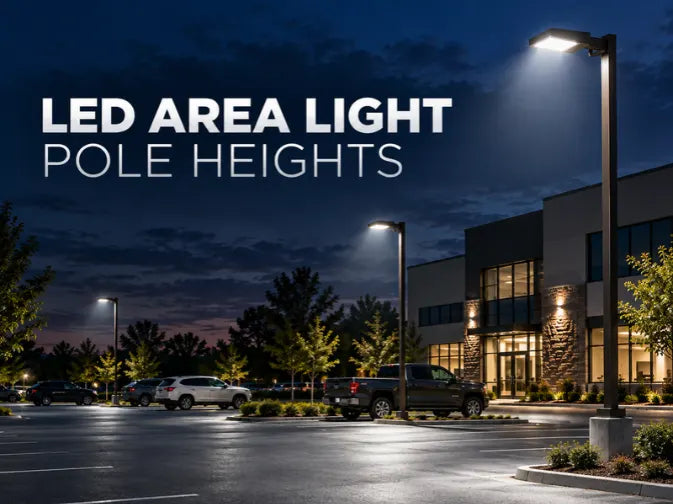
Best Pole Heights for LED Area Lights: 15 ft, 20 ft, 25 ft or 30 ft?
Table of Contents
- What Is the Best Pole Height for LED Area Lights?
- 20-Foot Pole Height: One of the Most Versatile Commercial Options
- Best Patel LED Light for a 20-Foot Pole
- 25-Foot Pole Height: A Strong Choice for Larger Parking Lots
- Best Patel LED Area Light for a 25-Foot Pole
- 30-Foot Pole Height: Better for Large Open Properties
- 30 Feet and Above: Photometric Design Should Drive the Purchase
- LED Area Light Pole Height and Wattage Chart
- Which Light Distribution Should You Use?
- Best Pole Height for Parking Lot Lights
- Best Pole Height for Industrial Yards
- Best Pole Height for Car Dealerships
- Best Pole Height for Apartment Parking Lots
- Best Pole Height for Retail Parking Lots
- Best Pole Height for Large Distribution Centers
- How Many LED Area Lights Do You Need?
- 20 ft vs 25 ft Patel LED Pole: Which Should You Choose?
- Selectable-Wattage Fixtures Make Pole-Height Planning Easier
- Do You Need a Photocell on Pole-Mounted Area Lights?
- Pole Height and Light Trespass
- Pole Height and Outdoor Fixture Efficiency
- Common Pole-Height Mistakes
- Pole Height Selection Checklist
- Patel LED Product Selection by Pole Height
- FAQs
- Choose the Pole Before You Choose the Wattage
Choosing the best pole height for an LED area light is one of the most important decisions in a parking lot, commercial property, roadway, industrial yard, or outdoor lighting project.
It also happens to be one of the most misunderstood.
Many buyers start with questions such as:
Should I buy a 200W or 300W parking lot light?
But the better question is:
How high will the fixture be mounted?
Pole height changes:
- How far the light spreads
- How many fixtures may be needed
- How much lumen output is appropriate
- How far apart poles can be placed
- How much glare drivers may experience
- Whether dark spots appear between fixtures
- How effectively the property is illuminated
A 300W LED area light installed at 15 feet behaves very differently from the same fixture installed at 30 feet.
This is why Patel LED recommends evaluating pole height together with:
- Fixture wattage
- Lumen output
- Light distribution
- Pole spacing
- Property size
- Target illumination
- Uniformity
- Mounting configuration
For many commercial projects, common parking lot and area-light pole heights include approximately:
- 15 feet
- 20 feet
- 25 feet
- 30 feet
Patel LED currently sells commercial steel poles in both 20-foot and 25-foot heights for outdoor LED area lights, parking lots, campuses, roadways, industrial yards, and other commercial properties.
This guide explains how each pole height performs and which Patel LED area-light options buyers should evaluate before placing an order.

What Is the Best Pole Height for LED Area Lights?
There is no single pole height that is best for every area-light application.
For early-stage commercial planning:
| Pole height | Typical application direction |
|---|---|
| 12–15 ft | Small lots, walkways, compact commercial areas |
| 15–20 ft | Small-to-medium parking lots |
| 20 ft | Common commercial parking and perimeter applications |
| 25 ft | Larger parking lots and industrial properties |
| 30 ft | Large open parking lots, yards and high-output applications |
| 30 ft+ | Large-scale applications requiring professional photometric design |
Patel LED’s own parking-lot design guidance lists 15 ft, 20 ft, 25 ft, and 30 ft among common pole heights used in commercial outdoor lighting.
Simple recommendation
If you are choosing between common commercial pole heights:
- 15 ft → smaller area, lower-output fixture, tighter spacing
- 20 ft → versatile commercial choice
- 25 ft → strong option for larger parking lots
- 30 ft → wider coverage but requires careful fixture and glare selection
The final choice should be based on a photometric layout rather than pole height alone.
Why Pole Height Matters So Much
Pole height changes the geometry of the lighting system.
When a fixture is installed higher:
- Light can cover a larger area
- Pole spacing may increase
- More lumen output may be needed
- Glare can sometimes be reduced
- Fixture distribution becomes increasingly important
When a fixture is installed lower:
- More light reaches the ground directly beneath the pole
- Coverage is smaller
- More poles may be needed
- Glare may become more noticeable
- High-output fixtures may create hotspots
This creates an important commercial tradeoff:
Lower poles may require more fixtures, while taller poles may require fewer but higher-output fixtures.
Patel LED’s current pole collection makes the same practical point: shorter poles may require more fixtures, while taller poles can allow wider coverage but need proper fixture selection to avoid glare and uneven illumination.
15-Foot Pole Height: Best for Smaller Commercial Areas
A 15-foot pole is generally on the lower side for commercial area lighting.
It can make sense for:
- Small parking lots
- Retail storefront parking
- Apartment-complex parking
- Walkways
- Small office properties
- Perimeter areas
- Lower-scale commercial environments
Advantages of a 15-foot pole
- Easier fixture maintenance
- Strong light at ground level
- Lower structural height
- Suitable for smaller properties
Potential drawbacks
- Smaller coverage area
- More poles may be required
- High-output fixtures can create glare
- Bright spots may appear directly below fixtures
What fixture output should you consider?
At 15 feet, starting with a lower output may make more sense than automatically installing a 300W or 450W fixture.
Depending on site conditions, buyers may consider:
- Lower-wattage area-light options
- Selectable fixtures configured to a reduced setting
- Controlled distribution rather than maximum lumens
Patel LED’s selectable area light can operate at 200W, 240W, or 300W and produces up to 45,000 lumens, giving commercial buyers flexibility where one fixed wattage may not be appropriate across the entire site.
Commercial recommendation
If the fixture is mounted around 15 feet, do not assume the 300W setting is necessary.
A photometric plan may show that the lower setting provides sufficient illumination while reducing:
- Glare
- Electricity consumption
- Overlighting
Using shorter poles? Compare Patel LED selectable Area Lights before paying for output you may not need.
20-Foot Pole Height: One of the Most Versatile Commercial Options
A 20-foot pole is a practical starting point for many commercial area-lighting projects.
It may be appropriate for:
- Medium parking lots
- Retail centers
- Office parking areas
- Churches
- Schools
- Hotels
- Small industrial lots
- Apartment complexes
- Commercial property perimeters
Patel LED currently sells a 20 ft steel light pole with a 4-inch square profile specifically for outdoor LED area-light installations.
This makes 20 feet particularly relevant for buyers looking to purchase both:
- Pole
- LED Area Light
from Patel LED.
Why 20 Feet Works Well
At approximately 20 feet, the fixture is high enough to:
- Provide wider coverage than a low pole
- Reduce extreme brightness immediately beneath the fixture
- Support commercial-grade area lighting
while remaining low enough that:
- Extremely high lumen output may not always be required
- Maintenance access remains more manageable than on very tall poles
Best Patel LED Light for a 20-Foot Pole
A strong product to evaluate is Patel LED’s:
200W / 240W / 300W Selectable LED Area Light
Current specifications include:
- Selectable 200W / 240W / 300W
- Up to 45,000 lumens
- 3000K / 4000K / 5000K selectable CCT
- IP65 protection
- Universal mounting
- Photocell-cap option
- UL/DLC listing shown on the product page
This flexibility can be particularly useful around 20-foot mounting heights.
Example
A project may use:
- 200W on perimeter poles
- 240W in central parking rows
- 300W only where spacing or site geometry requires additional output
One fixture family can therefore support different positions across the property.
Building a 20-foot pole layout? Pair Patel LED’s 20 ft steel pole with an appropriately configured Patel LED Area Light after verifying your photometric plan.
25-Foot Pole Height: A Strong Choice for Larger Parking Lots
For larger commercial parking areas, 25 feet is another common mounting height.
It can work well for:
- Shopping-center parking
- Warehouse employee lots
- Distribution centers
- Industrial yards
- Large office properties
- Schools and campuses
- Car dealerships
- Large apartment communities
Patel LED currently sells a 25 ft steel light pole, 4-inch square, intended for LED area lights and outdoor commercial lighting.
That makes 25 feet particularly important for large parking-lot projects where buyers need both fixtures and new poles.
Why Choose a 25-Foot Pole?
Compared with a 20-foot pole, a 25-foot mounting height can provide:
- Wider light distribution
- Better overlap between fixtures
- Potentially fewer poles
- Improved large-area coverage
However, it can also require:
- More fixture lumens
- More careful optic selection
- Stronger photometric verification
- Greater consideration of wind loading and pole structure
IES roadway and parking guidance notes that maintenance access and available service equipment can influence pole height and location.
That is an important consideration because a pole must be practical not only when installed - but also throughout the life of the lighting system.
Best Patel LED Area Light for a 25-Foot Pole
Patel LED’s selectable 200W / 240W / 300W LED Area Light is again a strong product to evaluate.
At 25 feet, the higher output settings may become more relevant, depending on:
- Pole spacing
- Fixture optics
- Lot size
- Target foot-candles
- Existing ambient light
- Property type
The fixture currently produces up to 45,000 lumens at 300W, with a stated efficacy of 150 lumens per watt on the current parking-lot product page.
Example configuration
A site might model:
- 240W perimeter positions
- 300W interior positions
instead of using 300W everywhere.
This is one reason selectable wattage can be useful for large commercial projects.
30-Foot Pole Height: Better for Large Open Properties
A 30-foot pole moves into a higher-output commercial lighting environment.
It may be considered for:
- Large retail parking lots
- Industrial yards
- Distribution centers
- Truck lots
- Commercial campuses
- Large municipal-style sites
- Large open commercial properties
At this height, professional photometric planning becomes increasingly important.
Why?
As mounting height increases:
- More lumens may be needed
- Optics matter more
- Pole spacing becomes more sensitive
- Poor fixture selection can produce dark zones
- Property-line spill must be controlled
Should You Use a 300W Area Light at 30 Feet?
Potentially.
Patel LED currently offers a 200W/240W/300W area light producing up to 45,000 lumens.
At approximately 30 feet, 300W may be appropriate for some commercial projects.
But the decision depends on:
- Distribution
- Target illumination
- Pole spacing
- Lot geometry
- Uniformity
- Number of fixtures
A 300W fixture should never be recommended solely because the pole is 30 feet tall.
When Should You Consider Patel LED's Higher-Output Parking Lot Lights?
Higher-output fixtures may make sense where:
- Mounting height is high
- Poles are widely spaced
- The illuminated area is very large
- Industrial operations require greater coverage
- Photometric design confirms the need
Patel LED’s current parking-lot portfolio includes products up to approximately 58,500 lumens in higher-output configurations, according to its current parking-lot lighting guidance.
The key is to use high output where it creates useful coverage—not merely because the product has a larger wattage number.
30 Feet and Above: Photometric Design Should Drive the Purchase
At mounting heights above approximately 30 feet, simple “watts by pole height” charts become increasingly unreliable.
You should model:
- Fixture distribution
- Pole spacing
- Target foot-candles
- Minimum illumination
- Maximum illumination
- Uniformity
- Glare
- Property-line light
- Building interference
IES’s current ANSI/IES RP-8-25 is the current Recommended Practice for Lighting Roadway and Parking Facilities and includes dedicated sections covering parking lots, design calculations, obtrusive light, controls, maintenance, and maintained illumination.
That reinforces why commercial site lighting is ultimately a design exercise rather than a simple wattage chart.
LED Area Light Pole Height and Wattage Chart
Use this as an early-stage commercial planning guide only.
| Pole height | Fixture direction to evaluate | Best application |
|---|---|---|
| 12–15 ft | Lower-output area light | Small parking areas |
| 15–20 ft | 150W–200W class / selectable lower setting | Small-medium lots |
| 20 ft | 200W–240W class | Commercial parking |
| 25 ft | 240W–300W class | Larger commercial lots |
| 30 ft | 300W or higher-output options | Large open properties |
| 30 ft+ | Project-specific high-output design | Industrial/large-area projects |
These ranges are not guaranteed fixture-selection rules.
A lower-wattage fixture with effective optics may outperform a higher-wattage fixture with poor distribution.
Why Lumens Matter More Than Watts
Wattage tells you how much electrical power a fixture uses.
Lumens tell you how much visible light it produces.
This means buyers should compare:
Lumens + optics + pole height
rather than:
Watts alone
DOE evaluates outdoor pole-mounted area and roadway luminaires using luminaire efficacy, measured in lumens per watt. Its current federal acquisition guidance uses 136 lm/W as the FEMP efficiency threshold for outdoor pole/arm-mounted area and roadway luminaires in covered federal purchases.
That does not mean every commercial project must use that federal threshold, but it demonstrates why efficacy is an important buying metric.
Example: Same Wattage, Different Pole Height
Assume a commercial fixture produces 30,000 lumens.
Mounted at 15 feet
Potential result:
- Strong illumination beneath pole
- Smaller coverage footprint
- Greater hotspot potential
Mounted at 25 feet
Potential result:
- Wider coverage
- Less concentrated illumination beneath fixture
- Better overlap potential
Mounted at 35 feet
Potential result:
- Much wider potential distribution
- Less illumination reaching the work plane unless optics/output are appropriate
- Greater dependence on professional photometric design
The fixture has not changed.
The mounting height has.
That is why pole height must be selected before finalizing the fixture.
Pole Height and Fixture Spacing
Patel LED’s existing parking-lot design guide uses a rough early-planning spacing guideline of approximately:
2.5–4 times pole height
as a starting point before photometric verification.
For example:
15-foot pole
Approximate conceptual spacing:
37.5–60 ft
20-foot pole
Approximate conceptual spacing:
50–80 ft
25-foot pole
Approximate conceptual spacing:
62.5–100 ft
30-foot pole
Approximate conceptual spacing:
75–120 ft
Important
These are not installation rules.
The final spacing depends on:
- Fixture distribution
- Output
- Pole arrangement
- Obstructions
- Required uniformity
- Property geometry
Always verify through photometric analysis.
The Problem with Poles That Are Too Short
A pole that is unnecessarily short may create:
- Small coverage areas
- More poles
- More foundations
- More underground wiring
- More fixtures
- Greater glare
- More bright spots
Suppose a large lot could be properly illuminated with:
20 fixtures on 25-foot poles
but instead requires:
30 fixtures on 15-foot poles
The lower poles could increase:
- Fixture cost
- Pole cost
- Installation
- Trenches
- Wiring
- Energy use
- Maintenance points
This is why the cheapest individual pole is not always the cheapest system.
The Problem with Poles That Are Too Tall
Taller poles are not automatically better.
An unnecessarily tall pole can create:
- Higher structural cost
- Harder maintenance access
- Greater wind-loading considerations
- Need for higher output
- More complex installation
IES specifically notes that maintenance-equipment height and safe luminaire access can influence pole height and location.
The best height balances:
- Coverage
- Fixture output
- Uniformity
- Pole quantity
- Maintenance
- Installation cost
How Pole Height Affects Glare
Glare is often associated with fixture brightness, but mounting height is also important.
Very low mounting + high output
May create:
- Strong direct glare
- Extreme hotspots
- Driver discomfort
Appropriate mounting height
Can help distribute output over a wider area.
Excessively high mounting
May require much higher output, potentially creating different glare or spill-light problems if optics are poorly controlled.
IES RP-8-25 covers parking facilities as well as environmental and visual issues in roadway and outdoor-lighting design.
Which Light Distribution Should You Use?
Pole height is only half of the equation.
The other major factor is distribution.
Patel LED’s parking-lot design guidance describes several common optical patterns:
Type I
Typically used for narrow pathways and roadways.
Type II
Often used for narrower roadways and elongated layouts.
Type III
Common choice for parking-lot applications where the fixture is positioned along the side of the area.
Type IV
Useful near boundaries and perimeter applications.
Type V
Provides broad symmetrical distribution for large open areas.
A 25-foot pole with the wrong distribution may perform worse than a 20-foot pole with the correct optic.
Best Pole Height for Parking Lot Lights
For many commercial parking lots:
20–25 feet is a highly practical range to evaluate.
Why?
It balances:
- Coverage
- Fixture output
- Pole quantity
- Maintenance
- Commercial-scale appearance
Patel LED supports both heights with currently available steel commercial poles.
Consider 20 feet when:
- Parking lot is moderate in size
- Poles are reasonably close
- Lower output is possible
- Maintenance accessibility matters
Consider 25 feet when:
- Lot is larger
- Pole spacing needs to increase
- Wider area coverage is desirable
- Higher-output area lights are appropriate
Best Pole Height for Industrial Yards
Industrial yards may contain:
- Trucks
- Trailers
- Outdoor equipment
- Loading operations
- Storage
- Employee vehicles
Because these areas can be larger than typical retail parking lots, buyers may evaluate:
- 25-foot poles
- 30-foot poles
- Higher mounting where engineered and appropriate
Higher-output Patel LED area lights may become relevant in these situations.
However, lighting should still be designed around:
- Worker activity
- Vehicle movement
- Security
- Spill light
- Property limits
Best Pole Height for Car Dealerships
Car dealerships present a different challenge.
Lighting often serves both:
- Visibility
- Product presentation
Lower or medium commercial poles may help provide better vertical illumination on vehicles.
Potential planning range:
- 15–25 feet
But extremely high poles may reduce the ability to create controlled merchandising illumination.
Area lights should be coordinated with:
- Building-mounted lights
- Entrance lighting
- Security cameras
Best Pole Height for Apartment Parking Lots
Apartment and multifamily properties usually need to balance:
- Resident visibility
- Driver comfort
- Pedestrian routes
- Nearby residential windows
- Light trespass
A planning range around:
15–20 feet
may often be evaluated, depending on site conditions.
Lower output and controlled optics can sometimes be more appropriate than tall, high-output fixtures.
Best Pole Height for Retail Parking Lots
Retail lots may contain:
- Customer vehicles
- Pedestrians
- Shopping carts
- Accessible spaces
- Drive lanes
A common commercial design direction is:
20–25 feet
depending on property size and layout.
This is precisely where Patel LED’s available 20 ft and 25 ft commercial steel pole products can become relevant.
Best Pole Height for Large Distribution Centers
Large distribution facilities can include:
- Employee parking
- Trailer storage
- Truck courts
- Loading zones
- Large perimeter areas
For larger open areas:
25–30 feet or higher engineered systems may be evaluated.
These properties often benefit from higher-output area lights because pole spacing can be substantial.
Photometric design should determine whether:
- 240W
- 300W
- Higher-output fixture
is actually required.
How Many LED Area Lights Do You Need?
Pole height influences fixture quantity, but you cannot calculate quantity from height alone.
A rough conceptual formula is:
Required Site Lumens ≈ Area × Target Foot-Candles
For example:
50,000 sq. ft.
Target:
3 foot-candles
Theoretical illumination:
50,000 × 3
= 150,000 lumens reaching the surface
But this does not mean three 50,000-lumen fixtures will illuminate the property correctly.
You must account for:
- Distribution
- Pole height
- Light-loss factors
- Fixture utilization
- Surface reflectance
- Layout
- Uniformity
Patel LED’s own parking-lot lighting guide similarly treats simple lumen calculations as an initial estimate rather than a final photometric design.
When a Taller Pole Can Reduce Total Project Cost
This seems counterintuitive.
A taller pole may cost more individually.
But it may potentially reduce:
- Total pole quantity
- Fixture quantity
- Concrete foundations
- Underground conduit
- Electrical wiring
- Installation labor
Example:
Option A
24 × 15-foot poles
versus
Option B
16 × 25-foot poles
If both designs meet the required illumination and uniformity, the taller-pole design might be commercially preferable.
However, actual economics must be calculated for the specific site.
When a Shorter Pole Can Be Better
Shorter poles can be a better choice when:
- Lot is small
- Nearby residences limit mounting height
- Local zoning restricts pole height
- Trees or architectural elements interfere
- Lower output is sufficient
- Maintenance access is a major priority
Local zoning requirements should always be checked before ordering poles.
New Pole vs Existing Pole Retrofit
Not every LED area-light project requires new poles.
Keep existing poles when:
- Structurally sound
- Appropriate height
- Correctly positioned
- Compatible with new fixture mounting
- Electrical infrastructure is suitable
Consider new Patel LED poles when:
- Existing poles are damaged
- Height is inappropriate
- Property layout changed
- New parking areas are being created
- New pole positions are needed
Patel LED currently offers:
- 20 ft steel commercial light pole
- 25 ft steel commercial light pole
That creates a useful opportunity for buyers building new commercial outdoor-lighting systems instead of performing only a fixture retrofit.
20 ft vs 25 ft Patel LED Pole: Which Should You Choose?
| Factor | 20 ft pole | 25 ft pole |
|---|---|---|
| Smaller commercial lots | Strong fit | Possible |
| Medium parking lot | Strong fit | Strong fit |
| Large parking lot | Possible | Stronger starting point |
| Industrial yard | Possible | Strong fit |
| Coverage | Moderate | Wider potential |
| Fixture output | Often moderate | Often moderate-high |
| Maintenance access | Easier | More equipment-dependent |
| Pole quantity | May require more | May allow wider spacing |
The correct option still requires structural, photometric, electrical, and local-code review.
Pole Height and Energy Cost
Pole height indirectly affects energy cost.
Suppose one design requires:
30 × 300W fixtures
Connected load:
9,000W
Another optimized design requires:
24 × 240W fixtures
Connected load:
5,760W
Difference:
3.24 kW
Assume:
4,380 annual operating hours
Annual electricity difference:
3.24 × 4,380 = 14,191.2 kWh
At $0.15/kWh:
= approximately $2,128.68 per year
This is only a modeled example.
The important point is:
Pole height, spacing, fixture count, optics and wattage should be optimized together.
Selectable-Wattage Fixtures Make Pole-Height Planning Easier
This is where Patel LED’s current area-light product can offer a major commercial advantage.
The fixture supports:
- 200W
- 240W
- 300W
with output up to 45,000 lumens.
Imagine a property with:
- 20-foot perimeter poles
- 25-foot interior poles
Instead of buying completely different fixture families, the project may be able to use the same Patel LED product while configuring output according to position, subject to photometric verification.
That can help with:
- Product standardization
- Replacement inventory
- Installation
- Future maintenance
Do You Need a Photocell on Pole-Mounted Area Lights?
For many outdoor commercial projects, automatic dusk-to-dawn control can help prevent unnecessary daytime operation.
Patel LED’s current selectable parking-lot fixture includes a built-in dusk-to-dawn photocell sensor, and a shorting cap can be used when manual or alternative control is required.
The same fixture is also listed as compatible with 0–10V dimming, allowing brightness adjustment where the project and control system support it.
DOE notes that advanced controls can save additional energy and operating costs beyond fixture-efficiency improvements alone.
Pole Height and Maintenance Cost
Outdoor lighting is not an install and forget asset.
Eventually a facility may need to:
- Inspect the fixture
- Clean the lens
- Replace a driver
- Repair wiring
- Service controls
- Repaint or repair the pole
IES specifically recognizes maintenance and luminaire accessibility as considerations when establishing pole height and location.
Commercial takeaway
If two layouts provide similar performance, the one that is easier and safer to maintain may have a lower lifecycle cost.
Pole Height and Wind Loading
The pole must support:
- Fixture weight
- Mounting arm
- Brackets
- Wind forces
- Multiple fixtures where applicable
If two or more fixtures are mounted on a pole using:
- Bullhorn brackets
- Tenon adapters
- Multi-head configurations
the structural load changes.
Patel LED notes that compatible brackets can allow one pole to support multiple fixtures, but the pole and bracket must both be suitable for the load.
Always have commercial pole installations reviewed for:
- Foundation
- Anchorage
- Wind zone
- EPA
- Fixture weight
- Local requirements
Pole Height and Light Trespass
A taller pole can spread light farther.
That can be useful inside a large property.
It can also create problems near:
- Homes
- Hotels
- Adjacent commercial buildings
- Property lines
The current IES RP-8-25 parking and roadway standard includes design consideration for obtrusive light as part of the wider outdoor-lighting process.
This is another reason distribution should be selected with pole height.
Pole Height and Color Temperature
Pole height does not determine CCT.
However, commercial buyers may need to choose:
- 3000K
- 4000K
- 5000K
based on:
- Property type
- Visual preference
- Neighboring properties
- Security needs
- Local regulations
Patel LED’s current selectable area light offers all three choices within one fixture.
Pole Height and Outdoor Fixture Efficiency
A poorly selected high-wattage fixture can waste energy regardless of pole height.
DOE currently evaluates outdoor pole- and arm-mounted area/roadway luminaires by efficacy and encourages buyers to compare product efficiency, lifecycle cost, performance, reliability and controls.
For commercial buyers, this means comparing:
- Lumens
- Watts
- Lumens per watt
- Distribution
- Dimming
- Controls
- Pole height
instead of assuming the most powerful fixture is the best value.

Common Pole-Height Mistakes
1. Choosing wattage before pole height
Determine mounting height first.
2. Using one pole height everywhere
Different areas may have different coverage needs.
3. Installing the highest-output fixture on a short pole
This may produce severe glare.
4. Increasing pole height without increasing design scrutiny
Higher mounting requires stronger photometric planning.
5. Using the same optical distribution at every pole
Perimeter and interior poles may require different patterns.
6. Ignoring maintenance access
The fixture eventually needs servicing.
7. Ignoring pole structural capacity
Especially when multiple fixtures are mounted.
8. Ignoring property boundaries
Tall fixtures may send light farther.
9. Assuming taller poles always mean fewer fixtures
Only a photometric plan can confirm that.
10. Buying fixtures before checking the existing pole mount
Mounting compatibility matters.
Pole Height Selection Checklist
Before ordering a Patel LED Area Light or steel pole, document:
Property
- Lot dimensions
- Property type
- Parking-space count
- Drive lanes
- Walkways
- Building entrances
- Property boundaries
Pole system
- Existing pole count
- Existing pole height
- Proposed pole height
- Pole spacing
- Pole construction
- Wind conditions
- Mounting type
Lighting requirements
- Target foot-candles
- Minimum illumination
- Uniformity
- Glare
- CCT
- Distribution
- Controls
Electrical
- Voltage
- Circuit
- Photocell
- Dimming
- Existing wiring
Patel LED product
- Exact SKU
- Wattage
- Lumens
- Efficacy
- CCT
- IP rating
- Mounting
- Photocell
- Dimming
- UL/DLC status where relevant
Patel LED Product Selection by Pole Height
Around 15 Feet
Start by evaluating:
- Lower output
- 200W setting where appropriate
- Controlled distribution
Avoid unnecessary high output.
Around 20 Feet
Review:
Patel LED 20 ft Steel Pole
Patel LED 200W / 240W / 300W Area Light
Strong candidate for:
- Retail
- Office
- Apartment
- Medium parking lots
Patel LED currently offers both product categories.
Around 25 Feet
Review:
Patel LED 25 ft Steel Pole
Patel LED Selectable Area Light
Strong candidate for:
- Larger parking lots
- Industrial sites
- Warehouses
- Campuses
Patel LED currently sells a 25-foot steel pole specifically for outdoor area lighting.
Around 30 Feet
Review:
- 300W Patel LED Area Light
- Higher-output Patel LED Parking Lot Light where justified
At this mounting height, verify performance through a photometric plan.
FAQs
Choose the Pole Before You Choose the Wattage
The biggest mistake in an LED area-light project is starting with:
I need a 300W light.
Start with:
What pole height, spacing and distribution will provide the illumination this property actually needs?
Then choose the fixture.
For many commercial properties:
- 15 ft → compact areas
- 20 ft → versatile commercial parking
- 25 ft → larger parking and industrial properties
- 30 ft → large open outdoor applications
Patel LED gives commercial buyers a particularly useful combination:
- 20 ft Steel Light Poles
- 25 ft Steel Light Poles
- 200W / 240W / 300W Selectable LED Area Lights
- Higher-output parking-lot lighting options
- Photocell-compatible products
- Dimmable options on applicable fixtures
That creates a more complete project approach than choosing a fixture in isolation.
Know your pole height? Now choose the Patel LED Area Light that delivers the right coverage without unnecessary wattage.
Before ordering, prepare:
- Pole height
- Pole count
- Pole spacing
- Lot dimensions
- Voltage
- Required foot-candles
- Existing fixture wattage
- Mounting type
- Property boundaries
Then compare the appropriate Patel LED pole and area-light combination.
Shop Patel LED Area Lights & Poles
Disclaimer
Pole height, fixture wattage, spacing, illumination levels, structural requirements, and product selection vary by property, jurisdiction, wind conditions, lighting criteria, and fixture photometrics. The ranges in this guide are for early-stage commercial planning and do not replace structural engineering, photometric design, electrical review, local code verification, or professional installation.