LED Lighting for Business Parks and Commercial Campuses: A Complete Buying Guide
Table of Contents
- Why Business Parks Need a Different Lighting Strategy
- Patel LED Commercial Campus Product Matrix
- Example: Lighting a Five-Building Business Park
- Business Park Lighting Checklist
- 15 Business Park Lighting Mistakes to Avoid
- Why Patel LED Makes Sense for Business Parks and Commercial Campuses
- People Also Ask
- Do Not Buy Lights Building by Building-Build a Campus Lighting System
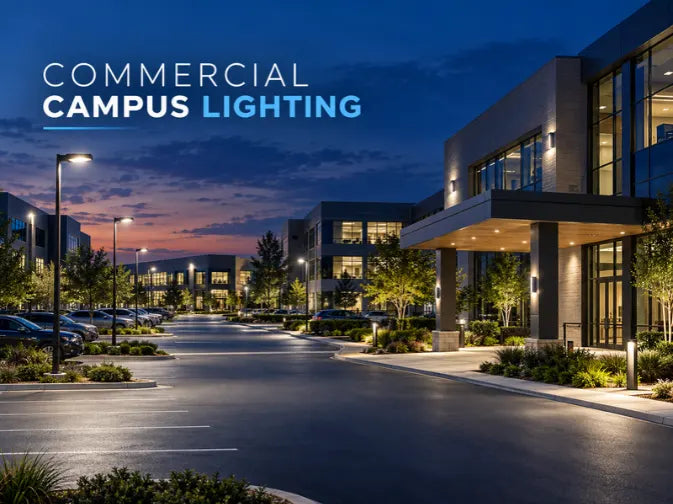
A business park can have five buildings, three parking lots, two access roads, dozens of walkways, covered entrances, loading areas, employee parking and landscaped common spaces.
Trying to light all of that with one type of LED fixture is rarely the best approach.
A commercial campus needs a lighting system, not simply brighter bulbs.
The right design should help people:
- Enter and leave the property safely
- Navigate roads and parking lots
- Walk between buildings
- Identify entrances
- Use loading and service areas
- See around building perimeters
- Support nighttime security and surveillance
At the same time, facility owners need to control:
- Electricity consumption
- Maintenance costs
- Fixture inventory
- Glare
- Dark spots
- Unnecessary overnight lighting
- Future replacement costs
That is where a zone-based Patel LED lighting strategy becomes valuable.
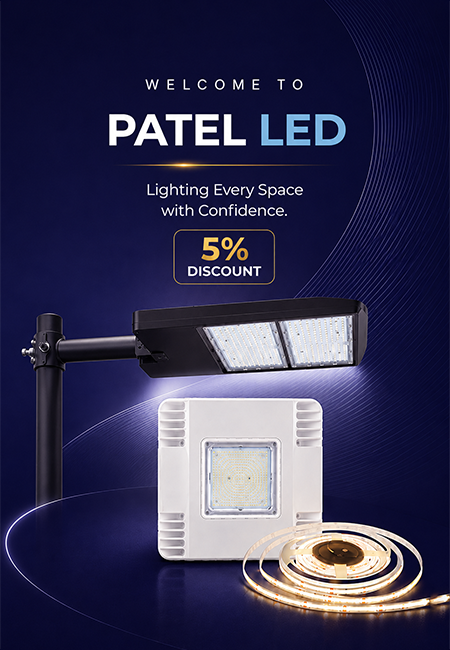
Instead of purchasing unrelated fixtures one at a time, business parks and commercial campuses can build a coordinated system using Patel LED Area Lights, commercial light poles, Wall Packs, Canopy Lights, Flood Lights and other commercial LED fixtures according to the needs of each part of the property.
This guide explains how to plan that system, which Patel LED products to consider, how to reduce unnecessary operating costs and what to check before placing a large commercial lighting order.
What Is the Best LED Lighting for a Business Park or Commercial Campus?
The best commercial campus lighting uses different LED fixture types for different zones.
A practical starting point is:
| Campus zone | Patel LED fixture to evaluate |
|---|---|
| Main parking lots | LED Area Lights |
| Employee parking | LED Area Lights |
| Internal roadways | LED Area Lights |
| Large open areas | LED Area Lights |
| New parking/roadway poles | Commercial Steel Poles |
| Building entrances | LED Wall Packs |
| Building perimeter | LED Wall Packs |
| Rear/service doors | LED Wall Packs |
| Covered drop-off | LED Canopy Lights |
| Parking structures | LED Canopy Lights |
| Covered loading zones | LED Canopy Lights |
| Security-sensitive areas | LED Flood Lights |
| Signage/equipment areas | LED Flood Lights |
| High-output exterior zones | High-output Area Lights |
Patel LED’s current outdoor range specifically positions LED Area Lights for parking lots, campuses, roadways, commercial yards and other large exterior areas. Wall Packs are intended for entrances, walkways and building perimeters, while Flood Lights provide more focused directional illumination.
The key buying principle: choose the Patel LED fixture by zone - not simply by wattage.

Why Business Parks Need a Different Lighting Strategy
A standalone retail property may have:
- One building
- One parking lot
- A few entrances
A business park or commercial campus can contain much more.
For example:
Building A: Corporate office
Building B: Warehouse
Building C: Research facility
Building D: Distribution space
Building E: Retail or customer-facing operation
All may share:
- Parking
- Roads
- Walkways
- Security
- Outdoor storage
- Loading areas
That creates a more complex lighting environment.
If every area uses the same fixture and wattage, the result may be:
- Overlighting in low-activity areas
- Insufficient lighting in busy areas
- Higher electricity use
- Excessive glare
- Difficult maintenance
- Multiple dark zones
The better approach is:
Campus → Zones → Requirements → Fixture Type → Output → Controls → Verification
1. Start With a Campus Lighting Map
Before choosing products, divide the property into zones.
A typical business park might look like:
Zone 1 - Main Entrance
Needs:
- Clear visibility
- Building identification
- Pedestrian visibility
Zone 2 - Main Parking Lot
Needs:
- Wide coverage
- Good uniformity
- Controlled glare
Zone 3 - Internal Roadway
Needs:
- Vehicle navigation
- Intersection visibility
- Controlled distribution
Zone 4 - Employee Parking
Needs:
- Useful nighttime illumination
- Efficient overnight operation
Zone 5 - Building Perimeter
Needs:
- Door visibility
- Security support
- Vertical illumination
Zone 6 - Walkways
Needs:
- Pedestrian visibility
- Smooth transitions between areas
Zone 7 - Loading/Service Area
Needs:
- Vehicle and worker visibility
- Door/perimeter illumination
Zone 8 - Covered Entrance
Needs:
- Lower-mounted overhead lighting
- Reduced glare
Zone 9 - Security Zone
Needs:
- Targeted illumination
Once those zones are defined, Patel LED product selection becomes much easier.
2. Use Patel LED Area Lights for Campus Parking Lots
Parking lots usually represent one of the largest illuminated areas on a business campus.
They require:
- Wide coverage
- Consistent illumination
- Appropriate pole spacing
- Controlled glare
- Outdoor durability
This is where Patel LED LED Area Lights become the primary product category.
Patel LED currently offers a selectable shoebox Area Light with:
- 200W / 240W / 300W selectable wattage
- Up to 45,000 lumens
- 3000K / 4000K / 5000K selectable CCT
- IP65 construction
- Universal mounting
- Shorting-cap and photocell-cap configurations
- UL/DLC listing shown on the current product page
Why selectable wattage matters on a campus
A campus may not need 300W at every pole.
For example:
Main visitor parking
240W or 300W may be evaluated.
Employee parking
200W or 240W may be sufficient depending on layout.
Perimeter parking
Lower output may be possible.
Large central areas
Higher output may be appropriate.
Instead of buying several unrelated fixture families, a project may be able to standardize around a selectable Patel LED fixture and configure output according to location.
That can simplify:
- Purchasing
- Installation
- Spare inventory
- Future maintenance
Compare Patel LED Selectable Area Lights
3. Use Area Lights for Internal Campus Roadways
Business parks frequently contain private internal roads connecting:
- Buildings
- Parking areas
- Loading zones
- Entrances
- Exit points
Patel LED Area Lights are also intended for roadways and campuses, making them relevant beyond parking spaces alone.
Roadway lighting should consider:
- Pole placement
- Intersections
- Curves
- Pedestrian crossings
- Building entrances
- Glare toward drivers
Do not automatically use the same wattage and distribution as the adjacent parking lot.
A roadway may require a different lighting pattern even when the same general Patel LED fixture family is used.
4. Consider Patel LED 20 ft and 25 ft Poles for New Campus Projects
New business parks or campus expansions may require more than fixtures.
They may require new poles.
Patel LED offers commercial steel light-pole options that can be considered for new outdoor area-light installations.
For many commercial projects:
20 ft poles
Can be useful for:
- Smaller parking areas
- Office parking
- Visitor lots
- Medium-sized campus areas
25 ft poles
Can be useful for:
- Larger parking fields
- Industrial campuses
- Wider open areas
The final height should be determined using:
- Fixture photometrics
- Pole spacing
- Site geometry
- Structural requirements
- Local requirements
- Maintenance access
Cross-sell opportunity
For a new parking lot, buyers may need:
Patel LED Area Light + Patel LED Steel Pole + appropriate mounting hardware
rather than only the LED fixture.
5. Use Wall Packs Around Every Building Strategically
Pole-mounted Area Lights can illuminate large horizontal areas.
But they do not necessarily provide ideal vertical illumination around:
- Doors
- Building corners
- Rear entrances
- Service entrances
- Loading doors
That is where Patel LED Wall Packs can complement the campus lighting system.
Patel LED currently positions Wall Packs for building perimeters, entrances, walkways, loading zones and back doors.
One current Patel LED model provides:
- 120W
- 15,600 lumens
- 5700K
- 100–277V
- Optional photocell
- IP65 construction
- DLC listing shown on the product page
Where Wall Packs make sense
Use them around:
- Main entrances
- Employee doors
- Emergency exits
- Rear service doors
- Building corners
- Loading areas
But coordinate them with nearby Area Lights.
Otherwise, you can create:
Very bright building → dark transition zone → bright parking lot
The objective should be a smooth lighting transition.
6. Use Canopy Lights for Covered Campus Areas
Business parks often have:
- Covered drop-offs
- Porte-cochères
- Parking structures
- Covered walkways
- Loading canopies
- Building overhangs
These should not automatically use the same fixtures as an open parking lot.
Patel LED offers dedicated LED Canopy Lights for covered commercial environments.
A current selectable Patel LED Canopy Light provides:
- 40W / 60W / 80W
- 5,200–10,400 lumens
- 3500K / 4000K / 5000K
- 0–10V dimming
- IP65 construction
- UL/cUL/DLC listings shown on the current product page
The selectable wattage can be particularly useful across a campus.
For example:
Main covered entrance
80W may be evaluated.
Smaller covered walkway
40W or 60W may be enough.
Parking structure
Output can be selected based on mounting and layout.
One product family can therefore support several covered campus applications.
7. Use Flood Lights for Targeted Security, Not the Entire Campus
Flood lights are valuable.
But they should be used for the right purpose.
Patel LED Flood Lights are better suited for directional applications such as:
- Security zones
- Building corners
- Equipment areas
- Signs
- Outdoor work areas
- Specific entrances
Patel LED distinguishes Flood Lights from Area Lights in its current outdoor guidance: Area Lights are designed for broad spaces such as campuses and parking lots, while Flood Lights provide focused illumination.
Avoid this mistake
Do not install a collection of randomly aimed Flood Lights and expect them to perform like a properly designed campus Area Light system.
That often creates:
- Bright hotspots
- Dark gaps
- Glare
- Light trespass
- Poor uniformity
Use:
Area Lights for broad coverage
and
Flood Lights for targeted coverage.
8. Coordinate the Entire Campus Instead of Lighting Each Building Separately
Imagine a campus containing four buildings.
Each building manager independently buys exterior lights.
Building A uses 3000K.
Building B uses 5000K.
Building C installs extremely bright Wall Packs.
Building D uses Flood Lights pointed into the parking lot.
The shared parking lot uses another fixture type.
The result can look inconsistent and perform poorly.
A campus-wide lighting plan should standardize where practical:
- Fixture families
- CCT
- Controls
- Mounting
- Wattage ranges
- Replacement inventory
This is another reason Patel LED selectable fixtures can be commercially useful.
9. Standardize Fixtures to Reduce Maintenance Complexity
Large campuses may contain dozens - or hundreds - of outdoor fixtures.
Every additional fixture family creates another:
- SKU
- Replacement part
- Mounting method
- Driver specification
- Wattage
- CCT
Suppose a campus uses 10 different outdoor fixture families.
Maintenance teams may need to identify exactly which replacement belongs at each location.
Now imagine the campus standardizes around:
Parking and roadways
Patel LED selectable Area Light
Buildings
Patel LED Wall Pack family
Covered areas
Patel LED selectable Canopy Light
Targeted security
Patel LED Flood Lights
This reduces the number of fixture types the facility team needs to understand and stock.
10. Choose Lumens Before You Choose Watts
A common purchasing mistake is saying:
“We need 300W parking lot lights.”
Why 300W?
The buyer may simply be replacing an older high-wattage fixture.
But wattage is energy consumption.
It does not directly tell you how effectively the property will be illuminated.
Compare:
- Lumens
- Efficacy
- Distribution
- Pole height
- Spacing
- Required light levels
DOE’s current federal exterior-lighting purchasing guidance evaluates outdoor fixtures using luminaire efficacy, or lumens produced per watt. It also notes that higher efficacy means more light output for each unit of electrical power. These FEMP thresholds apply to covered federal purchasing rather than every private commercial project, but the metric is useful for comparing products.
11. Look at Lumens per Watt
Patel LED currently offers a 300W/240W/200W parking-lot fixture rated at:
Up to 45,000 lumens
and
150 lm/W at its stated configuration.
Why does efficacy matter?
Suppose:
Fixture A
300W
30,000 lumens = 100 lm/W
Fixture B
300W
45,000 lumens = 150 lm/W
Both consume 300 watts.
But Fixture B produces substantially more rated light output.
Commercial buyers should therefore compare performance per watt, not simply the wattage printed on the box.
12. Do Not Use Maximum Wattage Everywhere
This can become especially expensive on a large campus.
Imagine:
50 Area Lights
All configured at 300W.
Connected load:
50 × 300W = 15 kW
Now suppose photometric design shows that:
- 20 fixtures can operate at 200W
- 20 fixtures need 240W
- 10 fixtures need 300W
Connected load becomes:
20 × 200 = 4,000W
20 × 240 = 4,800W
10 × 300 = 3,000W
Total:
11.8 kW
Difference:
3.2 kW
Assume 12 hours per night:
3.2 × 4,380 annual hours = 14,016 kWh
At a modeled $0.15/kWh:
= $2,102.40 per year
Over five years:
= $10,512
That is only a modeled electricity example.
It excludes:
- Rate changes
- Maintenance
- Controls
- Rebates
- Installation
But it demonstrates why selectable wattage matters more as project size grows.
13. Use Photocells to Prevent Daytime Operation
One unnecessary hour matters more when multiplied across a campus.
Suppose:
50 fixtures
Average 240W
They accidentally operate for two unnecessary daylight hours each day.
Annual wasted energy:
50 × 0.24 kW × 2 × 365 = 8,760 kWh
At $0.15/kWh:
= $1,314 annually
Patel LED’s current 200W/240W/300W Area Light offers photocell-cap configurations, while another current 45,000-lumen parking-lot model includes a dusk-to-dawn photocell.
For a large business park, automatic exterior lighting control can therefore become an important operating-cost feature.
14. Consider Dimming During Low-Activity Hours
Does every section of a business park need maximum output at 3:00 AM?
Possibly not.
A campus might have:
6 PM–10 PM
High employee and visitor activity.
10 PM–1 AM
Reduced activity.
1 AM–5 AM
Minimal activity.
Where permitted by applicable requirements and appropriate for security and operations, compatible lighting controls can reduce output during low-use periods.
DOE exterior-lighting guidance specifically identifies strategies such as:
- Scheduling
- Light sensors
- Occupancy-based control
- Reduced general lighting when full output is unnecessary.
Patel LED’s current 45,000-lumen parking-lot fixture is listed with 0–10V dimming compatibility, providing a potential path for compatible control strategies.
15. Divide the Campus Into Control Zones
A large campus should not necessarily operate as one giant lighting circuit.
Consider separate control zones for:
- Main entrance
- Visitor parking
- Employee parking
- Rear parking
- Roadways
- Loading area
- Walkways
- Building perimeter
This lets the facility adjust lighting according to actual use.
DOE has highlighted a real commercial research-campus project at Spring House Innovation Park that used exterior LED lighting across parking lots, walking paths and courtyard space with wireless advanced controls providing detailed scheduling over 35 zones and occupancy-based dimming.
That does not mean every campus needs 35 zones.
It shows why large commercial properties can benefit from zoned control instead of all-or-nothing operation.
16. Plan Pole Height Before Ordering Area Lights
Pole height affects:
- Coverage
- Fixture output
- Glare
- Spacing
- Fixture quantity
Common commercial mounting heights may include:
- 15 ft
- 20 ft
- 25 ft
- 30 ft+
For many business parks, 20–25 feet is a useful range to evaluate for parking areas, while larger open zones may use taller systems when the photometric and structural design supports them.
Patel LED’s current guidance identifies 20-foot poles as versatile for many commercial parking applications and 25-foot poles as useful for larger lots and industrial properties.
Do not finalize wattage until mounting height is known.
17. Design for Uniformity, Not Just Brightness
A campus can be bright and still be poorly illuminated.
Consider:
Campus A
Average: 3 fc
Minimum: 2 fc
Maximum: 4 fc
Campus B
Average: 3 fc
Minimum: 0.3 fc
Maximum: 8 fc
Both average 3 foot-candles.
But Campus B contains severe dark and bright zones.
That can create:
- Difficult visual transitions
- Uncomfortable glare
- Dark areas between buildings
- Poor pedestrian experience
A good commercial lighting plan should consider both:
Illumination + uniformity
rather than chasing the highest possible lumen output.
18. Coordinate Parking Lots With Building Entrances
This is a common campus-design problem.
The parking lot is illuminated by pole-mounted Area Lights.
The building has bright Wall Packs.
But the walkway between them is relatively dark.
That creates an uncomfortable transition.
A better design coordinates:
Parking
Area Lights
Walkway approach
Area-light spill or appropriate walkway lighting
Building exterior
Wall Packs
Covered entrance
Canopy Lights where appropriate
The objective is continuous visibility from:
Vehicle → Walkway → Entrance → Building
19. Think About Vertical Illumination
Parking-lot measurements often focus on the horizontal ground plane.
But people need to see:
- Faces
- Doors
- Signs
- Building numbers
- Vehicles
- Loading entrances
This makes Wall Packs and carefully aimed Flood Lights useful complements to pole-mounted Area Lights.
Do not rely entirely on high-mounted pole fixtures to solve every exterior visibility requirement.
20. Coordinate Lighting With Security Cameras
Security cameras do not necessarily benefit from maximum brightness.
They benefit from usable, consistent illumination.
Poor lighting can create:
- Overexposed faces
- Dark backgrounds
- Headlight contrast
- Deep shadows
- Bright hotspots
Review camera locations when selecting:
- Area Lights
- Wall Packs
- Flood Lights
A targeted Patel LED Flood Light may sometimes be more useful for a specific camera zone than increasing the wattage of every parking-lot fixture.
21. Use the Right CCT Across the Campus
A campus looks more intentional when its outdoor lighting has a consistent color appearance.
Common options include:
3000K
Warmer appearance.
Useful where a softer architectural environment is desired.
4000K
Neutral white.
Useful across many office and commercial properties.
5000K
Cooler daylight appearance.
Often selected for parking, industrial and security-oriented environments.
Patel LED’s current selectable Area Light provides 3000K, 4000K and 5000K within one fixture.
That can help a contractor standardize the fixture family while selecting an appropriate CCT for the project.
22. Verify Outdoor Environmental Protection
Campus fixtures may be exposed to:
- Rain
- Dust
- Snow
- Humidity
- Temperature changes
Multiple current Patel LED outdoor products, including its selectable Area Lights and parking-lot fixtures, are listed as IP65.
IP ratings describe environmental ingress protection.
They do not by themselves establish that a complete lighting installation meets all local codes or project requirements.
23. Confirm Voltage Before a Bulk Order
This becomes critical when one campus contains multiple buildings.
Some circuits may use:
- 120V
- 208V
- 240V
- 277V
while larger commercial or industrial campuses may have:
- 480V systems
Patel LED’s Area Light collection currently includes:
- 100–277V products
- 120–277V products
- A selectable 200W/240W/300W model for 277–480V applications.
Procurement warning
Do not assume every building or parking field on a campus uses the same voltage.
Confirm before ordering quantities.
24. Check Mounting Compatibility
Existing campuses may have different:
- Pole tops
- Arms
- Tenons
- Brackets
Patel LED currently offers Area Light configurations including universal mounting and slip-fitter models. One current slip-fitter version provides selectable 200W/240W/300W output and up to 45,000 lumens.
Before ordering, document:
- Existing pole type
- Pole diameter
- Tenon
- Arm
- Fixture orientation
- Number of fixtures per pole
This helps avoid installation-day surprises.
25. Consider DLC Qualification for Commercial Projects
Large campus projects can involve significant fixture quantities.
Utility incentives may therefore materially affect project economics.
Some U.S. efficiency programs use DLC qualification as part of product eligibility.
However:
DLC qualification does not automatically guarantee a rebate.
Before purchasing:
- Check the utility
- Check the current program
- Verify the exact Patel LED model
- Determine whether preapproval is required
- Confirm installation deadlines
Do this before ordering rather than after the fixtures arrive.
26. Calculate Campus Lighting Energy Cost
A simple formula is:
Fixture Quantity × Watts ÷ 1,000 × Annual Operating Hours × Electricity Rate
Consider a campus with:
60 existing exterior fixtures.
Assume:
400W actual input per fixture
12 hours per night
365 days/year
$0.15/kWh
Annual hours:
12 × 365 = 4,380 hours
Connected load:
60 × 400W = 24 kW
Annual energy:
24 × 4,380 = 105,120 kWh
Annual electricity cost:
105,120 × $0.15 = $15,768
27. Modeled LED Campus Retrofit
Now assume the redesigned Patel LED system averages 220W per pole-mounted fixture.
60 × 220W = 13.2 kW
Annual energy:
13.2 × 4,380 = 57,816 kWh
Annual electricity cost:
57,816 × $0.15 = $8,672.40
Modeled annual electricity difference
$15,768 − $8,672.40 = $7,095.60
Modeled five-year difference
= $35,478
This is an illustrative energy model only.
It excludes:
- Installation
- Controls
- Maintenance
- Rebates
- Demand charges
- Electricity-rate changes
- Different fixture quantities
But it shows why commercial campus lighting should be evaluated as a lifecycle operating-cost decision, not only a fixture purchase.
28. Add Controls and the Economics Can Change Again
Suppose controls reduce the equivalent full-output runtime of the LED system from:
12 hours
to:
9.5 equivalent hours per night.
Annual hours:
9.5 × 365 = 3,467.5
Energy:
13.2 kW × 3,467.5 = 45,771 kWh
Modeled annual electricity cost:
45,771 × $0.15 = $6,865.65
Compared with the original modeled system:
$15,768 − $6,865.65 = $8,902.35 annual difference
Again, this is only an illustrative scenario.
Actual control savings depend on:
- Operating schedule
- Occupancy
- Required security lighting
- Control strategy
- Local requirements
DOE notes that advanced exterior controls can produce additional energy and operating-cost savings beyond fixture-efficiency improvements alone.
29. Do Not Forget Maintenance Costs
Campus lighting maintenance can become expensive.
A failed pole fixture may require:
- Bucket truck
- Technician
- Electrician
- Traffic control
- Parking-space closure
A business park with many older HID fixtures may also have recurring:
- Lamp replacement
- Ballast replacement
- Service calls
When evaluating a Patel LED retrofit, compare:
Electricity + Maintenance + Controls + Incentives
rather than electricity alone.
30. Retrofit the Campus at Once or in Phases?
Both approaches can make sense.
Full campus retrofit
Advantages:
- Consistent appearance
- Standardized products
- Faster energy reduction
- Simplified maintenance
- Easier control strategy
Phased retrofit
Advantages:
- Lower immediate capital requirement
- Ability to prioritize worst areas
- Easier budget allocation
A practical phased approach could be:
Phase 1
Parking lots and roads
Phase 2
Building perimeters
Phase 3
Covered entrances and loading zones
Phase 4
Targeted security areas
Using Patel LED product families across phases can help maintain consistency.
31. Prioritize the Highest-Cost Zones First
If the budget is limited, identify:
- Highest wattage
- Longest runtime
- Most fixtures
- Highest maintenance cost
- Worst lighting performance
Large parking areas often rise to the top because they may combine:
- High fixture count
- High wattage
- Long nightly runtime
That makes Patel LED Area Lights a logical starting point for many campus retrofits.
32. Run a Photometric Plan Before Ordering Dozens of Fixtures
This becomes increasingly important with a campus-scale project.
A photometric plan can predict:
- Average illumination
- Minimum illumination
- Maximum illumination
- Uniformity
- Dark spots
- Fixture overlap
- Property-line spill
It can also help determine whether each position needs:
- 200W
- 240W
- 300W
- A different fixture or distribution
The goal is to avoid paying for wattage that the site does not need.
Patel LED Commercial Campus Product Matrix
| Campus application | Patel LED product | Why consider it |
|---|---|---|
| Main parking | Selectable Area Light | Broad coverage |
| Employee parking | Selectable Area Light | Adjustable output |
| Internal road | Area Light | Roadway coverage |
| Large open area | High-output Area Light | Greater lumen demand |
| New pole installation | Steel Light Pole | New campus infrastructure |
| Building perimeter | Wall Pack | Vertical/perimeter light |
| Exterior door | Wall Pack | Entrance visibility |
| Loading entrance | Wall Pack | Door/perimeter coverage |
| Covered entrance | Canopy Light | Overhead covered lighting |
| Covered loading area | Canopy Light | Lower mounting |
| Security corner | Flood Light | Directional output |
| Equipment yard | Flood/Area Light | Depends on coverage need |
Example: Lighting a Five-Building Business Park
Imagine a property containing:
- 5 commercial buildings
- 3 parking areas
- 2 internal roads
- 4 covered entrances
- 10 rear service doors
- 2 security-sensitive equipment areas
A Patel LED lighting plan might include:
Parking Areas
Selectable Patel LED Area Lights
Internal Roads
Patel LED Area Lights
New Pole Locations
Patel LED commercial steel poles where appropriate
Building Perimeters
Patel LED Wall Packs
Covered Entrances
Patel LED Canopy Lights
Security Areas
Patel LED Flood Lights
Instead of purchasing five unrelated lighting systems for five buildings, the owner creates one campus-wide fixture strategy.
That can make future purchasing much easier.
Business Park Lighting Checklist
Before placing a Patel LED commercial order, document:
Campus
- Number of buildings
- Total parking area
- Internal roadways
- Walkways
- Loading zones
- Covered areas
- Security zones
Existing Fixtures
- Fixture quantity
- Fixture type
- Wattage
- Lumens if known
- CCT
- Voltage
- Age
- Condition
Poles
- Pole count
- Pole height
- Pole spacing
- Pole condition
- Mount type
Controls
- Photocell
- Timer
- 0–10V dimming
- Occupancy control
- Scheduling
Performance
- Foot-candle readings
- Dark spots
- Glare
- Uniformity
- Camera visibility
- Property-line spill
Purchasing
- Exact Patel LED SKU
- Quantity
- Wattage setting
- CCT
- Voltage
- Mount
- Certification
- DLC verification where required
- Photometric review
- Bulk-order pricing

15 Business Park Lighting Mistakes to Avoid
1. Treating each building as a completely separate lighting project
Plan the campus as one system.
2. Using the same wattage everywhere
Different zones have different requirements.
3. Choosing watts instead of useful light output
Compare lumens, optics and efficacy.
4. Using Flood Lights for all parking areas
Use Area Lights for broad coverage.
5. Ignoring Wall Packs
Building entrances need appropriate vertical illumination.
6. Using Area Lights under low canopies
Use dedicated Canopy Lights.
7. Ignoring pole height
It directly affects distribution and spacing.
8. Operating every fixture at full output all night
Evaluate controls where appropriate.
9. Leaving lights on during daylight
Consider photocell control.
10. Mixing several CCTs randomly
Create a campus-wide standard.
11. Ignoring mounting compatibility
Check poles and brackets first.
12. Assuming every circuit uses the same voltage
Verify building by building.
13. Ignoring maintenance access
Campus fixtures eventually need servicing.
14. Ordering large quantities before checking photometrics
Verify the layout first.
15. Buying only on unit price
Compare lifecycle cost and system performance.
Why Patel LED Makes Sense for Business Parks and Commercial Campuses
A large property rarely needs just one light.
That is why a broad commercial product ecosystem matters.
Patel LED currently carries products across the categories needed for multi-zone properties, including:
- LED Area Lights
- Parking Lot Lights
- Wall Packs
- Flood Lights
- Canopy Lights
- Commercial light poles
- Indoor commercial fixtures for other building applications.
Current Patel LED Area Light options include features such as:
- Selectable 200W / 240W / 300W output
- Up to 45,000 lumens
- Selectable CCT on applicable models
- Photocell configurations
- 0–10V dimming on applicable models
- IP65 construction
- Multiple mounting configurations
- 100–277V options
- 277–480V options
- UL, ETL and/or DLC listings depending on the exact model.
For campus buyers, that flexibility can reduce the need to source unrelated fixtures from multiple suppliers.
People Also Ask
A business park usually needs a combination of LED Area Lights for parking and roadways, Wall Packs for building perimeters, Canopy Lights for covered areas and Flood Lights for targeted security zones.
Pole-mounted LED Area Lights are generally the primary fixture category. Patel LED currently offers selectable 200W/240W/300W Area Lights with up to 45,000 lumens.
There is no universal wattage. Output depends on pole height, spacing, distribution, required illumination and property geometry. Selectable-wattage fixtures can provide more flexibility.
They may be appropriate for some high-output locations, but not every pole needs 300W. Patel LED's selectable models allow 200W, 240W or 300W operation on applicable fixtures.
Approximately 20–25 feet is a useful range to evaluate for many commercial parking areas, while larger properties may use higher mounting where photometric and structural design supports it.
Yes. Patel LED positions Area Lights for roadways, campuses, parking lots and other large outdoor commercial areas.
Wall Packs can be useful around entrances, rear doors, loading areas and building perimeters, but quantity and output should be determined by the site design.
Dedicated LED Canopy Lights are generally better suited to covered overhead applications than high-output pole-mounted Area Lights.
Automatic dusk-to-dawn control can prevent unnecessary daylight operation. Several Patel LED outdoor fixtures include or support photocell configurations.
Where allowed and appropriate, compatible controls can reduce lighting output during lower-activity periods. DOE identifies scheduling, occupancy sensing and reduced-output strategies as potential exterior-lighting control approaches.
They can reduce operating costs when the redesigned system achieves required illumination using less energy and/or more effective controls than the existing system. Actual savings vary by project.
Use:
Number of Fixtures × Wattage ÷ 1,000 × Annual Operating Hours × Electricity Rate
For multi-pole or large-property projects, photometric planning is strongly recommended before ordering commercial quantities.
3000K, 4000K and 5000K are all used in commercial exterior lighting. The choice depends on site requirements, visual goals, surrounding properties and local rules.
Area Lights provide broad distribution for parking lots, roads and large spaces. Flood Lights provide more directional illumination for specific areas. Patel LED sells both categories.
Wall Packs can provide building-mounted perimeter illumination, while Canopy Lights can be used where entrances have covered overhead structures.
Patel LED currently lists a selectable 200W/240W/300W Area Light for 277–480V applications.
Yes. Patel LED offers commercial pole products that can be paired with appropriate Area Lights for new outdoor installations.
No. Utility incentive requirements vary. Verify the exact model, utility program and current eligibility requirements before purchasing.
Patel LED offers multiple fixture categories needed across a commercial campus - including Area Lights, Wall Packs, Flood Lights, Canopy Lights and related commercial lighting products - allowing buyers to build a more coordinated multi-zone lighting system.
Do Not Buy Lights Building by Building-Build a Campus Lighting System
A business park is not simply five buildings standing next to each other.
It is one connected environment.
Employees move from:
Road → Parking Lot → Walkway → Entrance → Building
Delivery drivers move from:
Campus Entrance → Internal Road → Loading Area → Service Door
Security teams monitor:
Parking → Perimeter → Entrance → Equipment Area
The lighting should support those journeys continuously.
For many commercial campuses, that means combining:
Large outdoor areas
Patel LED Area Lights
New parking or roadway installations
Patel LED Commercial Light Poles
Building perimeters
Patel LED Wall Packs
Covered entrances
Patel LED Canopy Lights
Targeted security areas
Patel LED Flood Lights
The commercial advantage is not simply buying LED fixtures.
It is creating a standardized Patel LED lighting system that can potentially reduce energy consumption, simplify maintenance and make future expansion easier.
Planning lighting for a business park or multi-building commercial campus? Build the complete fixture list before you place the order.
Prepare:
- Number of buildings
- Parking-lot dimensions
- Existing fixture quantity
- Existing wattage
- Pole height
- Pole spacing
- Voltage
- Covered areas
- Loading areas
- Operating hours
- Required controls
- Project quantity
Then match each zone to the appropriate Patel LED product.
Build Your Patel LED Campus Lighting Plan
Disclaimer
Commercial campus lighting requirements vary by site, activity, mounting height, photometrics, electrical system, jurisdiction, adopted energy code, local zoning, structural conditions and security requirements. Product-selection examples and energy calculations in this guide are for commercial planning purposes and do not replace professional photometric design, structural engineering, electrical review, code verification or qualified installation.