LED Lighting vs Rising Electricity Costs: How Businesses Can Reduce Monthly Energy Bills
Table of Contents
- What You Need to Know
- Why Rising Electricity Costs Hurt Businesses More Than Homeowners
- Why Commercial Lighting Is a Major Expense
- How Rising Electricity Costs Turn Old Lighting into a Bigger Problem
- Warning Signs Your Lighting Is Increasing Your Utility Bills
- LED Lighting vs Fluorescent Lighting
- LED Lighting vs Metal Halide Lighting
- How Much Is Rising Electricity Really Costing Your Business?
- Commercial Lighting Cost Calculator
- Why LED Lighting Helps Fight Rising Electricity Costs
- Smart Controls Increase Savings Further
- Five-Year Cost Comparison
- Mistakes Businesses Make When Trying to Reduce Energy Costs
- How to Choose Commercial LED Fixtures
- What Makes Commercial LED Fixtures Different?
- Is Your Facility Ready to Reduce Electricity Costs?
- How Patel LED Helps Businesses Reduce Electricity Costs
- FAQs
- Key Takeaways
Many business owners blame rising electricity rates for higher operating costs.
But in many commercial buildings, outdated lighting is quietly multiplying those costs every single month.
If your warehouse, office, retail store, school, hospital, restaurant, hotel, or manufacturing facility still uses fluorescent, HID, or metal halide lighting, your business may be paying more than necessary - not just for electricity, but also for maintenance, heat, downtime, safety risks, and reduced productivity.
Rising utility costs are not something most businesses can control.
But lighting efficiency is.
This guide explains how rising electricity costs affect commercial facilities and why upgrading to LED lighting can be one of the fastest ways to reduce long-term operating expenses.
What You Need to Know
Rising electricity costs make outdated commercial lighting more expensive every month. Businesses using fluorescent, HID, or metal halide fixtures often pay more in energy, maintenance, cooling, and downtime. Commercial LED lighting helps reduce wattage, improve efficiency, lower maintenance, and create measurable long-term savings.
Quick Summary
- Electricity costs are rising across many U.S. markets.
- Commercial buildings feel the impact faster because lights run many hours daily.
- Outdated lighting wastes energy and adds maintenance costs.
- LED lighting can reduce lighting energy use by 50–70%.
- Patel LED helps U.S. businesses upgrade to efficient commercial LED lighting solutions.
Expert Recommendation
If your facility operates lights for 8–24 hours per day, review your lighting system immediately. Older fixtures may be one of the easiest places to reduce monthly electricity costs without changing your business operations.
Why Rising Electricity Costs Hurt Businesses More Than Homeowners
A homeowner may run lights for a few evening hours.
A commercial facility may run lighting:
- 10 hours per day
- 12 hours per day
- 16 hours per day
- 24 hours per day
- 365 days per year
That difference matters.
When electricity rates increase, commercial buildings feel the impact quickly because they consume energy at scale.
A small increase in cost per kilowatt-hour may seem minor on paper, but across hundreds of fixtures and thousands of operating hours, it can turn into thousands of dollars annually.

Why Commercial Lighting Is a Major Expense
Lighting is one of the most controllable energy expenses in a commercial building.
Many businesses cannot easily reduce:
- Refrigeration needs
- Production equipment usage
- HVAC requirements
- Medical equipment use
- Business operating hours
But they can reduce the cost of lighting by upgrading inefficient systems.
Commercial lighting affects:
- Warehouses
- Manufacturing facilities
- Retail stores
- Hospitals
- Offices
- Schools
- Hotels
- Restaurants
- Auto dealerships
- Distribution centers
- Parking lots
- Outdoor campuses
If your lights are outdated, your business may be paying more every hour they remain on.
How Rising Electricity Costs Turn Old Lighting into a Bigger Problem
Outdated lighting was already expensive.
Rising electricity costs make it worse.
Older fixtures usually consume more watts to produce less useful light. As utility rates rise, inefficient fixtures become more expensive to operate.
Example
A 400W metal halide fixture may be replaced by a 150W LED fixture.
That saves 250W per fixture.
If a facility has 100 fixtures, that is 25,000W saved every hour.
Over months and years, the savings become significant.
Warning Signs Your Lighting Is Increasing Your Utility Bills
Your lighting may be costing too much if:
- Your facility still uses fluorescent tubes
- You still use metal halide or HID fixtures
- Lights run more than 8 hours daily
- Parking lot lights stay on all night
- Maintenance teams replace bulbs often
- Utility bills are rising every year
- Fixtures feel hot
- Lights flicker or buzz
- Areas still look dim despite high wattage
- You have no motion sensors or dimming controls
If several of these apply, your facility is likely paying more than necessary.
LED Lighting vs Fluorescent Lighting
| Feature | Fluorescent Lighting | LED Lighting |
|---|---|---|
| Energy use | Higher | Lower |
| Lifespan | Shorter | Longer |
| Maintenance | Frequent | Lower |
| Flickering | Common | Minimal with quality fixtures |
| Heat output | Higher | Lower |
| Efficiency | Moderate | High |
| Best upgrade option | Retrofit or replacement | Commercial LED fixtures |
Fluorescent lighting is common in offices, schools, hospitals, and retail stores. However, older fluorescent systems often require tube replacements, ballast repairs, and higher electricity usage.
LED Panel Lights and LED Retrofit Lighting can help reduce these recurring costs.
LED Lighting vs Metal Halide Lighting
| Feature | Metal Halide | LED |
|---|---|---|
| Startup time | Slow | Instant |
| Energy use | High | Lower |
| Brightness over time | Declines quickly | More consistent |
| Maintenance | High | Low |
| Heat output | High | Lower |
| Best replacement | LED High Bay or Area Light | Efficient commercial LED |
Metal halide fixtures are common in:
- Warehouses
- Parking lots
- Gyms
- Industrial facilities
- Auto dealerships
- Outdoor campuses
Replacing them with LED High Bay Lights, LED Area Lights, or LED Flood Lights can create major energy savings.
How Much Is Rising Electricity Really Costing Your Business?
Use this simple formula:
Lighting Cost Formula
Fixture wattage × number of fixtures ÷ 1,000 × operating hours × electricity rate
Example:
100 fixtures × 400W = 40,000W
40,000W ÷ 1,000 = 40 kW
40 kW × 12 hours/day = 480 kWh/day
480 kWh × 365 days = 175,200 kWh/year
175,200 × $0.15 = $26,280 annual lighting cost
Now compare LED:
100 fixtures × 150W = 15,000W
15 kW × 12 hours/day = 180 kWh/day
180 × 365 = 65,700 kWh/year
65,700 × $0.15 = $9,855 annual lighting cost
Estimated Annual Savings
$26,280 - $9,855 = $16,425
That is before maintenance savings.
Commercial Lighting Cost Calculator
Use this simple checklist:
| Question | Your Answer |
|---|---|
| How many fixtures do you have? | |
| What is the current wattage? | |
| How many hours do lights run daily? | |
| What is your electricity rate? | |
| How often do you replace bulbs? | |
| Do you pay for lift rental or labor? | |
| Are outdoor lights running overnight? | |
| Do you use sensors or dimmers? |
If you cannot answer these questions, your facility may need a lighting audit.
Hidden Cost #1: Higher Monthly Utility Bills
The most obvious cost is electricity.
But many businesses underestimate how quickly lighting costs grow.
A 10% increase in electricity rates can significantly affect facilities that operate lights for long hours.
For example:
If your current lighting cost is $30,000 per year, a 10% electricity increase adds $3,000 annually.
If your lighting cost is $100,000 per year, that same increase adds $10,000 annually.
That is why reducing wattage is one of the smartest ways to protect your business from rising utility costs.
Hidden Cost #2: Maintenance Costs
Outdated lighting requires frequent maintenance.
Common expenses include:
- Replacement lamps
- Ballasts
- Labor
- Lift rentals
- Disposal
- Downtime
LED lighting reduces maintenance because commercial LED fixtures last much longer than traditional lighting.
Maintenance Comparison
| Cost Factor | Outdated Lighting | LED Lighting |
|---|---|---|
| Lamp replacement | Frequent | Rare |
| Ballast failure | Common | Not applicable in many LED systems |
| Labor | Higher | Lower |
| Lift rental | More frequent | Less frequent |
| Downtime | Higher | Lower |
Hidden Cost #3: Heat Generation and HVAC Load
Older lights generate more heat.
That heat can make HVAC systems work harder, especially in:
- Retail stores
- Offices
- Schools
- Hospitals
- Restaurants
- Hotels
LED lighting produces less heat, which may help reduce cooling demand in conditioned spaces.
This means LED upgrades can support both lighting savings and HVAC efficiency.
Hidden Cost #4: Employee Productivity
Poor lighting can reduce productivity.
Dim, flickering, or uneven lighting may cause:
- Eye strain
- Headaches
- Slower work
- More mistakes
- Lower concentration
In warehouses, poor lighting can increase picking errors.
In offices, it can reduce focus.
In manufacturing, it can affect inspection accuracy.
Better LED lighting supports clearer visibility and more comfortable working conditions.
Hidden Cost #5: Safety and Liability
Poor visibility increases risk.
Commercial spaces need reliable lighting for:
- Walkways
- Parking lots
- Loading docks
- Warehouse aisles
- Stairways
- Emergency exits
- Outdoor perimeters
Lighting is not only an energy issue.
It is a safety issue.
LED Area Lights, LED Wall Pack Lights, LED Flood Lights, and LED Canopy Lights can improve visibility in outdoor and high-risk areas.
Hidden Cost #6: Customer Experience
Lighting affects how customers perceive your business.
Poor lighting can make a space feel:
- Old
- Unsafe
- Uncomfortable
- Unprofessional
- Low quality
This matters for:
- Retail stores
- Restaurants
- Hotels
- Auto dealerships
- Medical offices
- Schools
- Commercial offices
Modern LED lighting can make facilities look cleaner, brighter, and more trustworthy.
Hidden Cost #7: Brand Image
A business with flickering fluorescent lights or dim parking lots may appear poorly maintained.
That affects:
- Customers
- Tenants
- Employees
- Visitors
- Investors
- Inspectors
Lighting is part of your brand environment.
Upgrading to LED lighting can improve the visual quality of the entire facility.
Real Commercial Example: Warehouse
Problem
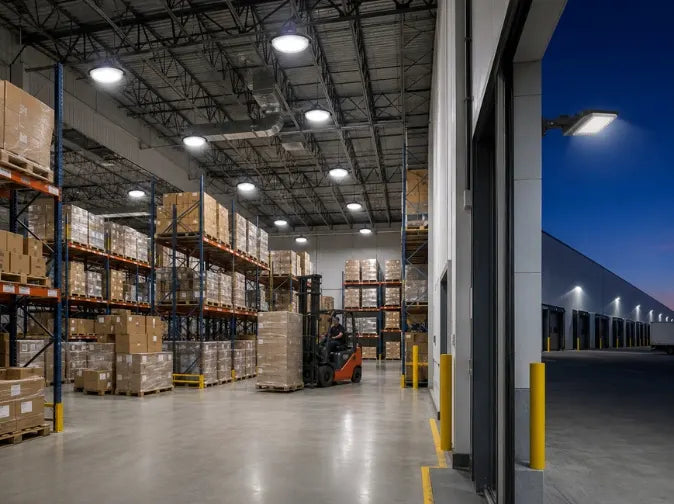
A warehouse uses 150 metal halide fixtures at 400W each for 14 hours daily.
Current Energy Cost
150 × 400W = 60,000W or 60 kW
60 kW × 14 hours = 840 kWh/day
840 × 365 = 306,600 kWh/year
At $0.15/kWh:
Annual cost = $45,990
LED Upgrade
150 LED High Bay Lights at 150W each:
150 × 150W = 22,500W or 22.5 kW
22.5 × 14 = 315 kWh/day
315 × 365 = 114,975 kWh year
Annual cost = $17,246
Annual Savings
$45,990 - $17,246 = $28,744
5-Year Energy Savings
$143,720
This excludes maintenance savings.
Real Commercial Example: Retail Store
Problem
A retail store uses outdated fluorescent lighting that runs 12 hours per day.
Business Impact
- Higher energy bills
- Poor product presentation
- More maintenance
- Less appealing customer environment
Recommended LED Solution
- LED Panel Lights
- LED Strip Lighting
- LED Retrofit Lighting
Retail lighting is not just about cost. It affects how products look and how customers feel.
Real Commercial Example: Office Building
Problem
An office building has old fluorescent troffers.
Business Impact
- Eye strain
- Flickering
- Maintenance calls
- Higher cooling load
- Poor workplace comfort
Recommended LED Solution
- LED Panel Lights
- LED Retrofit Lighting
- Dimmable LED systems
Better office lighting can improve comfort while reducing energy usage.
Real Commercial Example: Hospital or Clinic
Problem
Healthcare facilities often operate lighting 24/7.
Business Impact
- High electricity usage
- Maintenance disruption
- Patient discomfort
- Staff fatigue
Recommended LED Solution
- LED Panel Lights
- LED Area Lights
- LED Wall Pack Lights
- LED Retrofit Lighting
Healthcare lighting must balance efficiency, comfort, and reliability.
Real Commercial Example: School
Problem
A school has fluorescent classroom lighting and outdated hallway fixtures.
Business Impact
- Flicker
- Eye strain
- High maintenance
- Poor learning environment
Recommended LED Solution
- LED Panel Lights
- LED Retrofit Lighting
- Outdoor LED Area Lights
- Schools can reduce operating costs while improving learning spaces.
Real Commercial Example: Restaurant
Problem
A restaurant uses outdated lighting that creates heat and poor ambiance.
Business Impact
- Higher cooling costs
- Poor dining atmosphere
- Weak brand experience
Recommended LED Solution
- LED Strip Lights
- Dimmable LEDs
- LED Panel Lights
- LED Retrofit Lighting
Restaurants benefit from LED lighting because it improves both efficiency and mood.

Why LED Lighting Helps Fight Rising Electricity Costs
LED lighting helps because it uses less power to produce useful light.
Key advantages:
- Lower wattage
- Higher lumens per watt
- Longer lifespan
- Less heat
- Lower maintenance
- Instant-on performance
- Smart control compatibility
Commercial LED lighting does not stop electricity rates from rising.
But it reduces the amount of electricity your facility needs.
That is what creates savings.
Smart Controls Increase Savings Further
LED systems can be paired with:
- Occupancy sensors
- Motion sensors
- Dimmers
- Daylight harvesting
- Photocells
- Timers
- Smart lighting controls
These controls reduce waste by ensuring lights operate only when needed.
Best applications include:
- Warehouses
- Offices
- Schools
- Parking lots
- Restrooms
- Storage rooms
- Hallways
- Outdoor areas
Five-Year Cost Comparison
| Cost Category | Outdated Lighting | LED Lighting |
|---|---|---|
| Annual energy cost | $45,990 | $17,246 |
| 5-year energy cost | $229,950 | $86,230 |
| Maintenance | Higher | Lower |
| Heat impact | Higher | Lower |
| Estimated savings | - | $143,720+ |
The longer the facility operates, the stronger the financial case for LED becomes.
Objection: “LEDs Cost Too Much”
LEDs may cost more upfront than replacing a few lamps, but the total cost of ownership is usually much lower.
Businesses should compare:
- Fixture cost
- Energy savings
- Maintenance savings
- Labor reduction
- Downtime reduction
- Payback period
- 5-year cost
The cheapest option today may become the most expensive option over time.
Objection: “My Lighting Still Works”
Working does not mean efficiency.
An old fixture can still turn on while wasting electricity every hour.
If your lighting uses more power than necessary, it is still costing your business money.
Objection: “Installation Sounds Expensive”
Many LED upgrades can be phased.
Businesses can start with:
- Warehouses
- Parking lots
- Offices
- High-use areas
- Outdoor security zones
LED Retrofit Lighting may also allow upgrades without major structural changes.
Objection: “Electricity Rates May Go Down”
Even if rates drop slightly, inefficient lighting still wastes energy.
LED lighting reduces consumption regardless of rate changes.
Lower wattage protects your business in both high-rate and low-rate markets.
Objection: “Will LEDs Work in My Building?”
Most commercial buildings can be upgraded with the right product selection.
Options include:
- LED Panel Lights
- LED High Bay Lights
- LED Area Lights
- LED Flood Lights
- LED Wall Pack Lights
- LED Canopy Lights
- LED Strip Lights
- LED Retrofit Lighting
A proper lighting plan ensures fixtures match the building, ceiling height, environment, and application.
Mistakes Businesses Make When Trying to Reduce Energy Costs
Avoid these mistakes:
- Only focusing on HVAC
- Ignoring lighting
- Buying cheap fixtures
- Not calculating ROI
- Skipping maintenance savings
- Ignoring smart controls
- Using indoor fixtures outdoors
- Choosing wrong wattage
- Ignoring lumens
- Not reviewing operating hours
Lighting is often one of the easiest energy expenses to reduce.
How to Choose Commercial LED Fixtures
Ask these questions:
- What type of space is being lit?
- How many hours do lights run daily?
- What is the ceiling height?
- How many lumens are needed?
- Is the space indoor or outdoor?
- Is moisture, dust, or heat a concern?
- Are controls needed?
- What is the existing fixture type?
- Should the project be retrofit or full replacement?
- What is the expected payback period?
What Makes Commercial LED Fixtures Different?
Commercial-grade lighting is designed for:
- Longer daily use
- Higher lumen output
- Stronger housings
- Better heat management
- More reliable drivers
- Longer lifespan
- Better performance in demanding environments
This is why businesses should avoid low-quality lighting products when upgrading important facilities.
Is Your Facility Ready to Reduce Electricity Costs?
Your facility may be ready if:
- Lights run 8+ hours daily
- Utility bills keep rising
- Fixtures are fluorescent, HID, or metal halide
- Maintenance is frequent
- Parking lots feel dim
- Employees report poor visibility
- Customers notice lighting quality
- You operate a warehouse, school, hospital, retail store, office, restaurant, or manufacturing facility
- You want measurable long-term savings
If several apply, an LED upgrade should be considered.
How Patel LED Helps Businesses Reduce Electricity Costs
Businesses planning to reduce electricity costs often choose Patel LED because the company offers commercial-grade LED lighting designed for warehouses, offices, schools, hospitals, manufacturing facilities, retail stores, parking lots, restaurants, auto dealerships, hotels, and commercial properties across the USA.
Patel LED product categories include:
- LED High Bay Lights
- LED Panel Lights
- LED Area Lights
- LED Flood Lights
- LED Wall Pack Lights
- LED Canopy Lights
- LED Strip Lights
- LED Retrofit Lighting
- Parking Lot Lighting
Patel LED helps businesses choose lighting based on:
- Application
- Facility size
- Mounting height
- Brightness requirements
- Energy-saving goals
- Outdoor durability
- Long-term ROI
FAQs
Key Takeaways
Rising electricity costs make outdated lighting more expensive every month.
Businesses can reduce the impact by upgrading to efficient LED lighting.
The biggest savings come from:
- Lower wattage
- Reduced maintenance
- Less heat
- Smart controls
- Longer fixture lifespan
- Improved facility visibility
For high-use commercial buildings, LED lighting is one of the most practical ways to reduce operating costs.
Every month your facility continues operating inefficient lighting, rising electricity costs continue affecting your bottom line.
Whether you are upgrading one warehouse, multiple retail locations, office buildings, manufacturing facilities, healthcare campuses, restaurants, schools, hotels, parking lots, or commercial properties, Patel LED helps businesses across the USA reduce operating costs with reliable commercial LED lighting designed for long-term performance and measurable savings.
Explore Patel LED commercial LED lighting solutions and start reducing electricity costs today.
Use less energy. Lower operating costs. Upgrade smarter with Patel LED.