Best LED Canopy Lights for Gas Stations, Parking Garages & Covered Commercial Areas
Table of Contents
- What Is an LED Canopy Light?
- Why Canopy-Light Selection Affects More Than Brightness
- Signs Your Existing Canopy Lights Need Replacement
- How Many Lumens Should a Canopy Light Produce?
- 75W vs 150W vs 200W LED Canopy Lights
- When Selectable-Wattage Canopy Lights Make Sense
- What Color Temperature Is Best?
- Is IP65 Enough for Outdoor Canopy Lighting?
- Surface Mount vs Recessed Mount
- Best Canopy Lights for Gas Stations
- Best Canopy Lights for Parking Garages
- Canopy Lights for Drive-Through Lanes
- Canopy Lights for Covered Entrances and Loading Areas
- LED vs Traditional HID Canopy Lighting
- Common Buyer Mistakes
- Objections Buyers Often Have
- Questions to Ask Before Ordering Canopy Lights
- Is Your Property Ready for an LED Canopy Upgrade?
- Why Choose Patel LED Canopy Lights?
- FAQs
- Final Buying Checklist
- Choose the Right Canopy Light Before Installation Costs Multiply
Choosing an LED canopy light should be simple.
Yet many commercial buyers make one of two expensive mistakes:
They select a fixture that does not produce enough useful light, leaving dark spots around vehicles, pumps, entrances, and pedestrian areas.
Or they purchase the highest-wattage fixture available, creating excessive glare, unnecessary electricity usage, and a higher project cost than the property actually requires.
The best LED canopy light is not automatically the brightest option.
It is the fixture that delivers the correct light output, distribution, color temperature, mounting method, voltage compatibility, and outdoor protection for the space.
This guide will help gas station owners, parking-garage operators, contractors, facility managers, and commercial property owners choose the right LED canopy lights and avoid paying twice for the wrong decision.

What You Need to Know
The best LED canopy light depends on canopy height, area size, fixture spacing, required visibility, and existing lighting. Moderate covered areas may need 40W–80W fixtures, while gas stations and larger commercial canopies may require 150W or 200W high-output models. Always compare lumens, mounting, voltage, IP rating, and certifications.
Quick buyer summary
Choose lumens based on the space, not wattage alone.
Select IP65 or suitable outdoor-rated fixtures for exposed covered areas.
Match surface or recessed mounting to the existing canopy.
Use selectable-wattage fixtures when flexibility is valuable.
Verify voltage, dimming, certifications, and fixture dimensions before ordering.
Expert recommendation
Before purchasing, document your current fixture count, wattage, mounting height, operating hours, voltage, and desired light level. This prevents underlighting, excessive glare, and avoidable reinstallation costs.
What Is an LED Canopy Light?
An LED canopy light is a low-profile commercial fixture installed beneath a ceiling, overhang, or covered outdoor structure.
Unlike pole-mounted area lights, canopy lights direct illumination downward into a defined covered space.
Common applications include:
- Gas station fueling areas
- Parking garages
- Drive-through lanes
- Covered building entrances
- Loading areas
- Carports
- Service stations
- Covered walkways
The fixture must provide consistent visibility without creating harsh glare for drivers or pedestrians.
Why Canopy-Light Selection Affects More Than Brightness
A canopy fixture affects:
- Customer safety
- Vehicle navigation
- Security-camera visibility
- Property appearance
- Electricity consumption
- Maintenance cost
- Contractor installation time
- Customer confidence
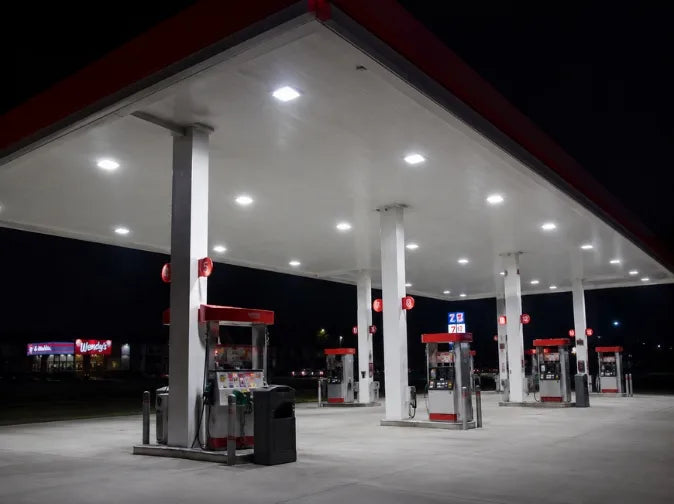
At a gas station, lighting contributes to how safe and professional the property looks after dark.
In a parking garage, it helps drivers see vehicles, columns, pedestrians, turns, payment areas, and entrances.
At a covered commercial entrance, it influences the customer’s first impression of the building.
This makes canopy lighting a business decision - not merely a fixture purchase.
Signs Your Existing Canopy Lights Need Replacement
Your canopy lighting may be ready for an upgrade when:
- Fixtures take time to reach full brightness.
- Lamps frequently burn out.
- Light levels vary between fixtures.
- Dark areas appear between pumps or parking spaces.
- The existing system uses HID, HPS, or metal halide lamps.
- Maintenance requires repeated lift or ladder access.
- Fixtures create excessive yellow or uneven light.
- Drivers experience glare.
- Surveillance footage lacks clarity at night.
- Electricity and maintenance costs continue increasing.
A fixture does not need to fail completely before it becomes expensive to keep.
Which LED Canopy-Light Wattage Do You Need?
Wattage measures power consumption.
It does not directly tell you how well the fixture will illuminate your property.
Two fixtures with similar wattage can produce different lumen output and light distribution.
Use wattage as part of the decision - not the entire decision.
General product-positioning guide
| Canopy-light range | Typical fit |
|---|---|
| 40W–60W | Entrances, covered walkways and lower-output areas |
| 60W–80W | Parking garages, drive-throughs and moderate canopies |
| 75W | Commercial garages, shops, carports and moderate covered areas |
| 150W | Gas stations and larger high-output canopy applications |
| 200W | Demanding commercial sites and high-output HID replacements |
These are starting points. Final selection should account for mounting height, spacing, optics, existing light levels, and local requirements.
How Many Lumens Should a Canopy Light Produce?
Lumens measure total visible light output.
Higher lumens can support larger spaces or higher mounting positions, but more lumens are not always better.
Too little output creates:
- Dark spots
- Poor visibility
- Weak security coverage
- Uneven customer areas
Too much output may create:
- Glare
- Excessive contrast
- Unnecessary electricity use
- Light spill
Visual discomfort
Patel LED current canopy-light collection includes products ranging from moderate-output commercial fixtures to a 200W model listed at 28,000 lumens.
Simplified buying approach
Ask:
How high is the canopy?
How far apart are the fixtures?
How large is the covered area?
Are surfaces dark or reflective?
Is the area used by vehicles, pedestrians, or both?
Is the current lighting too dim or simply inefficient?
Are you replacing fixtures one for one?
A photometric plan is preferable for large, safety-critical, or new-construction projects.
75W vs 150W vs 200W LED Canopy Lights
| Option | Current Patel LED positioning | Best suited for |
|---|---|---|
| 75W | 9,750 lumens, 5000K and IP65 | Moderate commercial canopies, garages, shops and carports |
| 150W | 19,500 lumens, 5700K, IP65, recessed/surface-mount listing | Gas stations and larger covered commercial areas |
| 200W | 28,000 lumens, 5700K and 140 lm/W listing | High-output replacements and demanding outdoor applications |
Product specifications should always be verified on the individual product page before purchase.
Which one should you choose?
Choose a lower-output fixture when:
- The canopy is relatively low.
- Fixtures are closely spaced.
- The area is smaller.
- Existing light levels are already adequate.
- Reducing glare is a priority.
Choose a higher-output fixture when:
- The canopy is higher.
- Fixtures are spaced farther apart.
- The covered area is large.
- Existing fixtures are high-wattage HID units.
- The property requires strong commercial visibility.
Do not assume that replacing every old fixture with the highest-output LED will create the best result.
When Selectable-Wattage Canopy Lights Make Sense
A selectable-wattage fixture allows the installer or facility team to choose from multiple power settings.
Patel LED currently lists a 40W/60W/80W selectable canopy model with selectable 3500K/4000K/5000K color temperature, dimming, IP65 protection, and UL/DLC listing.
This can be useful when:
- Multiple areas have different brightness needs.
- Final light levels need adjustment after installation.
- A contractor wants to standardize one fixture across several zones.
- The existing fixture wattage is uncertain.
- The property may change its layout.
- Inventory simplification is important.
Fixed wattage vs selectable wattage
| Feature | Fixed wattage | Selectable wattage |
|---|---|---|
| Output | Predetermined | Adjustable |
| Ordering simplicity | Requires correct model selection | One model may serve several zones |
| On-site flexibility | Limited | Higher |
| Standardization | Multiple SKUs may be needed | Fewer SKUs may cover the project |
| Best use | Clearly defined application | Retrofit or multi-zone project |
Buyer takeaway
Choose selectable wattage for flexibility. Choose fixed wattage when the project specifications and light levels are already clearly defined.
What Color Temperature Is Best?
Color temperature affects the appearance of the illuminated area.
3500K
Softer appearance
Suitable for some entrances and customer-facing spaces
Less clinical than cooler temperatures
4000K
Neutral white
Balanced visibility and comfort
Suitable for parking structures and commercial entrances
5000K
Crisp daylight appearance
Common for garages, gas stations and security-oriented applications
Supports clear nighttime visibility
5700K
Cooler white appearance
Often selected for bright commercial and outdoor environments
May feel more intense than 4000K or 5000K
The ideal choice depends on property appearance, surrounding lighting, visibility needs, and customer comfort.
Selectable-CCT fixtures help contractors adjust color temperature on site.
Is IP65 Enough for Outdoor Canopy Lighting?
IP65 indicates protection against dust ingress and water jets.
It is widely used for outdoor canopy fixtures because these lights may be exposed to:
- Moisture
- Wind-driven rain
- Dust
- Insects
- Temperature changes
- Vehicle exhaust
- Cleaning activity
However, an IP rating alone does not guarantee that a fixture is suitable for every environment.
Also review:
- Operating temperature
- Corrosion exposure
- Housing material
- Lens and gasket quality
- Installation method
- Electrical connections
- Local code requirements
Patel LED’s listed canopy-light models currently include IP65 options intended for commercial outdoor applications.
Surface Mount vs Recessed Mount
Surface-mounted canopy lights
The fixture is attached directly to the underside of the canopy or ceiling.
Advantages:
- Straightforward replacement
- Useful where no recessed opening exists
- Accessible installation
- Suitable for many garages and covered entrances
Recessed canopy lights
The fixture is installed into an opening so it sits more flush with the surface.
Advantages:
- Cleaner integrated appearance
- Common in gas station canopy designs
- May align with an existing recessed fixture layout
Decision table
| Choose surface mount when… | Choose a recessed mount when… |
|---|---|
| The ceiling is solid | A suitable opening already exists |
| Simpler installation is preferred | A flush appearance is important |
| You are replacing a surface fixture | The canopy was designed for recessed fixtures |
| Access above the ceiling is limited | Wiring and clearance support recessed mounting |
Before ordering, confirm cutout size, fixture dimensions, junction-box requirements, and available ceiling depth.
Best Canopy Lights for Gas Stations
Gas stations need lighting that supports:
- Safe fueling
- Payment-terminal visibility
- Vehicle movement
- Customer confidence
- Security cameras
- Brand presentation
- Long operating hours
A poorly illuminated fueling area may feel unsafe even when the station is otherwise well maintained.
Buyer priorities
Gas station buyers should evaluate:
- Lumen output
- Uniformity
- Glare
- Recessed or surface mounting
- Canopy height
- Fixture spacing
- Voltage
- IP rating
- Operating hours
- Certifications
High-output 150W or 200W canopy lights may be appropriate for larger or demanding gas station applications, while lower or selectable wattage fixtures may suit lower canopies, closely spaced layouts, or smaller properties.
Explore Patel LED 150W and 200W canopy-light options when replacing high-output gas station fixtures. Compare actual lumens and mounting requirements, not wattage alone.
Best Canopy Lights for Parking Garages
Parking garages present different challenges.
They often have:
- Lower ceilings
- Closely spaced fixtures
- Concrete surfaces
- Dark corners
- Columns and visual obstructions
- Continuous or long operating hours
Using an overly powerful fixture at a low mounting height can create glare and uncomfortable contrast.
For many parking-garage areas, moderate or selectable wattage may provide better control than a very high-output fixture.
Useful features include:
- 40W/60W/80W selection
- 4000K or 5000K selection
- Dimming
- Wide distribution
- IP65 protection
- Commercial voltage compatibility
Canopy Lights for Drive-Through Lanes
Drive-through lighting must support:
- Menu visibility
- Vehicle movement
- Payment areas
- Employee security
- Surveillance
- Customer comfort
The lighting should be bright enough for safe transactions without shining directly into drivers’ eyes.
Consider:
- Moderate wattage
- Controlled mounting angle
- Neutral or daylight color temperature
- Dimming where appropriate
- Additional wall packs for vertical illumination
Canopy lights can be combined with LED Wall Pack Lights or Flood Lights where facial recognition, signage, or perimeter visibility is required.
Canopy Lights for Covered Entrances and Loading Areas
Covered commercial entrances need a professional, welcoming appearance.
Loading areas need stronger functional visibility.
Covered entrances
Prioritize:
- Comfortable color temperature
- Low glare
- Uniform illumination
- Attractive low-profile design
Loading areas
Prioritize:
- Higher visibility
- Durable construction
- Wide coverage
- Security integration
Long operating life
One fixture type may not be ideal for both areas. A selectable-wattage or selectable-CCT model may help standardize the project while allowing different settings.
LED vs Traditional HID Canopy Lighting
| Factor | Traditional HID | LED canopy light |
|---|---|---|
| Startup | May require warm-up | Instant |
| Energy consumption | Higher | Lower |
| Light depreciation | Often noticeable | More consistent with quality products |
| Maintenance | Lamp and ballast service | Lower replacement frequency |
| Controls | Limited | Dimming or sensors on compatible models |
| Color options | Limited | Fixed or selectable CCT |
| Glare control | Depends on reflector | Modern optics can improve distribution |
The business case is strongest when existing fixtures operate for long hours and require frequent maintenance.
Modeled Energy-Savings Example
Consider a gas station with:
- 24 existing 250W HID fixtures
- 14 operating hours per day
- 365 operating days
- Electricity rate of $0.15/kWh
- Proposed 100W LED replacements
Existing annual electricity use
24 × 250W = 6,000W or 6kW
6kW × 14 × 365 = 30,660 kWh
Annual cost:
30,660 × $0.15 = $4,599
Proposed LED electricity use
24 × 100W = 2,400W or 2.4kW
2.4 × 14 × 365 = 12,264 kWh
Annual cost:
12,264 × $0.15 = $1,839.60
Estimated annual electricity savings
$4,599 − $1,839.60 = $2,759.40
Estimated five-year electricity savings
$2,759.40 × 5 = $13,797
This modeled estimate excludes maintenance savings, installation, controls, utility-rate changes, and rebates.
Why buyers should care
Waiting another year may mean purchasing thousands of kilowatt-hours that an efficient lighting system could avoid.
How Many Canopy Lights Do You Need?
Do not calculate quantity from square footage alone.
Fixture count depends on:
- Canopy dimensions
- Mounting height
- Lumen output
- Optical distribution
- Fixture spacing
- Surface reflectance
- Obstacles
- Required uniformity
- Application
- Existing openings
Basic planning process
- Measure the canopy.
- Record existing fixture positions.
- Record mounting height.
- Identify dark areas and glare.
- Determine required light levels.
- Compare fixture photometrics.
- Select a preliminary wattage and lumen range.
- Confirm the layout before ordering.
Large gas stations, parking structures, and new commercial projects benefit from a professional photometric layout.
Should You Replace Fixtures One for One?
A one-for-one replacement is convenient, but it is not always optimal.
It may work when:
- Existing spacing is effective.
- New fixtures have similar distribution.
- Existing openings must be reused.
- Required light levels are already acceptable.
- The goal is primarily energy and maintenance reduction.
A redesigned layout may be better when:
- Existing lighting has dark spots.
- Fixtures are poorly positioned.
- The property has excessive glare.
- The canopy has changed.
- New fixtures produce significantly different distributions.
- Fewer fixtures may achieve the required coverage.
Do not preserve a bad layout simply because it already exists.
Common Buyer Mistakes
Buying only by wattage
Why it fails: Wattage does not describe distribution, uniformity, glare, or actual light output.
Ordering the highest lumen output everywhere
Why it fails: Lower ceilings and close spacing can create glare and overlighting.
Ignoring mounting compatibility
Why it fails: The fixture may not fit the existing opening or junction arrangement.
Forgetting voltage
Why it fails: Commercial properties may use different supply voltages.
Buying indoor fixtures for covered outdoor areas
Why it fails: Moisture, dust, and temperature exposure can cause early failure.
Ignoring certifications
Why it fails: Unverified fixtures may create project, inspection, rebate, or reliability concerns.
Choosing price over total ownership cost
Why it fails: A low-cost fixture that requires early replacement can erase initial savings.
Objections Buyers Often Have
Why not purchase the 200W model for maximum brightness?
Because maximum brightness is not the objective.
The objective is suitable, uniform light with acceptable glare and energy use. A 200W fixture can be appropriate for demanding sites but excessive for lower or smaller canopies.
Is 5000K too bright?
Kelvin describes color appearance, not brightness.
A 5000K fixture can look crisp and cool, but its perceived intensity also depends on lumens, optics, height, and surface conditions.
Are selectable-wattage fixtures reliable?
Selectable wattage is a useful commercial feature when properly designed. It allows one fixture to serve different zones or lets the installer adjust output after observing actual conditions.
Can an LED replace a 400W HID fixture?
Possibly, but replacement should be based on delivered light, distribution, mounting height, and existing performance - not a simple wattage-equivalent claim.
Should I retrofit all locations at once?
Multi-location businesses can phase upgrades by property, canopy, or operating schedule. However, standardizing products may simplify inventory, installation, and future maintenance.
Questions to Ask Before Ordering Canopy Lights
- What type of fixture am I replacing?
- What is its actual input wattage?
- How many lumens does the proposed LED produce?
- What is the mounting height?
- Is the fixture surface or recess mounted?
- What are the existing cutout dimensions?
- What voltage is available?
- Is dimming required?
- Would selectable wattage help?
- Which color temperature fits the property?
- Is IP65 appropriate for the environment?
- Is the product UL or DLC listed where needed?
- How many hours will it operate?
- What is the expected annual electricity reduction?
- Do I need a photometric plan?
- Will additional wall packs or area lights be required?
- Can the installation be phased?
- Does the fixture fit the project budget and long-term plan?

Is Your Property Ready for an LED Canopy Upgrade?
Your property is likely a strong candidate if:
- It uses HID, HPS, fluorescent, or metal halide canopy fixtures.
- Lights operate 10 or more hours daily.
- Lamps or ballasts fail regularly.
- Dark spots are visible.
- Customers complain about visibility.
- Cameras struggle at night.
- The property has inconsistent color or brightness.
- Energy expenses are increasing.
- Existing fixtures require difficult maintenance access.
- You are renovating, rebranding, or expanding.
If several conditions apply, delaying the project may cost more than evaluating a replacement now.
Why Choose Patel LED Canopy Lights?
Patel LED currently offers canopy-light options for different commercial requirements, including:
- Selectable 40W/60W/80W output
- Selectable 3500K/4000K/5000K color temperature
- 75W moderate-output fixtures
- 150W gas station canopy fixtures
- 200W high-output canopy fixtures
- Surface and recessed applications
- IP65 outdoor protection
- Commercial voltage compatibility
- Dimmable options
- UL/DLC-listed options on applicable products
Availability and specifications should be confirmed on the individual product listing before ordering.
The collection allows buyers to compare solutions based on the actual application instead of forcing one fixture into every project.
FAQs
Patel LED offers several canopy-light configurations, allowing commercial buyers to compare fixed and selectable wattage, different lumen outputs, color temperatures, mounting styles, and project-specific features.
Final Buying Checklist
Before purchasing, confirm:
- Application
- Canopy dimensions
- Mounting height
- Fixture spacing
- Required lumens
- Wattage
- Color temperature
- Surface or recessed mount
- Input voltage
- IP rating
- Dimming
- Certifications
- Fixture dimensions
- Quantity
- Expected annual runtime
A correct first purchase avoids repeat installation, return costs, dark spots, glare, and unnecessary energy consumption.
Choose the Right Canopy Light Before Installation Costs Multiply
The cost of an incorrect fixture is not limited to the product price.
An underpowered fixture can leave unsafe dark areas. An oversized fixture can create glare and waste electricity. An incompatible mounting style can delay installation and increase labor costs.
Patel LED offers LED canopy lights for gas stations, parking garages, drive-throughs, covered entrances, loading areas, and other commercial applications across the USA.
Compare:
- 40W/60W/80W selectable fixtures
- 75W commercial canopy lights
- 150W gas station canopy lights
- 200W high-output canopy lights
- Selectable color temperatures
- Surface and recessed options
- Dimmable and IP65-rated models
Review the Patel LED LED Canopy Lights collection and choose the fixture that fits your canopy, not simply the fixture with the highest wattage.
Explore LED Canopy Lights: