How Many Foot-Candles Does a Warehouse Need? A Practical LED Lighting Guide for Commercial Buyers
Table of Contents
- What Is a Foot-Candle?
- Foot-Candles vs Lumens: What Is the Difference?
- Is There an OSHA Foot-Candle Requirement for Warehouses?
- Best Patel LED fixture category
- How to Measure Warehouse Foot-Candles
- Why Uniformity Can Matter More Than Average Foot-Candles
- How Many Lumens Do You Need to Reach the Foot-Candle Target?
- UFO vs Linear High Bays by Foot-Candle Goal
- Warehouse Lighting Controls Can Reduce Operating Costs
- How to Choose Patel LED Products from Your Foot-Candle Target
- Warehouse Foot-Candle Buyer Checklist
- Common Warehouse Foot-Candle Mistakes
- Why Warehouse Buyers Consider Patel LED
- FAQs
- Build Your Warehouse Lighting Plan Around Foot-Candles-Not Wattage
A warehouse can look bright from the entrance and still be too dark where employees actually work. That happens because warehouse lighting is not measured by how bright the ceiling appears. It is measured by how much useful light reaches:
- The warehouse floor
- Rack labels
- Picking locations
- Packing stations
- Loading docks
- Forklift aisles
- Inspection tables
- Work surfaces
- Exit routes
- Equipment areas
This is where foot-candles become important. A foot-candle tells you how much light reaches a surface. That makes it one of the most useful measurements for deciding whether a warehouse has enough illumination. But there is one mistake warehouse owners make repeatedly:
They search for one foot-candle number and use it for the entire building.
A reserve-storage aisle does not have the same visual needs as a packing station. A general warehouse floor does not have the same requirements as detailed inspection. An open storage area does not behave like a 30-foot-high rack aisle. The best warehouse lighting design therefore uses different target light levels for different tasks, then selects the right fixture type, lumen output, distribution, spacing, mounting height, and controls for each zone. For Patel LED buyers, that can mean:
- UFO LED High Bay Lights for open warehouse areas
- Linear LED High Bay Lights for long aisles and structured layouts
- Panel or Troffer Lights for warehouse offices
- Canopy Lights for covered loading areas
- Wall Packs for exterior doors and building perimeters
- Area Lights for truck yards and parking
- Vapor-Tight Fixtures for damp or dusty areas
This guide explains how many foot-candle warehouses typically need, how to measure them, how foot-candles relate to lumens, and how to turn the measurement into the right Patel LED product decision.

What You Need to Know
Most warehouses do not have one universal foot-candle requirement. General storage may need relatively modest illumination, while picking, packing, labeling, inspection, and detailed work often need substantially more. Final light levels should reflect the task, layout, mounting height, racks, glare, uniformity, local requirements, and professional lighting design. For early-stage commercial planning:
- Inactive storage: around 5–10 foot-candles
- Active storage: around 10–20 foot-candles
- General warehouse areas: around 10–30 foot-candles
- Picking and packing: around 30–50 foot-candles
- Detailed inspection: often 50 foot-candles or more
- Offices: around 30–50 foot-candles
- Loading zones: project-specific, often higher where detailed work occurs
These are general design-planning ranges, not universal legal requirements.
Buyer recommendation
Do not buy high-bay lights based on foot-candles alone. Use the foot-candle target to determine the required light at the task surface, then compare:
- Fixture lumens
- Beam distribution
- Mounting height
- Fixture spacing
- Rack layout
- Vertical illumination
- Controls
with the appropriate Patel LED warehouse-lighting product.
What Is a Foot-Candle?
A foot-candle is a measurement of illumination. One foot-candle means that one lumen of light is reaching one square foot of surface area. The important phrase is: reaching the surface. A light fixture may produce 20,000 lumens at the ceiling, but workers do not perform their jobs at the ceiling. They work at:
- Floor level
- Shelf level
- Eye level
- Workbench height
- Packing-table height
That is why foot-candle measurements are more useful than fixture wattage alone.
Foot-Candles vs Lumens: What Is the Difference?
Warehouse buyers often confuse these terms.
| Measurement | What it tells you |
|---|---|
| Watts | How much electricity the fixture uses |
| Lumens | How much light the fixture produces |
| Foot-candles | How much light reaches the surface |
| Lumens per watt | How efficiently the fixture produces light |
| Beam distribution | Where the light is directed |
Example
Imagine two 150W LED high bays. Fixture A:
- 22,500 lumens
- Wide distribution
Fixture B:
- 22,500 lumens
- Narrower distribution
Both produce the same total light. But at 25 feet, they may produce very different foot-candle patterns. One may provide broad warehouse-floor coverage. The other may place more light into a narrower aisle. That is why you should not select a warehouse fixture from lumen output alone.
Is There an OSHA Foot-Candle Requirement for Warehouses?
This question needs careful explanation. OSHA does publish minimum illumination values in several standards, but those values apply to specific industries, operations, or work conditions. For example, OSHA’s construction illumination standard requires areas covered by that construction rule to meet minimum light levels while construction work is being performed. Its table includes different values for construction areas, shops, offices, and storage spaces. OSHA also has other lighting requirements for specific environments. For example, marine-terminal active work areas have an average minimum illumination requirement of 5 foot-candles under the applicable rule. OSHA also requires illumination around indoor electrical service equipment, switchboards, panelboards, and motor-control centers.
The important takeaway
A commonly quoted OSHA number should not be used as the design target for every operating warehouse. A legal minimum in one standard may not provide good:
- Label visibility
- Rack-face illumination
- Forklift visibility
- Packing accuracy
- Inspection lighting
- Glare control
- Uniformity
Use regulatory requirements as a compliance baseline where applicable - not as the complete lighting design.
How Many Foot-Candles Does Each Warehouse Area Need?
The following table is intended for commercial planning. It is not a substitute for a site-specific code review or professional lighting design.
| Warehouse zone | General planning range |
|---|---|
| Inactive storage | 5–10 fc |
| Reserve storage | 5–15 fc |
| Active bulk storage | 10–20 fc |
| General warehouse floor | 10–30 fc |
| Forklift aisles | 10–30 fc |
| High rack aisles | 15–30 fc |
| Picking areas | 30–50 fc |
| Packing stations | 30–50 fc |
| Shipping and receiving | 20–50 fc |
| Detailed label reading | 30–75 fc |
| Inspection | 50–100+ fc |
| Quality control | 50–100+ fc |
| Maintenance area | 30–50 fc |
| Warehouse office | 30–50 fc |
| Covered loading dock | 10–30+ fc |
The correct target depends on:
- Product size
- Label size
- Visual contrast
- Employee tasks
- Rack height
- Warehouse traffic
- Equipment
- Employee age
- Company standards
- Safety requirements
- Local regulations
Why One Foot-Candle Level Should Not Be Used Everywhere
Consider a 100,000-square-foot distribution warehouse. It includes:
- Reserve storage
- Fast-moving inventory
- Narrow rack aisles
- Picking
- Packing
- Shipping
- Offices
- Loading docks
If the entire building is designed for 50 foot-candles: You may overlight:
- Reserve storage
- Low-traffic aisles
- Staging areas
That increases:
- Electricity use
- Fixture quantity
- Project cost
- Glare
If the entire warehouse is designed for 10 foot-candles: You may underlight:
- Packing
- Detailed picking
- Quality inspection
- Small-label areas
A zone-based plan produces a better commercial outcome.
Zone 1: Open Storage Areas
Open warehouse floors usually have:
- High ceilings
- Fewer vertical obstructions
- Pallet staging
- Bulk goods
- Forklift traffic
A general target may fall in the 10–30 foot-candle range depending on activity.
Best Patel LED fixture category
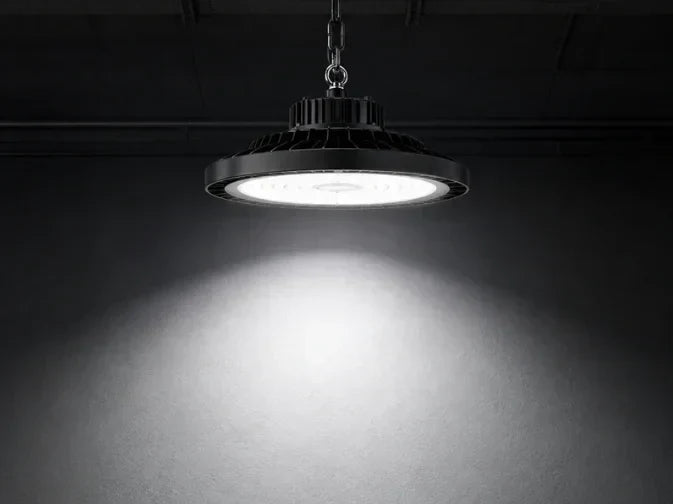
UFO LED High Bay Lights
UFO high bays are a strong fit for open high-ceiling areas because their compact round design works well in grid-style layouts. Patel LED currently offers multiple high-bay models for warehouses and commercial facilities. One listed selectable model offers 100W, 120W, or 150W output with up to 22,500 lumens.
Buyer considerations
Before selecting a UFO high bay, verify:
- Ceiling height
- Mounting height
- Lumens
- Beam angle
- Fixture spacing
- Voltage
- Dimming
- Controls
- Environmental conditions
Lighting an open warehouse floor? Compare Patel LED UFO High Bay Lights by lumen output and mounting height, not wattage alone.
Zone 2: High Rack Aisles
High rack aisles create a different lighting challenge. Workers need to see:
- Floor markings
- Rack labels
- Pallet positions
- Barcodes
- Safety signs
- Lower shelves
The key issue is often vertical illumination. A fixture may provide strong horizontal light on the floor but weak illumination on vertical rack faces.
Best Patel LED product category
Linear LED High Bay Lights
Linear high bays are especially useful for:
- Long aisles
- Distribution centers
- Rack rows
- Structured rectangular layouts
Patel LED’s linear high-bay collection emphasizes aisle-based layouts, mounting height, beam angle, lumen output, and control compatibility as key selection factors.
Why linear alignment helps
When fixtures follow the aisle:
- More useful light can reach the working zone
- Less light may be wasted above racks
- Fixture rows align with worker movement
- Lower shelf visibility may improve
The actual outcome depends on the fixture optics and layout. Need more light on rack faces instead of rack tops? Compare Patel LED Linear High Bay Lights for long warehouse aisles.
Zone 3: Picking Areas
Picking often requires higher light levels because workers must:
- Read SKUs
- Scan labels
- Match products
- Read small print
- Identify shelf positions
- Check order quantities
A common planning range is around 30–50 foot-candles. But more important than the average is:
- Uniformity
- Vertical illumination
- Glare
- Label contrast
A 40-foot-candle floor reading is not enough if lower rack labels remain dark.
Fixture approach
Use:
- Linear high bays aligned with aisles
- Supplemental task lighting where necessary
- Appropriate CRI
- Controls in lower-traffic aisles
Zone 4: Packing Stations
Packing stations may require:
- 30–50 foot-candles
- More for detailed work
Workers may be:
- Reading shipping information
- Checking labels
- Inspecting packaging
- Matching products
- Using computers
- Applying barcodes
General high-bay lighting may leave the table in shadow because the employee or equipment blocks the overhead beam.
Better solution
Layer lighting. Use:
- Warehouse ambient lighting
- Lower-mounted linear fixtures
- Task lighting where necessary
This is more efficient than increasing the entire warehouse’s high-bay output.
Zone 5: Inspection and Quality Control
Inspection areas may require 50–100 foot-candles or more depending on the task. Employees may be checking:
- Surface quality
- Small components
- Paint
- Wires
- Product color
- Fine details
- Damage
- Packaging
These areas should prioritize:
- High CRI
- Good uniformity
- Low glare
- Strong task-level illumination
Do not design the rest of the warehouse to the same high light level simply because a small inspection area needs it.
Zone 6: Shipping and Receiving
Shipping and receiving typically experience:
- Forklifts
- Pedestrians
- Trailers
- Open dock doors
- Daylight
- Paperwork
- Pallet staging
A planning range may be around 20–50 foot-candles depending on the work.
Recommended Patel LED strategy
Interior:
- UFO High Bays
- Linear High Bays
Covered dock:
- LED Canopy Lights
Exterior doors:
- LED Wall Packs
Truck yard:
This is where one warehouse blog can naturally lead buyers into several Patel LED product categories.
Zone 7: Loading Docks
Loading docks may have lower general lighting requirements than detailed workstations, but visibility is critical because of:
- Vehicle movement
- Dock plates
- Trailer edges
- Pedestrians
- Pallets
- Equipment
The lighting plan should consider both:
- Indoor illumination
- Outdoor illumination
Patel LED product categories
Canopy Lights
Use beneath:
- Covered loading docks
- Overhangs
- Service entrances
Wall Packs
Use around:
- Dock doors
- Building perimeters
- Walkways
- Service entrances
Patel LED’s warehouse wall-pack content specifically identifies loading docks and industrial buildings as common applications.
Zone 8: Warehouse Offices
Warehouse offices usually use lower ceilings. A high bay is not appropriate. Consider:
- LED Panel Lights
- Troffer Lights
Typical planning range: 30–50 foot-candles. Prioritize:
- Low glare
- Screen comfort
- Uniformity
- Dimming
- Occupancy controls
DOE’s current commercial and industrial LED purchasing guidance includes dedicated efficiency requirements for linear ambient fixtures and troffers, reinforcing the importance of matching the fixture type to the actual space.
How to Measure Warehouse Foot-Candles
Use a calibrated light meter.
Step 1: Define the measurement grid
Take readings at consistent intervals throughout the zone. Example:
- Every 10 feet
- Every aisle intersection
- Every workbench
- Aisle ends
Step 2: Measure at the correct height
Examples: Warehouse floor: Measure near floor level if that is the task surface. Packing station: Measure at table height. Rack labels: Consider vertical readings where workers actually read labels.
Step 3: Do not measure only beneath fixtures
Measure:
- Beneath fixtures
- Between fixtures
- Along walls
- Aisle ends
- Corners
- Lower rack levels
Otherwise, you may record only the brightest areas.
Step 4: Calculate average and minimum values
Average foot-candles matter. But minimum readings matter too. Example: Readings: 40 38 35 10 8 Average: 26.2 foot-candles That average hides a serious dark-zone problem. This is why uniformity matters.
Why Uniformity Can Matter More Than Average Foot-Candles
Imagine two warehouses.
Warehouse A
- Average: 30 fc
- Minimum: 25 fc
- Maximum: 35 fc
Warehouse B
- Average: 30 fc
- Minimum: 8 fc
- Maximum: 55 fc
Both average 30 foot-candles. But Warehouse A provides much more consistent visibility. Warehouse B forces workers’ eyes to adjust constantly between bright and dark zones. That can be caused by:
- Excessive spacing
- Narrow beams
- Failed fixtures
- Rack obstruction
- Wrong fixture type
- Poor row alignment
How Mounting Height Changes Foot-Candles
The farther the fixture is from the work surface, the more critical distribution becomes. A fixture that performs well at 16 feet may not provide the same floor-level illumination at 30 feet. Typical planning categories:
| Mounting height | Initial fixture direction |
|---|---|
| Under 12 ft | Panels, troffers, strips |
| 12–15 ft | Lower-output commercial fixtures |
| 15–20 ft | High bays may be appropriate |
| 20–30 ft | Higher-output high bays |
| Above 30 ft | Photometric design strongly recommended |
This is not a wattage chart. The correct fixture also depends on:
- Required foot-candles
- Beam distribution
- Rack height
- Spacing
- Reflectance
How Many Lumens Do You Need to Reach the Foot-Candle Target?
At the most basic level: Foot-candles × square feet = lumens reaching the surface Example: A 10,000-square-foot warehouse area needs an average target of 20 foot-candles. 20 × 10,000 = 200,000 lumens reaching the working surface. That does not mean you simply buy 200,000 fixture lumens. Some emitted light is lost because of:
- Fixture distribution
- Height
- Reflectance
- Racks
- Dirt
- Optical losses
- Walls
A more realistic design uses:
- Coefficient of utilization
- Light-loss factor
- Photometric files
- Room geometry
This is why a photometric layout should verify commercial quantities.
Simple Early-Stage Fixture Calculation
For rough planning: Fixture quantity ≈ required adjusted lumens ÷ lumens per fixture Suppose you estimate the project requires 900,000 emitted lumens after layout factors. If the selected fixture produces 22,500 lumens: 900,000 ÷ 22,500 = 40 fixtures But that is still only an initial estimate. Forty fixtures may produce a poor result if:
- They are spaced incorrectly
- Racks block them
- The beam is too narrow
- The beam is too broad
Use the calculation for budgeting, then verify with photometric planning.
UFO vs Linear High Bays by Foot-Candle Goal
| Facility condition | UFO High Bay | Linear High Bay |
|---|---|---|
| Open floor | Strong fit | Possible |
| High rack aisle | Optics dependent | Strong fit |
| Broad staging | Strong fit | Possible |
| Long picking aisle | Possible | Strong fit |
| Structured rectangular area | Possible | Strong fit |
| Circular grid layout | Strong fit | Less natural |
| Goal: vertical rack light | Verify distribution | Often better aligned |
Patel LED itself distinguishes UFO fixtures as a strong fit for open areas and linear high bays as a stronger fit for structured aisle layouts.
How to Increase Foot-Candles Without Wasting Energy
The first reaction is usually: Install higher-wattage lights. Try these options first.
Improve fixture spacing
Poor overlap creates gaps.
Use the correct distribution
A linear distribution may put more useful light into an aisle than a broad UFO.
Lower the fixture where appropriate
Reducing mounting height may improve work-plane illumination.
Clean fixtures
Dust can reduce usable output.
Remove obstructions
Racks, signs, ducts, and conveyors can block light.
Add targeted task lighting
Do not raise the entire warehouse from 20 to 50 foot-candles because one packing table needs more light.
Use controls
Output can be increased in active zones and reduced elsewhere. DOE highlights high/low bay and linear lighting as major remaining commercial and industrial LED savings opportunities and notes that connected capabilities are important for maximizing energy and cost savings.
Warehouse Lighting Controls Can Reduce Operating Costs
Modern LED warehouse lighting can support:
- Occupancy sensors
- Dimming
- Zoning
- Scheduling
- Daylight control
DOE documented a warehouse retrofit where 240 high-bay, aisle, and other fixtures were controlled with occupancy sensors that dimmed during vacancy, with estimated lighting savings of 230,000 kWh annually for that project. This is a specific case study, not a universal savings guarantee.
Best warehouse control zones
- Low-traffic rack aisles
- Reserve storage
- Utility rooms
- Mezzanines
- Seasonal storage
- Daylit docks
Buyer rule
Only assume that a Patel LED fixture supports dimming or sensors when the exact live product specification confirms the capability.
Foot-Candles and Warehouse Energy Cost
Higher foot-candle targets usually require more light. That can mean:
- More fixtures
- More wattage
- More runtime
But poor layout can waste far more energy than a correctly designed target.
Example
Facility A: 100 × 200W fixtures Connected load: 20 kW Facility B: 100 × 150W LED fixtures Connected load: 15 kW Operating hours: 4,000 annually Difference: 5 kW × 4,000 = 20,000 kWh/year At $0.15/kWh: = $3,000 annual electricity difference The important question is: Can the lower-wattage system still deliver the required foot-candles and uniformity? If yes, the efficiency improvement is commercially valuable.
Modeled Warehouse Retrofit ROI
This example is for planning only.
Existing system
- 120 HID warehouse fixtures
- Actual modeled input: 458W
- 4,000 operating hours
- Electricity rate: $0.15/kWh
Annual electricity use: 120 × 458 ÷ 1,000 × 4,000 = 219,840 kWh Annual electricity cost: 219,840 × $0.15 = $32,976
Proposed LED system
- 120 LED high bays
- 150W average modeled input
- Same operating hours
Annual use: 120 × 150 ÷ 1,000 × 4,000 = 72,000 kWh Annual cost: 72,000 × $0.15 = $10,800
Modeled annual electricity savings
$22,176
Five-year modeled electricity savings
$110,880 This excludes:
- Controls
- Maintenance
- Utility incentives
- Installation
- Electricity-rate changes
- Demand charges
DOE’s 2026 purchasing guidance sets efficiency requirements for industrial high-bay LED luminaires and recommends lifecycle-cost evaluation rather than purchasing solely by first cost. If your warehouse still uses HID, metal-halide, or older fluorescent lighting, measure the current foot-candles first - then compare whether Patel LED LED high bays can maintain or improve the target with lower connected wattage.
How to Choose Patel LED Products from Your Foot-Candle Target
Open warehouse floor
Review:
Patel LED UFO High Bay Lights
Use when:
- Ceiling is high
- Area is open
- Broad coverage is required
Verify:
- Lumen output
- Beam angle
- Mounting
- Dimming
- Voltage
High rack aisles
Review:
Patel LED Linear High Bay Lights
Use when:
- Layout is long and structured
- Vertical rack illumination matters
- Fixtures need to align with aisles
Patel LED describes linear high bays as suitable for warehouse aisle-based layouts and recommends selecting products based on beam angle, ceiling height, output, voltage, and controls.
Warehouse offices
Review:
Patel LED Panel and Troffer Lights
Use for:
- Low ceilings
- Administrative areas
- Conference spaces
Covered loading docks
Review:
Patel LED Canopy Lights
Use beneath:
- Overhangs
- Covered loading areas
- Garage-like spaces
Exterior loading doors
Review:
Patel LED Wall Packs
Patel LED identifies warehouse exteriors and loading docks among common wall-pack applications.
Parking and truck yards
Review:
Patel LED Area Lights
Use for:
- Wide exterior coverage
- Vehicle circulation
- Large industrial properties
When to Use a Photometric Plan
A photometric plan is especially valuable when:
- Warehouse is larger than a simple room
- Ceiling is high
- Racks are present
- Aisles are narrow
- Fixture quantity is large
- Existing lighting is poor
- You are changing fixture types
- You need predictable uniformity
- You want to avoid overbuying
A photometric plan can show:
- Average foot-candles
- Minimum foot-candles
- Maximum foot-candles
- Fixture locations
- Dark spots
- Beam overlap
- Rack performance
- Exterior spill light
Before ordering dozens of Patel LED warehouse fixtures, verify the layout with actual mounting heights, rack dimensions, and photometric data.
Warehouse Foot-Candle Buyer Checklist
Facility details
- Square footage
- Ceiling height
- Mounting height
- Rack height
- Aisle width
- Floor plan
- Operating hours
- Shift schedule
Task information
- Storage
- Picking
- Packing
- Inspection
- Shipping
- Forklift activity
- Small-label reading
Existing lighting
- Fixture quantity
- Wattage
- Lumens
- Voltage
- Fixture type
- Spacing
- Controls
- CCT
Measurements
- Average foot-candles
- Minimum foot-candles
- Maximum foot-candles
- Rack-face readings
- Aisle-end readings
- Workbench readings
Product selection
- UFO High Bay
- Linear High Bay
- Panel/Troffer
- Canopy Light
- Wall Pack
- Area Light
- Vapor-Tight Fixture
Procurement
- Exact Patel LED SKU
- Quantity
- Certifications
- DLC status where required
- Warranty
- Delivery date
- Installation schedule
DLC maintains verified Qualified Products Lists for high-performing commercial LED lighting and controls; buyers seeking rebates or project-specific qualification should verify the exact model where required.

Common Warehouse Foot-Candle Mistakes
1. Using one number throughout the building
Different tasks need different illumination.
2. Measuring only beneath fixtures
This hides dark spots.
3. Ignoring vertical illumination
Rack labels may remain dark.
4. Buying by wattage
Wattage measures energy, not work-plane visibility.
5. Ignoring uniformity
Average foot-candles can hide poor minimum levels.
6. Installing the highest-output fixture everywhere
This may create glare and energy waste.
7. Ignoring mounting height
Higher mounting changes performance.
8. Using broad-distribution lights in narrow aisles
Light may be wasted on rack tops.
9. Ignoring controls
Low-use areas may remain fully illuminated unnecessarily.
10. Treating OSHA minimums as an ideal design target
Regulatory requirements depend on the standard and application.
Is Your Warehouse Underlit?
Your warehouse may need a lighting review if:
- Employees use flashlights
- Lower rack labels are hard to read
- Aisle ends are dark
- Some areas feel dramatically brighter than others
- Forklift operators experience glare
- Packaging work requires extra portable lights
- Older HID fixtures have become dim
- Fixtures are frequently failing
- Racks have been added since the lighting was installed
- Packing areas are illuminated only by high bays
If several of these are true, do not simply increase wattage. Measure the area and correct the layout.
Why Warehouse Buyers Consider Patel LED
Patel LED offers multiple warehouse-related commercial lighting categories rather than one generic warehouse fixture. Relevant categories include:
- UFO LED High Bay Lights
- Linear LED High Bay Lights
- Panel Lights
- Troffer Lights
- Vapor-Tight Fixtures
- Wall Packs
- Canopy Lights
- Area Lights
- Flood Lights
- Emergency Lighting
Patel LED’s existing warehouse content also differentiates UFO fixtures for open spaces from linear high bays for structured aisle layouts, giving buyers a clearer starting point for product selection. This makes it possible to plan the entire warehouse:
- Floor
- Racks
- Packing
- Offices
- Loading
- Exterior
- Parking
instead of buying every fixture from one category.
FAQs
Build Your Warehouse Lighting Plan Around Foot-Candles-Not Wattage
A warehouse does not need the highest-wattage light everywhere. It needs the correct light level at the correct surface. That means:
- Lower light levels may work for reserve storage.
- General warehouse areas need consistent coverage.
- Rack aisles need vertical illumination.
- Picking and packing need stronger task visibility.
- Inspection needs higher-quality detailed lighting.
- Offices need low-glare panels or troffers.
- Loading docks need indoor and exterior layers.
Patel LED gives commercial buyers multiple product categories to build that system. If you know your target foot-candles, the next step is choosing the fixture that delivers them efficiently. Prepare:
- Warehouse square footage
- Ceiling height
- Rack height
- Existing fixture count
- Current wattage
- Existing foot-candle readings
- Operating hours
- Voltage
- Project deadline
Then compare Patel LED:
- UFO High Bays
- Linear High Bays
- Panel Lights
- Troffers
- Wall Packs
- Canopy Lights
- Area Lights
- Vapor-Tight Fixtures
Explore Patel LED Warehouse Lighting
Disclaimer
Warehouse lighting needs vary by activity, layout, jurisdiction, mounting height, equipment, and task. The planning ranges in this guide are general educational references and do not replace applicable codes, OSHA review, photometric analysis, electrical inspection, or professional lighting design.