Commercial LED Lighting for Healthcare Facilities: Complete Guide for Hospitals, Clinics & Medical Centers
Table of Contents
- Introduction
- Why Healthcare Lighting Matters
- The Unique Challenges of Healthcare Lighting
- Areas That Require Different Lighting Strategies
- Best LED Lighting Types for Healthcare Facilities
- Recommended Healthcare Color Temperatures
- Outdoor Healthcare Campus Lighting
- LED Lighting for Healthcare Warehouses & Storage Areas
- Why Healthcare Facilities Upgrade to LED
- LED Retrofit Projects for Existing Hospitals
- Common Healthcare Lighting Mistakes
- Best Practices for Healthcare LED Lighting
- How Patel LED Supports Healthcare Facilities
- Why Healthcare Buyers Choose Patel LED
- FAQs
- Expert Recommendations
- Conclusion
Introduction
Healthcare facilities operate differently from almost every other commercial building.
Unlike offices, warehouses, or retail stores, hospitals and medical facilities operate around the clock. Lighting must support patient care, medical accuracy, staff productivity, safety, comfort, and energy efficiency simultaneously.
A healthcare facility may contain:
- Patient rooms
- Operating rooms
- Emergency departments
- Examination rooms
- Laboratories
- Nurse stations
- Waiting areas
- Administrative offices
- Parking lots
- Outdoor campuses
Each environment has unique lighting requirements.
Poor lighting can negatively affect:
- Patient comfort
- Staff performance
- Medical accuracy
- Facility safety
- Energy costs
Modern LED lighting has transformed healthcare facilities by providing better illumination, reduced maintenance, improved visual comfort, and significant energy savings.
This guide explains how healthcare facilities can use commercial LED lighting to improve patient experience, operational efficiency, and long-term ROI.
What You Need to Know
The best commercial LED lighting for healthcare facilities combines high-CRI LED panel lights, specialized medical lighting, LED high bays, area lights, and smart controls. Proper healthcare lighting improves patient comfort, supports medical accuracy, enhances staff productivity, reduces energy costs, and provides long-term operational savings while meeting modern facility requirements.
- LED lighting improves patient comfort and staff efficiency.
- High CRI lighting supports accurate diagnosis and examinations.
- LED panel lights are ideal for patient rooms and offices.
- LED high bay lights work well in hospitals with high ceilings and service areas.
- Smart controls can reduce healthcare lighting costs by up to 70%.
Healthcare lighting should never be viewed solely as an energy-saving upgrade. Properly designed LED lighting contributes directly to patient satisfaction, staff performance, operational safety, and overall facility effectiveness.
Why Healthcare Lighting Matters
Healthcare lighting affects people differently than lighting in most commercial environments.
Patients may spend:
- Hours
- Days
- Weeks
inside healthcare facilities.
Medical professionals often work:
- Long shifts
- Overnight hours
- High-stress environments
Lighting directly influences:
✔ Patient comfort
✔ Staff alertness
✔ Treatment accuracy
✔ Facility safety
✔ Operational costs
The Unique Challenges of Healthcare Lighting
Healthcare facilities must balance:
Clinical Performance
Medical staff require accurate lighting for:
- Diagnosis
- Examinations
- Procedures
Patient Wellness
Patients need:
- Comfortable environments
- Reduced glare
- Stress reduction
Energy Efficiency
Healthcare facilities consume significant energy.
Lighting often accounts for a major portion of utility expenses.

Areas That Require Different Lighting Strategies
A hospital or medical facility includes many environments.
Each area requires different lighting levels and fixture types.
| Area | Primary Goal |
|---|---|
| Patient Rooms | Comfort |
| Operating Rooms | Precision |
| Examination Rooms | Visibility |
| Nurse Stations | Productivity |
| Waiting Areas | Relaxation |
| Offices | Efficiency |
| Parking Lots | Security |
| Hallways | Safety |
What Is Healthcare LED Lighting?
Definition
Healthcare LED lighting refers to commercial LED lighting systems specifically designed to support:
- Patient care
- Medical tasks
- Facility operations
while maximizing:
- Energy efficiency
- Comfort
- Reliability
Why Healthcare Facilities Are Switching to LED
Traditional systems create several problems:
Fluorescent Lighting
Issues include:
- Flickering
- Limited lifespan
- Maintenance costs
HID & Metal Halide
Problems include:
- High energy consumption
- Slow startup
- Frequent replacement
LED Advantages
Healthcare facilities choose LED lighting because it offers:
✔ Long lifespan
✔ Low maintenance
✔ Better light quality
✔ Higher CRI
✔ Improved comfort
✔ Significant energy savings
Best LED Lighting Types for Healthcare Facilities
LED Panel Lights
LED panel lights are among the most common healthcare lighting fixtures.
Ideal for:
- Patient rooms
- Offices
- Hallways
- Waiting areas
Benefits:
✔ Uniform illumination
✔ Low glare
✔ Professional appearance
✔ Energy efficiency
LED Troffer Lights
Used in:
- Hospitals
- Clinics
- Administrative spaces
Benefits:
✔ Consistent lighting
✔ Easy installation
✔ Excellent coverage
LED High Bay Lights
Applications:
- Hospital warehouses
- Supply centers
- Maintenance departments
- Large medical campuses
Benefits:
✔ High lumen output
✔ Long lifespan
✔ Reduced maintenance
LED Area Lights
Applications:
- Parking lots
- Campus roads
- Outdoor walkways
Benefits:
✔ Enhanced security
✔ Improved visibility
✔ Lower operating costs
LED Wall Pack Lights
Applications:
- Building exteriors
- Emergency exits
- Service entrances
Benefits:
✔ Perimeter security
✔ Weather resistance
✔ Reliable illumination
Patient Room Lighting Guide
Patient rooms require a careful balance between:
- Comfort
- Functionality
- Safety
Goals of Patient Room Lighting
Lighting should:
✔ Support healing environments
✔ Minimize stress
✔ Provide flexibility
✔ Reduce eye strain
Recommended Fixtures
LED Panel Lights
Best choice for:
- General illumination
Benefits:
✔ Soft light
✔ Uniform coverage
✔ Low glare
Recommended Color Temperature
3000K–4000K
This range creates:
✔ Warm environment
✔ Patient comfort
✔ Better relaxation
Examination Room Lighting
Examination rooms require more precise lighting.
Doctors must accurately assess:
- Skin conditions
- Eye conditions
- Wounds
- Symptoms
Recommended CRI
Minimum:
90+
Why High CRI Matters
High CRI lighting improves:
✔ Color accuracy
✔ Diagnostic precision
✔ Patient assessment
Recommended Color Temperature
4000K–5000K
This provides:
✔ Clinical clarity
✔ Accurate color rendering
Operating Room Lighting
Operating rooms require the highest level of lighting performance.
Lighting impacts:
- Precision
- Safety
- Outcomes
Key Requirements
✔ Extremely high illumination
✔ Accurate color rendering
✔ Minimal shadows
✔ Reliability
Recommended CRI
95+
Recommended Color Temperature
4500K–5000K
Nurse Station Lighting
Nurses spend significant time at:
- Workstations
- Computers
- Documentation areas
Lighting should support:
✔ Concentration
✔ Accuracy
✔ Comfort
Best Fixtures
LED Panel Lights
Advantages:
✔ Even illumination
✔ Reduced glare
✔ Productivity support
Healthcare Hallways & Corridors
Hallways must remain illuminated continuously.
Requirements:
✔ Safety
✔ Navigation
✔ Emergency access
Recommended Lighting
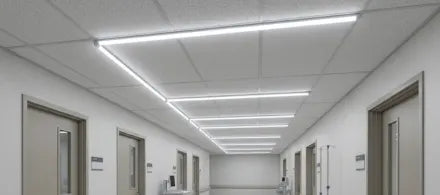
LED panel lights and troffers provide:
✔ Consistent illumination
✔ Long lifespan
✔ Low maintenance
Waiting Area Lighting
Patients and visitors often experience stress.
Lighting should help create:
✔ Calm environments
✔ Positive first impressions
✔ Comfortable experiences
Recommended Color Temperature
3000K–4000K
Benefits:
✔ Warm atmosphere
✔ Reduced anxiety
✔ Better visitor experience
Administrative Office Lighting
Healthcare offices include:
- Billing departments
- Administration
- Scheduling
- Management offices
Recommended Fixtures
✔ LED Panel Lights
✔ LED Troffers
Benefits
✔ Better focus
✔ Reduced eye strain
✔ Energy efficiency
Color Temperature Explained
Definition
Color temperature measures how warm or cool a light source appears.
Measured in Kelvin (K).
| Kelvin | Appearance |
|---|---|
| 3000K | Warm White |
| 4000K | Neutral White |
| 5000K | Daylight White |
Recommended Healthcare Color Temperatures
| Area | Recommended |
|---|---|
| Patient Rooms | 3000K–4000K |
| Waiting Areas | 3000K–4000K |
| Examination Rooms | 4000K–5000K |
| Operating Rooms | 4500K–5000K |
| Offices | 4000K |
What Is CRI?
Definition
CRI stands for:
Color Rendering Index
It measures how accurately colors appear under a light source.
Why CRI Matters in Healthcare
Doctors often rely on color evaluation.
Examples:
- Skin tone
- Bruising
- Infections
- Wound healing
Recommended CRI Levels
| Area | CRI |
|---|---|
| Patient Rooms | 80+ |
| Examination Rooms | 90+ |
| Operating Rooms | 95+ |
Healthcare Lighting Standards
Healthcare facilities typically follow guidelines based on:
- IES recommendations
- Facility design standards
- Local building codes
Recommended Illumination Levels
| Area | Foot Candles |
|---|---|
| Patient Rooms | 10–30 |
| Examination Rooms | 50–100 |
| Operating Rooms | 150+ |
| Nurse Stations | 50 |
| Hallways | 10–20 |
LED vs Fluorescent Lighting in Healthcare
| Feature | LED | Fluorescent |
|---|---|---|
| Lifespan | 50,000+ Hours | 10,000–15,000 Hours |
| Flicker | Minimal | Common |
| Maintenance | Low | High |
| Energy Use | Low | Higher |
| Color Quality | Excellent | Moderate |
Outdoor Healthcare Campus Lighting
Healthcare facilities operate 24/7, making outdoor lighting just as important as indoor lighting.
Patients, visitors, doctors, nurses, emergency responders, and staff members rely on properly illuminated outdoor areas for safe navigation and security.
Poor outdoor lighting can lead to:
- Safety concerns
- Trip hazards
- Security risks
- Negative patient experiences
Modern commercial LED lighting helps healthcare campuses remain safe, efficient, and welcoming at all hours.
Parking Lot Lighting for Hospitals & Medical Centers
Parking lots are often the first and last areas patients interact with.
Proper lighting improves:
✔ Visitor confidence
✔ Staff safety
✔ Emergency vehicle visibility
✔ Security camera performance
✔ Nighttime accessibility
Recommended Fixtures
LED Area Lights are the preferred solution for:
- Hospital parking lots
- Medical campuses
- Visitor parking areas
- Staff parking zones
Benefits include:
✔ Wide light distribution
✔ High lumen output
✔ Reduced maintenance
✔ Long lifespan
Recommended Parking Lot Light Levels
| Area | Foot Candles |
|---|---|
| General Parking | 2–5 fc |
| Emergency Entrance | 5–10 fc |
| Ambulance Areas | 10+ fc |
| Pedestrian Walkways | 2–5 fc |
Emergency Department Exterior Lighting
Emergency entrances require exceptional visibility.
Lighting should support:
- Ambulance arrivals
- Patient drop-offs
- Staff response
- Nighttime operations
Best Fixtures
Applications:
- Ambulance canopies
- Covered entrances
- Emergency vehicle drop-off zones
Benefits:
✔ Bright illumination
✔ Uniform coverage
✔ Reliable performance
Walkway & Campus Lighting
Healthcare campuses often include:
- Sidewalks
- Courtyards
- Building connections
- Outdoor seating areas
Proper lighting improves:
✔ Safety
✔ Wayfinding
✔ Security
Recommended Fixtures
LED Area Lights
LED Bollard Lighting
LED Wall Pack Lights
Building Perimeter Security Lighting
Healthcare facilities must remain secure around the clock.
Perimeter lighting helps:
✔ Deter unauthorized access
✔ Improve surveillance
✔ Increase staff safety
Recommended Fixtures
LED Wall Pack Lights
Benefits:
✔ Building-mounted security illumination
✔ Weather-resistant performance
✔ Low maintenance
LED Flood Lights
Best for:
✔ Security zones
✔ Loading docks
✔ Utility areas
LED Lighting for Healthcare Warehouses & Storage Areas
Large hospitals often operate:
- Supply warehouses
- Equipment storage
- Maintenance facilities
These areas require:
✔ High visibility
✔ Energy efficiency
✔ Long-term reliability
Best Fixtures
LED High Bay Lights
Benefits:
✔ High lumen output
✔ Excellent coverage
✔ Reduced operating costs
Healthcare Facility Energy Consumption
Hospitals are among the most energy-intensive commercial buildings in the United States.
Reasons include:
- 24-hour operation
- Large building footprints
- Specialized equipment
- Continuous lighting requirements
Lighting can represent a significant portion of utility costs.
Why Healthcare Facilities Upgrade to LED
Primary reasons include:
✔ Energy savings
✔ Reduced maintenance
✔ Better patient experience
✔ Sustainability goals
✔ Improved reliability
Healthcare LED ROI Example
Existing System
200 Fluorescent Fixtures
Power Consumption:
128W each
Total:
25,600W
LED Upgrade
200 LED Panel Lights
40W each
Total:
8,000W
Energy Reduction
Savings:
17,600W
Daily Operation:
24 Hours
Daily Savings
422.4 kWh
Annual Savings
154,176 kWh
At $0.15/kWh:
Annual Cost Savings
$23,126+
Maintenance Savings
Traditional healthcare lighting often requires:
- Lamp replacement
- Ballast replacement
- Frequent service visits
LED lighting significantly reduces these costs.
Typical Maintenance Reduction
70–90%
LED Retrofit Projects for Existing Hospitals
Many healthcare facilities prefer retrofit projects because they:
✔ Reduce installation costs
✔ Minimize disruption
✔ Accelerate ROI
✔ Avoid major renovations
Common Retrofit Solutions
LED Retrofit Lighting
Used for:
- Existing troffers
- Fluorescent fixtures
- Ceiling systems
Smart Lighting Controls in Healthcare
Healthcare facilities increasingly use:
- Occupancy sensors
- Daylight harvesting
- Smart dimming
- Automated controls
Benefits
✔ Reduced energy consumption
✔ Extended fixture lifespan
✔ Improved comfort
✔ Better facility management
Occupancy Sensors in Healthcare
Best applications:
- Storage rooms
- Utility spaces
- Staff rooms
- Administrative areas
Benefits:
✔ Lights operate only when needed
✔ Additional energy savings
Daylight Harvesting
Daylight harvesting adjusts artificial lighting based on available natural light.
Benefits:
✔ Improved comfort
✔ Reduced electricity costs
✔ Sustainability support
Common Healthcare Lighting Mistakes
Mistake #1: Using Low CRI Fixtures
Poor color rendering can negatively affect:
- Medical assessments
- Examinations
- Patient evaluations
Mistake #2: Ignoring Patient Comfort
Lighting should not focus solely on efficiency.
Patient experience matters.
Mistake #3: Overlighting Patient Areas
Excessive brightness can:
- Cause discomfort
- Increase stress
- Affect recovery environments
Mistake #4: Underlighting Parking Lots
Creates:
- Safety concerns
- Security issues
- Negative visitor experiences
Mistake #5: Choosing Fixtures Based Only on Cost
Healthcare lighting should prioritize:
✔ Quality
✔ Reliability
✔ Long-term ROI

Best Practices for Healthcare LED Lighting
1. Use High CRI Lighting Where Accuracy Matters
Recommended:
90+ CRI
Applications:
- Examination rooms
- Laboratories
- Operating areas
2. Create Lighting Zones
Separate zones for:
- Patient care
- Administration
- Outdoor areas
- Security
3. Incorporate Smart Controls
Benefits:
✔ Lower operating costs
✔ Improved efficiency
✔ Better management
4. Focus on Uniform Illumination
Avoid:
❌ Hot spots
❌ Shadows
❌ Uneven lighting
5. Plan for Future Expansion
Choose scalable lighting systems that can grow with facility needs.
How Patel LED Supports Healthcare Facilities
Healthcare facilities require lighting systems that balance:
- Performance
- Reliability
- Efficiency
- Patient comfort
Patel LED offers a complete range of commercial LED lighting solutions suitable for hospitals, clinics, medical offices, and healthcare campuses.
Commercial Lighting Solutions from Patel LED
LED Panel Lights
Ideal for:
- Patient rooms
- Offices
- Waiting areas
LED High Bay Lights
Ideal for:
- Warehouses
- Maintenance facilities
- Storage departments
LED Area Lights
Ideal for:
- Parking lots
- Medical campuses
- Walkways
LED Flood Lights
Ideal for:
- Security zones
- Building exteriors
LED Wall Pack Lights
Ideal for:
- Perimeter security
- Emergency exits
LED Canopy Lights
Ideal for:
- Ambulance entrances
- Covered drop-off zones
Why Healthcare Buyers Choose Patel LED
✔ Commercial-grade quality
✔ ETL-certified products
✔ High efficiency
✔ Long lifespan
✔ Low maintenance
✔ Fast USA shipping
✔ Expert project support
FAQs
Expert Recommendations
Healthcare facilities planning lighting upgrades should prioritize:
✔ High-CRI LED Lighting
✔ Patient-Centered Lighting Design
✔ Smart Lighting Controls
✔ Outdoor Safety & Security Lighting
✔ Energy-Efficient LED Retrofits
✔ Long-Term Reliability
Key Takeaways
- Healthcare lighting affects patient comfort and clinical performance.
- LED lighting improves efficiency, reliability, and visibility.
- High CRI lighting is critical for examinations and treatment areas.
- Outdoor lighting improves safety and security.
- Smart controls help reduce operating costs.
- LED retrofits offer fast ROI for existing healthcare facilities.
Conclusion
Healthcare facilities have some of the most demanding lighting requirements of any commercial environment.
The right commercial LED lighting strategy can improve:
- Patient satisfaction
- Staff productivity
- Clinical accuracy
- Safety
- Energy efficiency
- Long-term operational savings
Modern hospitals, clinics, and healthcare campuses are increasingly adopting LED lighting because it delivers superior performance while supporting both patient care and sustainability goals.
As healthcare facilities continue to modernize, high-quality LED lighting will remain a critical component of efficient, patient-focused environments.
Upgrade Your Healthcare Facility with Reliable Commercial LED Lighting
Healthcare facilities operate around the clock - and your lighting should be designed to support that mission.
Whether you're upgrading a hospital, medical office, outpatient center, clinic, or healthcare campus, Patel LED provides commercial-grade LED lighting solutions built for performance, efficiency, and reliability.
Why Choose Patel LED?
✔ High-CRI Healthcare Lighting Solutions
✔ Energy Savings up to 70%
✔ Long-Life Commercial Fixtures
✔ ETL-Certified Products
✔ LED Panel, Area, High Bay & Wall Pack Solutions
✔ Reduced Maintenance Costs
✔ Fast USA Shipping
✔ Expert Commercial Project Support
Explore Commercial LED Lighting Solutions
Visit Patel LED to discover lighting solutions engineered for modern healthcare facilities.
Improve patient comfort. Increase efficiency. Reduce operating costs. Choose Patel LED.