How to Eliminate Dark Spots in Warehouses: A Practical LED Lighting and Product-Selection Guide
Table of Contents
- Why Dark Spots Matter to Warehouse Operations
- Start with a Warehouse Dark-Spot Audit
- The 10 Most Common Causes of Warehouse Dark Spots
- Diagnose the Dark Spot by Warehouse Zone
- How to Fix Dark Spots on Open Warehouse Floors
- How to Eliminate Dark Spots in Rack Aisles
- How to Fix Dark Spots at Picking and Packing Stations
- How to Eliminate Dark Spots Under Mezzanines
- How to Fix Dark Loading Docks
- Can Higher Wattage Eliminate Warehouse Dark Spots?
- Photometric Planning: The Most Reliable Way to Prevent Dark Spots
- Warehouse Dark-Spot Self-Assessment
- Modeled ROI: Fixing Dark Spots During an LED Upgrade
- Should You Add Fixtures or Replace the Layout?
- Choosing the Right Patel LED Product for the Problem
- Common Mistakes When Fixing Warehouse Dark Spots
- Warehouse Lighting Buyer Checklist
- Why Warehouse Buyers Consider Patel LED
- FAQs
- Eliminate Dark Spots with a Zone-Based Patel LED Lighting Plan
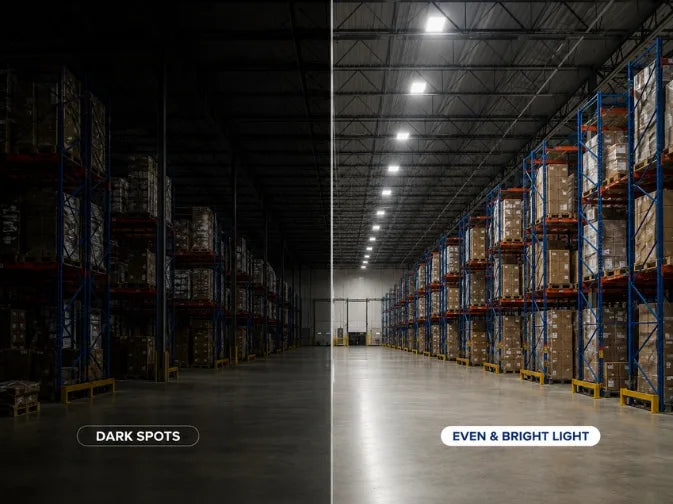
A warehouse can contain dozens or even hundreds of bright fixtures and still have dangerous or unproductive dark spots.
Those dark areas may appear:
- Between high-bay fixtures
- At the ends of rack aisles
- On lower shelves
- Around loading docks
- Beneath mezzanines
- Behind conveyors
- Near walls and corners
- At picking and packing stations
- Around equipment and columns
- Outside service doors and truck-loading areas
The usual response is to add a higher-wattage fixture.
That is often the wrong solution.
Dark spots are rarely caused by wattage alone. They are more often created by poor spacing, unsuitable beam distribution, tall racks, blocked light, inconsistent fixture types, failed lamps, dirty lenses, or a lighting layout that no longer matches the way the warehouse operates.
Installing brighter lights without diagnosing the actual cause may create a second problem:
- Glare beneath the fixture
- Higher electricity consumption
- Overlit areas next to dark zones
- Poor uniformity
- Unnecessary project costs
- More difficult forklift visibility
- Continued shadows on rack faces
The most effective solution is to identify why the dark spot exists and then correct the layout, distribution, output, or fixture type.
For some warehouse areas, that may mean Patel LED UFO LED High Bay Lights. For structured rack aisles, Patel LED Linear LED High Bay Lights may provide a more useful distribution. Covered docks, building exteriors, offices, damp areas, and truck yards require different product categories.
This guide explains how warehouse owners, facility managers, contractors, and purchasing teams can diagnose dark spots and build a better commercial LED lighting system using the appropriate Patel LED products.
What You Need to Know
Warehouse dark spots are usually caused by poor fixture spacing, unsuitable light distribution, blocked beams, tall racks, failed or dirty fixtures, insufficient output, or changes to the warehouse layout. The best solution is to measure the affected zone, identify the cause, and select the correct Patel LED fixture type rather than simply installing a higher-wattage light.
Quick diagnosis
- Dark open-floor areas may need improved UFO high-bay spacing.
- Dark rack faces may need linear high bays aligned with aisles.
- Dark packing stations may need localized task lighting.
- Dark covered docks may need canopy lights.
- Dark exterior doors may need wall packs.
- Dark truck yards may need properly distributed area lights.
- Intermittent darkness may indicate fixture, driver, sensor, or wiring failure.
- A photometric layout can help identify problems before products are ordered.
Buyer recommendation
Before replacing a fixture, record the mounting height, spacing, rack height, aisle width, existing wattage, lumen output, beam distribution, voltage, and current light readings. This information helps determine which Patel LED product category fits the actual problem.
Why Dark Spots Matter to Warehouse Operations
Dark spots are not only a visual issue.
They may affect:
- Forklift navigation
- Pedestrian visibility
- Shelf-label reading
- Picking speed
- Barcode scanning
- Product inspection
- Loading accuracy
- Security-camera performance
- Employee comfort
- Facility appearance
In a busy warehouse, inconsistent lighting forces employees’ eyes to adjust repeatedly as they move from a bright area into a darker one.
A worker may clearly see a label in one section but struggle with the same-sized print in another.
A forklift driver may move from a brightly illuminated cross-aisle into a shadowed rack row.
A loading-dock employee may face bright daylight through an open door while the interior staging area remains comparatively dark.
The objective is therefore not maximum brightness.
It is consistent, useful visibility across the entire working area.
Start with a Warehouse Dark-Spot Audit
Do not begin by ordering lights.
Begin by locating and classifying the problem.
Walk the warehouse during actual operating conditions
Inspect the facility:
- During daytime
- After sunset
- With dock doors open
- With dock doors closed
- During a normal shift
- When occupancy controls are active
- When all equipment is operating
A warehouse may appear acceptable during daylight but reveal significant deficiencies at night.
Mark every problem zone
Record dark spots on a floor plan.
Classify them as:
- Open-floor dark spots
- Rack-aisle shadows
- Lower-shelf darkness
- Aisle-end darkness
- Workstation shadows
- Conveyor obstructions
- Mezzanine darkness
- Dock darkness
- Exterior darkness
- Emergency-route concerns
Measure at the relevant surface
Do not measure only directly below a fixture.
Take readings at:
- Floor level
- Worktable height
- Rack-label height
- Lower shelf height
- Aisle ends
- Midpoints between fixtures
- Door thresholds
- Loading surfaces
A foot-candle measures the amount of light reaching a surface. Lumens measure total fixture output. A fixture may produce many lumens but deliver poor illumination to a task surface when its optics, spacing, or mounting are unsuitable.
Check whether the problem is permanent or intermittent
A dark area may result from:
- A failed fixture
- A failed driver
- A malfunctioning occupancy sensor
- Incorrect dimming
- Loose wiring
- A circuit issue
- A programmed control schedule
- Dirt buildup
- A fixture operating at the wrong selectable-wattage setting
Intermittent problems should be electrically diagnosed before the entire layout is redesigned.

The 10 Most Common Causes of Warehouse Dark Spots
1. Fixtures are spaced too far apart
When fixture beams do not overlap sufficiently, darker bands appear between them.
Common signs include:
- Bright circles beneath fixtures
- Darker areas halfway between rows
- Uneven forklift aisles
- A visible checkerboard pattern on the floor
The solution may involve:
- Reducing spacing
- Repositioning rows
- Selecting a wider distribution
- Adding fixtures at strategic gaps
- Adjusting output after the layout is corrected
Installing a higher-wattage fixture in the same position may make the area below it brighter without fixing the gap between fixtures.
2. The beam distribution does not match the warehouse layout
A broad round distribution may work well in an open warehouse.
The same distribution may waste light on top of storage racks while leaving vertical rack faces and lower shelves dark.
Patel LED’s UFO High Bay collection is positioned for high-ceiling warehouses and large open commercial areas, while its Linear High Bay collection is designed for warehouses, aisles, and industrial spaces requiring more directional coverage.
Product decision
Consider Patel LED UFO High Bay Lights when the dark spot appears in:
- Open storage
- Bulk pallet zones
- Manufacturing areas
- Wide unobstructed floors
- Large staging areas
Consider Patel LED Linear High Bay Lights when the problem appears in:
- Long rack aisles
- Distribution-center rows
- Conveyor lanes
- Rectangular work zones
- Structured shelving layouts
Compare Patel LED UFO and Linear High Bay Lights based on warehouse geometry - not fixture wattage alone.
3. Tall racks are blocking the light
Warehouse layouts frequently change after the original lighting system is installed.
New racks may be:
- Taller
- Wider
- Positioned differently
- Placed beneath existing fixture rows
When fixtures sit above rack tops rather than over aisles, much of the useful light may be blocked.
Better approach
- Center fixture rows over the usable aisle.
- Review rack height against mounting height.
- Check both horizontal and vertical illumination.
- Measure lower shelf visibility.
- Review aisle ends separately.
- Consider linear fixtures aligned with the rack direction.
Adding more UFO fixtures above the racks may not correct dark rack faces.
4. The mounting height is too high for the selected output or distribution
Light spreads and loses intensity as it travels farther from the fixture.
A product that works at a moderate mounting height may not deliver adequate floor-level illumination when installed much higher.
Patel LED describes high-bay fixtures as commercial overhead lights for warehouses and other spaces with ceilings typically around 15 feet or higher. The appropriate fixture still depends on lumen output, optics, spacing, and the required light level.
Review:
- Ceiling height
- Suspension length
- Mounting height above the work plane
- Fixture output
- Beam distribution
- Aisle width
- Rack height
Do not select a fixture from ceiling height alone.
5. The mounting height is too low for a narrow or high-output fixture
A fixture mounted too low may create:
- Harsh bright zones
- Dark areas outside the beam
- Direct glare
- Uncomfortable contrast
- Poor forklift-driver visibility
The solution may be:
- A wider distribution
- Lower output
- Different fixture spacing
- Diffused lighting
- Higher mounting
- More fixtures operating at lower wattage
The brightest product is not always the best product.
6. Fixtures are dirty or obstructed
Dust, smoke, grease, packaging debris, insects, and dirt can reduce useful output.
Light may also be blocked by:
- HVAC ducts
- Sprinkler lines
- Structural beams
- Signs
- Conveyor supports
- Cable trays
- Cranes
- Mezzanine structures
Before purchasing replacements:
- Inspect the fixture.
- Clean appropriate components safely.
- Confirm the fixture is not obstructed.
- Compare light readings before and after maintenance.
- Reposition the fixture when practical.
A maintenance problem should not automatically become a full replacement project.
7. Existing lamps or fixtures have depreciated
Older fluorescent, HID, and metal-halide systems can lose useful output over time even before complete failure.
A facility may therefore contain:
- Newer bright lamps
- Older dim lamps
- Failed ballasts
- Mismatched replacements
- Different color temperatures
- Long warm-up times
This creates visibly inconsistent zones.
Patel LED high-bay products offer LED options for replacing older warehouse systems, while commercial LEDs can also support lower maintenance frequency and more consistent operation.
8. Packing and inspection stations rely only on ceiling lighting
A warehouse may have acceptable general illumination while individual workstations remain shadowed.
This happens when:
- Employees stand between the fixture and the work
- Shelves block the beam
- Conveyors sit above the workstation
- Equipment creates shadows
- Fine labels require more task light
The best solution may be a layered system:
- High bays for general illumination
- Lower-mounted linear lighting
- Task fixtures for detailed work
- Appropriate CRI
- Controlled glare
Do not overlight the entire warehouse to solve a local packing-station problem.
9. Daylight creates extreme contrast
Open dock doors, skylights, translucent wall panels, and windows can make adjacent interior areas appear darker.
The actual light level may not have changed, but the contrast makes the zone harder to see.
Possible corrections include:
- Daylight-responsive dimming
- Separate dock lighting zones
- Better interior illumination near thresholds
- Canopy lighting outside covered doors
- Wall packs around entrances
- More uniform transitions
10. The warehouse has changed but the lighting layout has not
Dark spots often appear after:
- New rack installation
- Conveyor expansion
- A mezzanine addition
- Workstation relocation
- Aisle narrowing
- Inventory growth
- A change in operating shifts
- New equipment
- A conversion from storage to picking
A lighting system designed for an open floor cannot be expected to perform identically after tall racks divide the space.
The layout should be reviewed whenever the operational floor plan changes.
Diagnose the Dark Spot by Warehouse Zone
| Problem area | Likely cause | Patel LED category to review |
|---|---|---|
| Open floor between fixtures | Spacing or broad-coverage problem | UFO High Bay |
| Long rack aisle | Wrong distribution or row alignment | Linear High Bay |
| Lower rack levels | Poor vertical illumination | Linear High Bay |
| Packing table | Overhead shadows | Strip or Linear Fixture |
| Damp or dusty zone | Fixture degradation or unsuitable housing | Vapor-Tight Fixture |
| Warehouse office | Inadequate low-ceiling lighting | Panel or Troffer |
| Covered loading dock | Missing overhead exterior layer | Canopy Light |
| Exterior loading door | Weak wall-mounted coverage | Wall Pack |
| Truck yard | Poor pole-light distribution | Area Light |
| Targeted security zone | Missing directional illumination | Flood Light |
| Exit path | Failed or missing emergency product | Emergency Light or Exit Sign |
This matrix should guide product research - not replace a site survey or photometric analysis.
How to Fix Dark Spots on Open Warehouse Floors
Open areas generally need broad and consistent overlap.
Step 1: Verify fixture spacing
Measure:
- Distance between fixtures
- Distance between rows
- Distance from fixtures to walls
- Mounting height above the floor
Dark perimeter areas may occur because the first fixture row is positioned too far from the wall.
Step 2: Review the beam pattern
A narrow beam may create bright circles with gaps between them.
A broader distribution may improve coverage, but it may also reduce intensity at very high mounting positions.
The correct choice balances:
- Width of coverage
- Mounting height
- Useful output
- Glare
- Uniformity
Step 3: Review Patel LED UFO High Bay options
Patel LED currently offers high-output LED High Bay Lights for warehouses, factories, distribution centers, and other high-ceiling facilities. Some models include selectable wattage or commercial dimming capabilities; buyers must verify the specifications on the exact product page before purchase.
Step 4: Use adjustable output strategically
A selectable-wattage product can help contractors commission different zones without ordering multiple fixture models.
However, every setting should be documented.
Otherwise:
- One aisle may operate at 100W
- Another at 150W
- Maintenance staff may not know why
- Future replacements may be configured incorrectly
Dark open storage areas?
Compare Patel LED UFO High Bay Lights by verified lumens, selectable wattage, beam distribution, voltage, and mounting requirements.
How to Eliminate Dark Spots in Rack Aisles
Rack aisles are one of the most common warehouse-lighting problem areas.
Align the fixture rows with the aisles
Linear high bays should generally follow the aisle direction when the photometric design supports that arrangement.
This helps direct more useful light:
- Along the aisle
- Toward labels
- Onto rack faces
- At floor level
- Near aisle ends
Avoid positioning fixtures directly above rack tops
When fixtures are centered over racks, the structure and stored products can block much of the beam.
Review Patel LED Linear High Bays
Patel LED’s Linear High Bay collection is designed to deliver uniform lighting in warehouse and industrial spaces. The collection specifically identifies aisle-based layouts as a strong use case and notes that beam angle, mounting height, lumen output, and control compatibility should be evaluated.
One current Patel LED 2-foot linear model is listed at 165W and 23,925 lumens with selectable 4000K, 5000K, and 5700K and 0–10V dimming. Exact availability and specifications should be confirmed on the live page.
Measure vertical surfaces
Take readings at:
- Eye-level labels
- Lower shelves
- Mid-level pallet positions
- Upper rack labels
- Aisle ends
A floor reading alone may hide serious rack-face darkness.
Correct aisle-end darkness
Possible solutions include:
- Moving the last fixture closer to the cross-aisle
- Adding an end fixture
- Adjusting distribution
- Reducing excessive spacing
- Reorienting the fixture row
- Adding cross-aisle illumination
Dark labels or lower shelves? Compare Patel LED Linear High Bay Lights for row-oriented warehouse illumination before adding more broad-distribution fixtures.
How to Fix Dark Spots at Picking and Packing Stations
The fastest solution is not always another ceiling high bay.
Identify the shadow source
Check whether the shadow is created by:
- The employee
- A shelf
- A conveyor
- A monitor
- A packing machine
- An overhead sign
- Stacked product
Use layered lighting
A practical system may include:
- General Patel LED high-bay illumination
- Lower-mounted Patel LED strip or linear fixtures
- Dedicated task lighting
- Separate workstation controls
Review color quality
CRI matters when employees need to distinguish:
- Product colors
- Wires
- Hazard markings
- Packaging
- Quality-control differences
Control glare
Task lighting should illuminate the work - not shine into employees’ eyes or create reflections on scanners and screens.
How to Eliminate Dark Spots Under Mezzanines
High-bay fixtures above a mezzanine cannot adequately illuminate the area underneath it.
That lower zone effectively becomes a separate low-ceiling room.
Appropriate Patel LED categories may include:
- LED Strip Fixtures
- LED Tube Fixtures
- Vapor-Tight Fixtures where conditions require
- LED Panels or Troffers in finished office-like areas
Review:
- Ceiling height beneath the mezzanine
- Structural beams
- Dust exposure
- Work performed below
- Controls
- Emergency lighting
Do not attempt to solve the lower level by increasing the output of fixtures above the mezzanine.
How to Fix Dark Loading Docks
Loading docks require both indoor and outdoor light.
Interior staging area
Review:
- High-bay spacing
- Dock-door shadows
- Trailer obstruction
- Forklift traffic
- Daylight contrast
Covered dock
Patel LED LED Canopy Lights are designed for covered commercial areas such as loading zones, garages, entrances, and similar overhead applications.
Exterior doors
Patel LED LED Wall Pack Lights can illuminate:
- Dock doors
- Walkways
- Service entrances
- Building perimeters
- Security zones
Patel LED specifically identifies warehouses and loading docks as wall-pack applications.
Truck yard
Use Patel LED Area Lights for wide outdoor coverage.
Patel LED describes its LED Area Lights as products designed to reduce dark spots and improve visibility for vehicles and pedestrians in parking lots, roadways, and large outdoor areas.
Use Flood Lights for specific targeted areas rather than replacing a planned wide-area system with uncontrolled directional light.
Dark docks or truck courts? Review Patel LED Canopy Lights, Wall Packs, Area Lights, and Flood Lights as separate layers of the warehouse property.
Can Higher Wattage Eliminate Warehouse Dark Spots?
Sometimes higher output is part of the solution.
It is not automatically the solution.
Higher output may help when:
- Mounting height increased
- Existing fixtures are genuinely underpowered
- Light levels are low throughout the entire zone
- The distribution is already suitable
- Spacing is appropriate
- Racks are not blocking the beam
Higher output may fail when:
- Fixtures are spaced too far apart
- The wrong beam pattern is used
- Racks block the light
- Fixtures sit above obstructions
- The problem exists only at one workstation
- The fixture is aimed incorrectly
- Dark spots occur at aisle ends
- The system is dirty or failing
The risk of excessive wattage
Installing unnecessarily powerful fixtures may produce:
- Higher electricity bills
- Strong glare
- Harsh contrast
- Overlit floor zones
- Poor security-camera exposure
- More connected lighting load
Choose wattage after distribution and layout - not before them.
Photometric Planning: The Most Reliable Way to Prevent Dark Spots
A photometric plan predicts how selected fixtures distribute light across a facility.
It may display:
- Fixture locations
- Mounting heights
- Average foot-candles
- Minimum foot-candles
- Maximum foot-candles
- Uniformity
- Dark zones
- Beam overlap
- Exterior spill
- Rack-aisle performance
Why square-foot estimates are not enough
A simple lumen calculation may provide an initial quantity:
Estimated fixture quantity = Required total lumens ÷ usable lumens per fixture
However, it does not fully account for:
- Optics
- Rack obstruction
- Light loss
- Reflectance
- Ceiling height
- Uniformity
- Vertical illumination
- Workstation shadows
- Wall spacing
Large warehouse projects should use photometric data before commercial quantities are purchased.
Warehouse Dark-Spot Self-Assessment
Answer yes or no:
- Are there dark bands between fixtures?
- Are rack labels difficult to read?
- Do employees use flashlights?
- Are aisle ends darker than aisle centers?
- Are lower shelves difficult to see?
- Do forklifts move between very bright and very dark areas?
- Are fixtures mounted above rack tops?
- Has the rack layout changed?
- Are packing tables shadowed by employees or equipment?
- Are some fixtures visibly dimmer than others?
- Do fixtures have different color temperatures?
- Are lenses dirty?
- Are sensors switching lights off too early?
- Are dock interiors dark when doors are open?
- Are exterior doors and truck areas poorly lit?
Results
0–3 yes answers:
The issue may be isolated maintenance, aiming, or control-related.
4–7 yes answers:
A zone-level lighting correction is likely needed.
8 or more yes answers:
The warehouse should be reviewed as a complete lighting-layout and product-selection project.
Modeled ROI: Fixing Dark Spots During an LED Upgrade
The following example is illustrative and does not guarantee actual savings.
Existing warehouse
- 100 metal-halide fixtures
- 458W actual input each
- 4,000 operating hours annually
- Electricity rate: $0.14/kWh
- Existing layout contains dark aisle areas
- Frequent lamp and ballast maintenance
Proposed system
- 60 Patel LED UFO High Bay Lights for open areas
- 40 appropriate Patel LED Linear High Bay Lights for rack aisles
- Modeled average input: 150W per fixture
- Revised spacing and row alignment
- Controls not included in the base calculation
Existing annual energy use
100 × 458W ÷ 1,000 × 4,000
= 183,200 kWh
Annual electricity cost:
183,200 × $0.14
= $25,648
Proposed annual energy use
100 × 150W ÷ 1,000 × 4,000
= 60,000 kWh
Annual electricity cost:
60,000 × $0.14
= $8,400
Modeled annual electricity savings
$25,648 − $8,400
= $17,248
Modeled five-year electricity savings
$17,248 × 5
= $86,240
This calculation excludes:
- Installation
- Maintenance savings
- Utility incentives
- Controls
- Demand charges
- Rate changes
- Photometric redesign costs
- Product-specific performance
Business impact
The value of the project is not only lower wattage.
A corrected mixed-fixture layout may also improve:
- Aisle visibility
- Rack-face illumination
- Packing accuracy
- Forklift navigation
- Fixture consistency
- Maintenance planning
Compare the cost of repeated spot repairs with a zone-based Patel LED warehouse-lighting upgrade that addresses both energy use and dark-area performance.
Should You Add Fixtures or Replace the Layout?
Add fixtures when:
- The current fixture type and optics are suitable.
- Only a few measurable gaps exist.
- Mounting and electrical access are practical.
- The added fixtures will not create glare.
- The existing system is still consistent and serviceable.
Reposition fixtures when:
- Rows do not align with aisles.
- Fixtures sit above racks.
- Aisle ends are dark.
- Structural changes altered the layout.
- The fixture count is adequate but poorly placed.
Replace the fixture type when:
- Broad UFO distribution is ineffective in narrow aisles.
- Old HID fixtures have inconsistent output.
- Lower energy and controls are priorities.
- Existing products are mismatched.
- The warehouse needs zone-specific lighting.
Add task lighting when:
- The problem is limited to detailed picking, inspection, or packing.
- General illumination is already adequate.
- Equipment blocks overhead light.
Choosing the Right Patel LED Product for the Problem
| Dark-spot problem | Product category | Why it may fit |
|---|---|---|
| Open-floor gaps | UFO High Bay | Broad high-ceiling coverage |
| Rack-face darkness | Linear High Bay | Row-oriented distribution |
| Packing-table shadows | Strip or Linear Fixture | Lower, targeted work-area light |
| Damp or dusty dark zone | Vapor-Tight Fixture | Environmental protection |
| Office dark spots | LED Panel or Troffer | Uniform low-ceiling illumination |
| Covered dock darkness | Canopy Light | Overhead covered-area lighting |
| Exterior door darkness | Wall Pack | Building-mounted perimeter light |
| Truck-yard dark areas | Area Light | Wide outdoor coverage |
| Focused security gap | Flood Light | Directional lighting |
| Failed exit illumination | Emergency Light or Exit Sign | Life-safety application |
Product specifications can change. Verify the exact Patel LED wattage, lumens, voltage, CCT, dimming, IP rating, certifications, warranty, and mounting requirements before ordering.
Common Mistakes When Fixing Warehouse Dark Spots
- Buying the highest-wattage fixture available
- Replacing one fixture without checking the layout
- Mixing UFO and linear fixtures without a zone plan
- Ignoring rack height
- Ignoring vertical illumination
- Measuring only directly beneath fixtures
- Ignoring aisle ends
- Installing fixtures above rack tops
- Adding more light without controlling glare
- Ignoring dirty lenses
- Ignoring failed drivers or ballasts
- Leaving selectable fixtures at inconsistent settings
- Forgetting sensors and dimming controls
- Ignoring daylight contrast
- Using indoor fixtures in damp areas
- Ignoring warehouse offices and utility rooms
- Stopping the lighting plan at the exterior wall
- Ordering before photometric verification
- Comparing price without comparing useful distribution
- Treating a legal minimum as a complete lighting design

Warehouse Lighting Buyer Checklist
Facility details
- Total square footage
- Ceiling height
- Mounting height
- Rack height
- Aisle width
- Floor plan
- Conveyor locations
- Mezzanines
- Operating hours
- Temperature
- Dust and moisture exposure
Dark-spot details
- Exact location
- Approximate size
- Time of day
- Nearby fixture spacing
- Nearby obstructions
- Rack position
- Current foot-candle reading
- Required visual task
- Employee complaints
- Camera-visibility issues
Existing system
- Fixture type
- Wattage
- Lumen output if known
- Voltage
- Beam distribution
- CCT
- CRI
- Mounting method
- Dimming
- Sensors
- Maintenance history
Purchasing information
- Patel LED category
- Exact model
- Quantity
- Verified specifications
- Photometric data
- Warranty
- Certifications
- DLC status where required
- Delivery date
- Installation schedule
- Replacement inventory
Why Warehouse Buyers Consider Patel LED
Patel LED offers warehouse buyers access to multiple indoor and outdoor commercial LED categories rather than one universal warehouse fixture.
Relevant products include:
- UFO LED High Bay Lights
- Linear LED High Bay Lights
- Vapor-Tight Fixtures
- Strip and Tube Fixtures
- LED Panels and Troffers
- LED Wall Packs
- LED Canopy Lights
- LED Area Lights
- LED Flood Lights
- Emergency Lights
- Exit Signs
Patel LED’s Commercial Lighting collection brings these categories together for warehouse, office, parking, loading, exterior, and industrial applications.
This allows buyers to solve dark spots by zone:
- Broad light for open floors
- Directional light for aisles
- Task light for workstations
- Protected fixtures for demanding areas
- Exterior products for docks and yards
- Separate products for offices and emergency routes
FAQs
Eliminate Dark Spots with a Zone-Based Patel LED Lighting Plan
Dark spots are rarely fixed by installing one brighter product throughout the entire warehouse.
A complete solution may use:
- Patel LED UFO High Bays for open floors
- Patel LED Linear High Bays for rack aisles
- Strip or linear fixtures for packing stations
- Vapor-tight fixtures for demanding environments
- Panels or troffers for warehouse offices
- Canopy lights beneath covered docks
- Wall packs around exterior doors
- Area lights across truck yards
- Flood lights for focused security zones
- Emergency products along exit paths
Start by measuring and mapping the dark areas.
Then determine whether each problem is caused by:
- Spacing
- Distribution
- Obstruction
- Mounting height
- Insufficient output
- Fixture failure
- Dirt
- Controls
- A changed warehouse layout
Finally, choose the Patel LED product category that addresses that specific cause.
Your warehouse may not need brighter lights everywhere. It needs the correct Patel LED light in every dark zone.
Prepare your floor plan, fixture count, mounting height, rack layout, voltage, current wattage, operating hours, and target completion date.
Then compare Patel LED UFO High Bays, Linear High Bays, Wall Packs, Canopy Lights, Area Lights, and other commercial fixtures for the entire facility.